What is the UK?
4 min read·Last updated: April 2026
In this chapter
Chapter Introduction
This chapter introduces the four nations that form the Union and clarifies the related terms — UK, Great Britain, British Isles, Britain — that are often used interchangeably. The chapter is short but contributes disproportionately to questions on the citizenship test: candidates commonly lose marks on the distinction between 'Great Britain' and 'the UK', or on what a Crown Dependency is.
The Countries of the UK
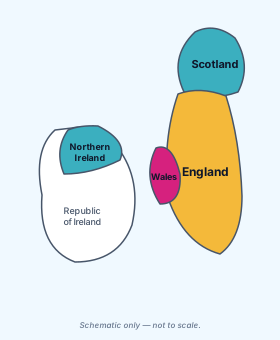
Schematic of the British Isles: Scotland, England and Wales form Great Britain; Northern Ireland is also part of the UK; the Republic of Ireland is a separate, independent country. · Original schematic diagram (not to scale).
Four nations form the United Kingdom: England, Scotland, Wales and Northern Ireland. The country's full formal title is the United Kingdom of Great Britain and Northern Ireland. The rest of Ireland is not part of the UK — it is a separate, independent country.
Key Facts
- •The UK is made up of England, Scotland, Wales and Northern Ireland
- •The rest of Ireland is an independent country
- •The official name of the country is the United Kingdom of Great Britain and Northern Ireland
Great Britain, Britain and the British Isles
Three closely-related terms are regularly tested. 'Great Britain' refers only to England, Scotland and Wales — the single geographical island. 'The British Isles' is a wider geographic term covering the UK plus the Republic of Ireland and the surrounding smaller islands. Everyday usage often treats 'Britain' or 'British' as shorthand for the UK as a whole, including Northern Ireland.
UK vs Great Britain vs British Isles — what's the difference?
⚠ Does NOT include Northern Ireland
- Republic of Ireland — independent country
- Crown Dependencies — Channel Islands, Isle of Man
Key Facts
- •'Great Britain' refers only to England, Scotland and Wales, not to Northern Ireland
- •'Britain' and 'British' are commonly used as shorthand terms that refer to the UK as a whole, including Northern Ireland
Crown Dependencies and Overseas Territories
Two separate categories of territory are linked to the UK without forming part of it. Crown Dependencies — the Channel Islands and the Isle of Man — operate their own governments and laws while recognising the monarch as head of state. British overseas territories, such as St Helena and the Falkland Islands, fall under UK sovereignty but are similarly outside the UK proper.
Key Facts
- •Crown Dependencies: the Channel Islands and the Isle of Man — closely linked to the UK but not part of it; they have their own governments
- •British overseas territories include St Helena and the Falkland Islands — linked to the UK but not part of it
Government of the UK
Parliament at Westminster legislates for the Union as a whole. Three of the four nations — Scotland, Wales and Northern Ireland — also operate their own devolved parliaments or assemblies with authority over specific policy areas such as education and health.
Key Facts
- •The UK is governed by the parliament sitting in Westminster
- •Scotland, Wales and Northern Ireland also have parliaments or assemblies of their own, with devolved powers in defined areas
Chapter Summary
All key facts from this chapter at a glance — read this to revise the full chapter quickly.
Chapter Summary
Quick revision- ✓The UK is made up of England, Scotland, Wales and Northern Ireland
- ✓The official name of the country is the United Kingdom of Great Britain and Northern Ireland
- ✓The rest of Ireland is an independent country
- ✓'Great Britain' refers only to England, Scotland and Wales — it does NOT include Northern Ireland
- ✓'Britain' and 'British' are commonly used as shorthand terms that refer to the UK as a whole, including Northern Ireland
- ✓Crown Dependencies — the Channel Islands and the Isle of Man — are closely linked to the UK but not part of it; they have their own governments
- ✓British overseas territories include St Helena and the Falkland Islands — linked to the UK but not part of it
- ✓The UK is governed by the parliament sitting in Westminster
- ✓Scotland, Wales and Northern Ireland also have parliaments or assemblies of their own, with devolved powers in defined areas
Test Yourself on This Chapter
Ready to practice? Take a focused test on this topic.