The Tudors and Stuarts
20 min read·Last updated: April 2026
In this chapter
- 1. Religious Conflicts
- 2. Queen Elizabeth I
- 3. The Reformation in Scotland and Mary, Queen of Scots
- 4. Exploration, Poetry and Drama
- 5. James VI and I
- 6. Ireland (under the Tudors and Stuarts)
- 7. The Rise of Parliament
- 8. The Beginning of the English Civil War
- 9. Oliver Cromwell and the English Republic
- 10. The Restoration
- 11. A Catholic King
- 12. The Glorious Revolution
- 13. Chapter Summary
Religious Conflicts
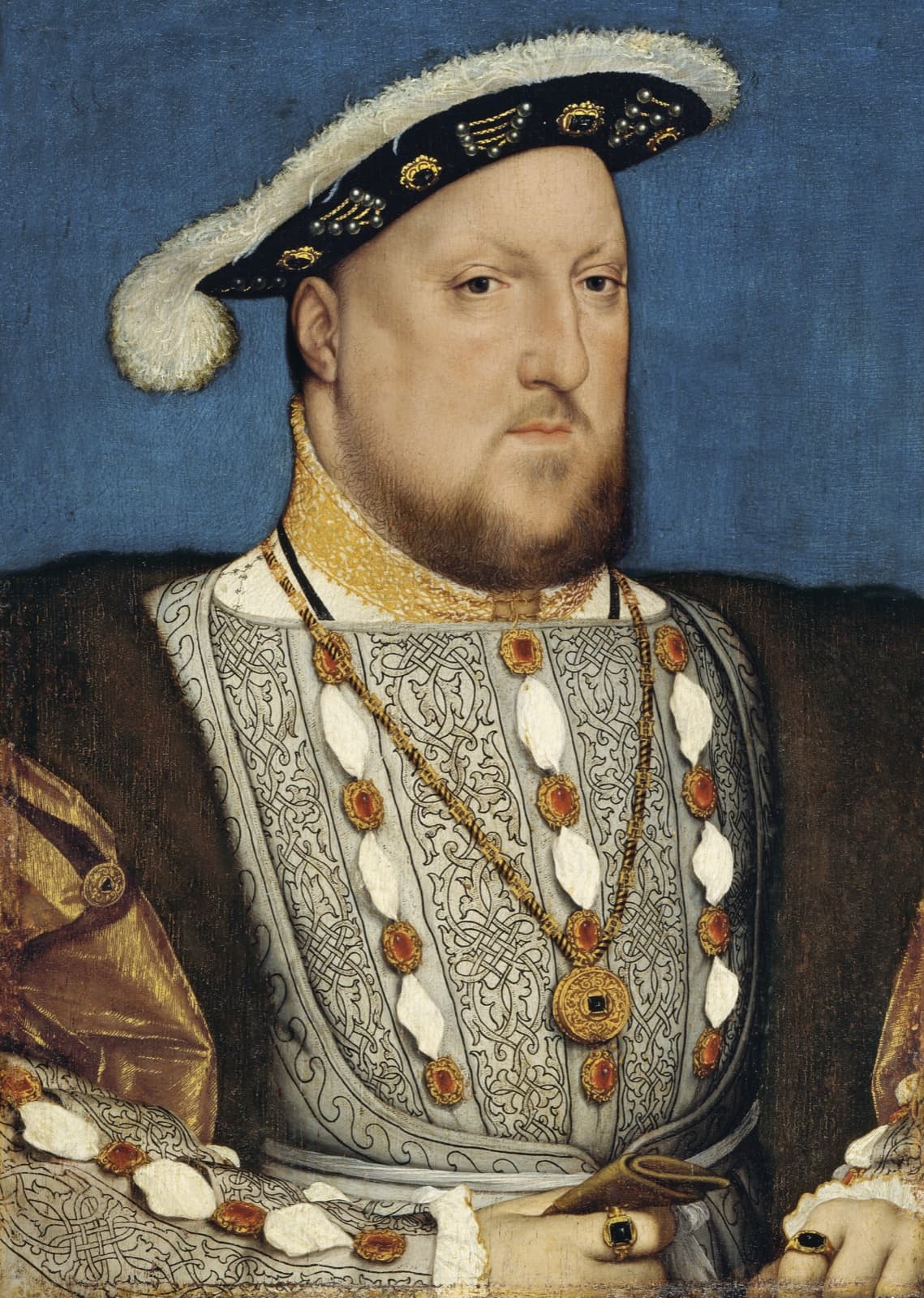
Portrait of King Henry VIII (Hans Holbein the Younger) · Hans Holbein the Younger (c.1497–1543), Portrait of Henry VIII, Thyssen-Bornemisza Museum. Public domain (PD-Art). Wikimedia Commons.
Once the Wars of the Roses were over, the first Tudor king, Henry VII, set about consolidating his position and keeping England at peace. He deliberately centralised power in the crown, cut back the independence of the old nobility, and ran a thrifty treasury that built up royal financial reserves. On his death his son Henry VIII continued the same policy of concentrating power at the centre.
Henry VIII is best remembered for two things: his six marriages, and his break with the Roman Catholic Church.
The Six Wives of Henry VIII:
To obtain a divorce from his first wife, Henry needed the Pope's approval under Roman Catholic law. When the Pope refused to grant it, Henry responded by detaching England's church from Rome and setting up the Church of England in its place. In the new English Church the monarch, rather than the Pope, would appoint bishops and decide on the forms of worship.
Elsewhere in Europe, the broader Reformation was under way. This was a religious and political movement rejecting the authority of the Pope and the teachings and practices of the Roman Catholic Church. Reformers — Protestants — set up their own churches. They read the Bible in their own national languages rather than in Latin; they rejected prayers to saints or at shrines; and they held that a person's individual relationship with God mattered more than submission to Church institutions. Protestant ideas made ground across England, Wales and Scotland throughout the 16th century.
In Ireland, by contrast, English attempts to impose Protestantism and to impose the English system of land-inheritance law provoked rebellion by the Irish chieftains and triggered decades of harsh fighting.
During Henry VIII's reign, the political union of Wales with England was formalised by the Act for the Government of Wales. Wales began to send representatives to the House of Commons at Westminster, and Welsh law and legal administration were reformed to match the English system.
Henry VIII's successor was his young son Edward VI, a strongly convinced Protestant. During Edward's short reign, the Book of Common Prayer was written for use in the Church of England, and a version of that book remains in use in some churches today. Edward died at just 15 after only about six years on the throne. He was succeeded by his half-sister Mary, a devout Catholic who vigorously persecuted English Protestants — which earned her the nickname 'Bloody Mary'. Mary's reign was also short; she was followed by her half-sister Elizabeth, daughter of Henry VIII and Anne Boleyn.
Key Facts
- •Catherine of Aragon – a Spanish princess; she and Henry had a number of children but only one, Mary, survived. Divorced.
- •Anne Boleyn – English; she and Henry had one daughter, Elizabeth. Unpopular and accused of taking lovers. Executed at the Tower of London.
- •Jane Seymour – married Henry after Anne's execution; she gave Henry the son he wanted, Edward, but died shortly after the birth.
- •Anne of Cleves – a German princess; Henry married her for political reasons but divorced her soon after.
- •Catherine Howard – a cousin of Anne Boleyn; accused of taking lovers and executed.
- •Catherine Parr – a widow who married Henry late in his life; she survived him and married again but died soon after.
- •Henry VII strengthened central administration, reduced the power of the nobles and built up the monarchy's financial reserves
- •Henry VIII was most famous for breaking away from the Church of Rome and marrying six times
- •When the Pope refused to approve Henry's divorce, Henry established the Church of England
- •In the Church of England, the king appoints bishops and orders how people should worship (not the Pope)
- •The Reformation was a movement against the authority of the Pope and the Roman Catholic Church
- •Protestants read the Bible in their own languages instead of Latin; they did not pray to saints or at shrines
- •During Henry VIII's reign, Wales was formally united with England by the Act for the Government of Wales
- •Edward VI was strongly Protestant; the Book of Common Prayer was written during his reign
- •Edward VI died aged 15; his half-sister Mary ('Bloody Mary') persecuted Protestants
Queen Elizabeth I
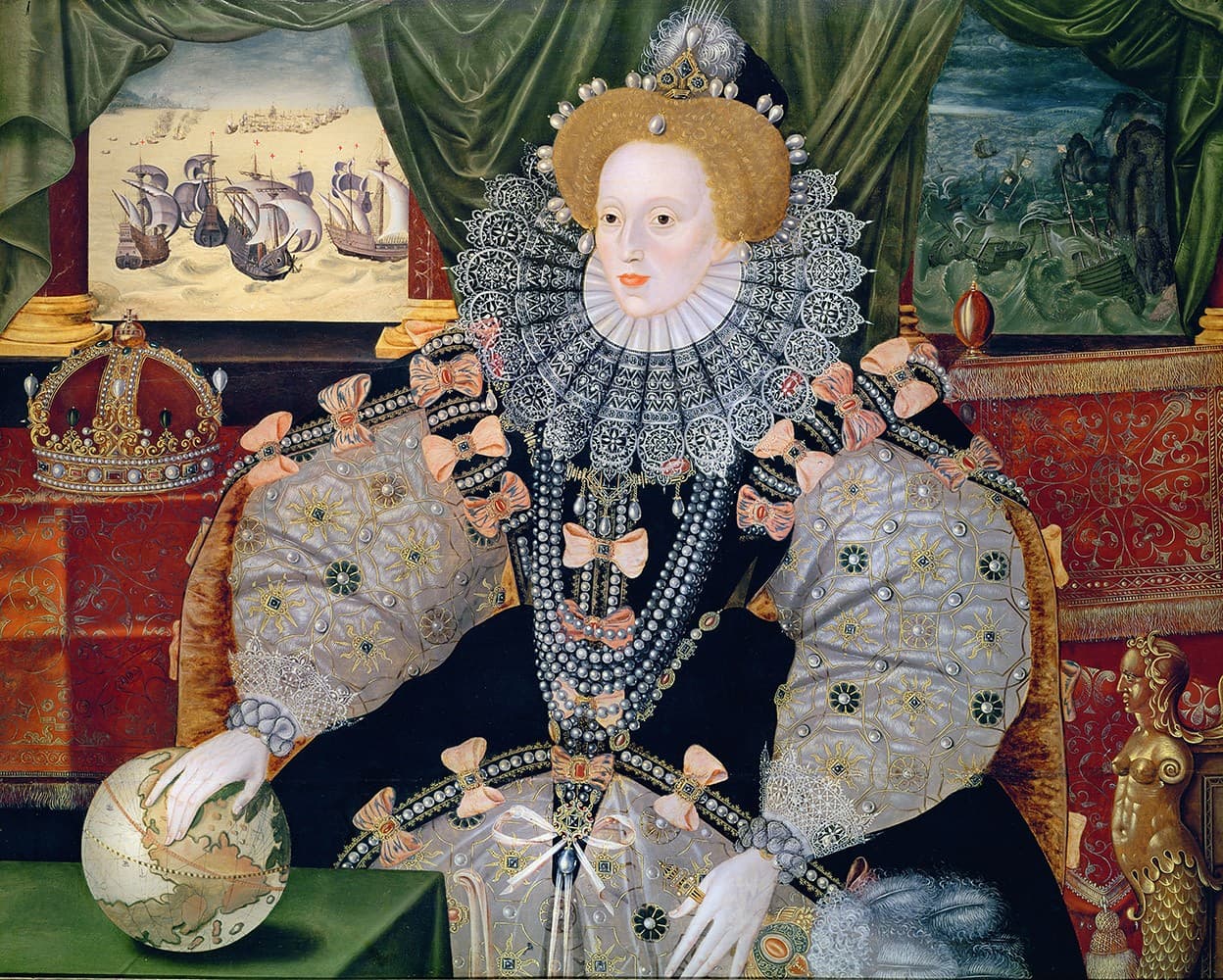
Queen Elizabeth I — Armada Portrait (Woburn Abbey) · Anonymous (attributed to George Gower), c.1588, Armada Portrait of Elizabeth I. Public domain (PD-Art). Wikimedia Commons.
Elizabeth I was a Protestant, and on her accession she re-established the Church of England as the official state Church. Attendance at one's local parish church became a legal requirement, and statute governed the forms of religious service and the permitted prayers; but in matters of private belief Elizabeth deliberately declined to inquire. The resulting compromise steered a careful middle course between Catholic practice and the sterner Protestants, and largely spared England the religious violence that convulsed continental Europe in the period. Elizabeth became one of the most popular monarchs in English history — particularly after 1588, when an English fleet defeated the Spanish Armada, the great fleet that Spain had dispatched against England with the twin aims of military conquest and the restoration of Catholicism.
Key Facts
- •Queen Elizabeth I was a Protestant
- •She re-established the Church of England as the official Church
- •Everyone had to attend their local church under Elizabeth
- •Elizabeth balanced Catholic and extreme Protestant views, avoiding serious religious conflict in England
- •In 1588 the English defeated the Spanish Armada, a large Spanish fleet sent to conquer England and restore Catholicism
- •Elizabeth became one of the most popular monarchs in English history
Key Dates
The Reformation in Scotland and Mary, Queen of Scots
Scotland too had been reshaped by Protestant ideas by this point. In 1560 the Scottish Parliament, now dominated by Protestant sympathisers, formally abolished the Pope's authority in Scotland and made Roman Catholic services illegal. A Protestant Church of Scotland — Presbyterian in structure, governed by elected elders — was then established. A significant distinction from the English arrangement: the Church of Scotland was not, and did not become, the state Church in the same sense.
The reigning queen of Scotland at this point, Mary Stuart — in modern usage 'Mary, Queen of Scots' — was herself a Catholic. She had become queen at just one week old when her father died, and much of her childhood was spent in France. On returning to Scotland as an adult, she became the focal point of a political power struggle between rival factions. When her husband was subsequently murdered, Mary came under suspicion of involvement in the plot and fled south to England, handing over the Scottish throne to her Protestant son, James VI of Scotland. In England, Mary had hoped that her cousin Elizabeth I would offer her political refuge; Elizabeth, however, suspected Mary of harbouring designs on the English throne and instead kept her a prisoner for 20 years. Mary was ultimately executed, accused of plotting against Elizabeth's life.
Key Facts
- •In 1560 the predominantly Protestant Scottish Parliament abolished the authority of the Pope in Scotland
- •Roman Catholic religious services became illegal in Scotland
- •A Protestant Church of Scotland was established — unlike in England, this was not a state Church
- •Mary Stuart ('Mary, Queen of Scots') was a Catholic and became queen when she was only a week old
- •Much of Mary's childhood was spent in France
- •Mary fled to England after her husband was murdered and she was suspected of involvement
- •She gave her throne to her Protestant son, James VI of Scotland
- •Mary was Elizabeth I's cousin but was kept a prisoner for 20 years
- •Mary was eventually executed, accused of plotting against Elizabeth I
Key Dates
Exploration, Poetry and Drama
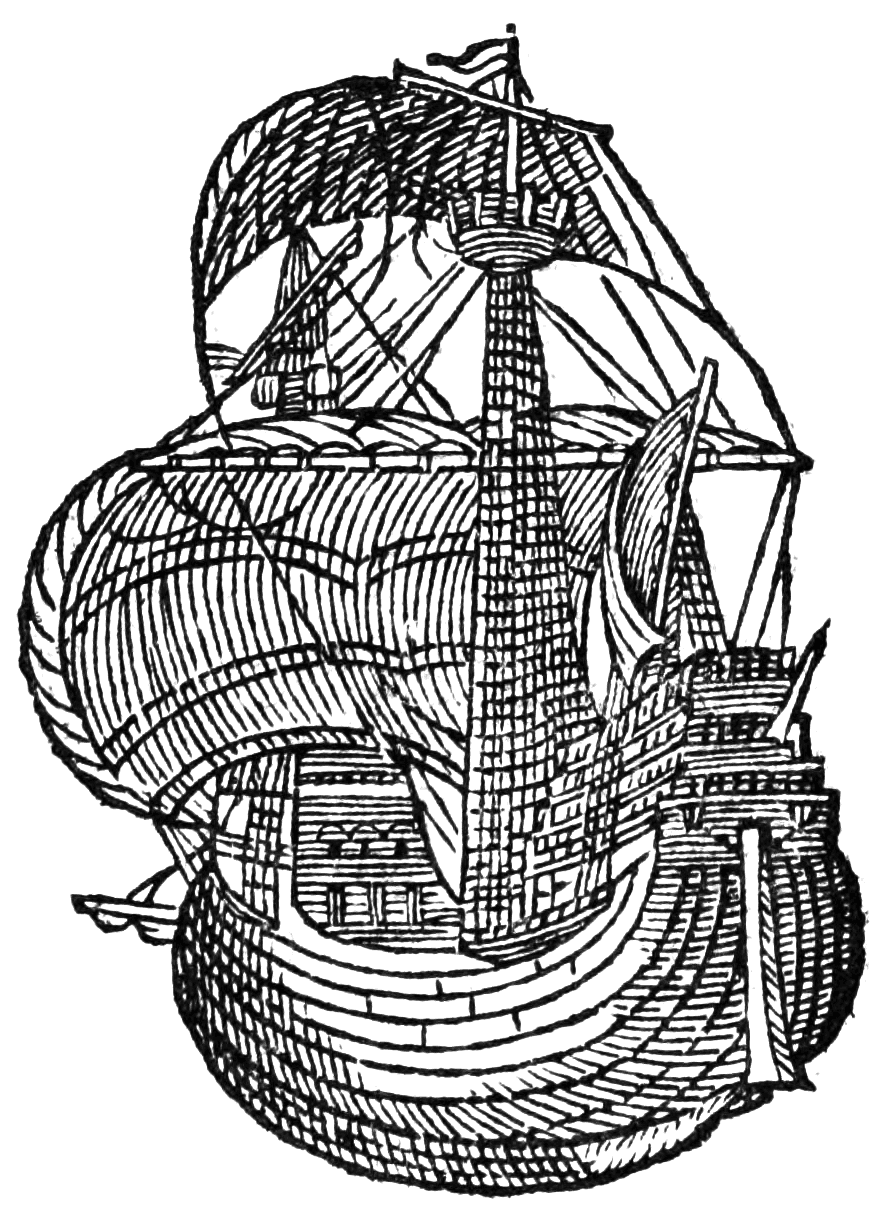
Sir Francis Drake's ship with billowing sails, engraving from the 1588 French account of Drake's voyage · Anonymous French engraver, title page of 'Le voyage de Messire François Drake chevalier', 1588. Public domain. Wikimedia Commons.
Elizabethan England was a period of pronounced national self-confidence — a growing pride in being English and in English-built institutions. English explorers pushed out in search of new trade routes, often in direct competition with the Spanish colonial reach in the Americas. Sir Francis Drake, who was one of the commanders at the defeat of the Spanish Armada, is also counted among the founders of England's naval tradition; his ship, the Golden Hind, was one of the first vessels ever to circumnavigate the globe. During Elizabeth's reign the first English settlers began to take land on the eastern seaboard of America — a process that would accelerate dramatically in the following century under the religious dissidents of the next two monarchs' reigns.
The Elizabethan period is, equally, a watershed in English literature — above all in the plays and poetry of William Shakespeare.
William Shakespeare (1564–1616) was born in Stratford-upon-Avon in the English Midlands. A playwright and actor, he produced poems and plays across an extraordinary range. His most frequently performed plays include A Midsummer Night's Dream, Hamlet, Macbeth and Romeo and Juliet. He also dramatised major historical episodes, and was distinctive for the period in giving space to ordinary English people — not only kings and queens — as subjects of serious drama. Shakespeare's influence on the English language has been vast, and he coined or popularised many words still in common currency. Lines from the plays and poems that remain quotable today include:
Many readers regard Shakespeare as the greatest playwright in any language. His work is still regularly performed and studied both in Britain and internationally. The Globe Theatre in London, on the south bank of the Thames, is a modern reconstruction of the open-air theatres in which the plays were originally staged.
Key Facts
- •Once more unto the breach (Henry V)
- •To be or not to be (Hamlet)
- •A rose by any other name (Romeo and Juliet)
- •All the world's a stage (As You Like It)
- •The darling buds of May (Sonnet 18 – Shall I Compare Thee To a Summer's Day)
- •The Elizabethan period was a time of growing patriotism — pride in being English
- •English explorers sought new trade routes into Spanish colonies in the Americas
- •Sir Francis Drake was one of the commanders in the defeat of the Spanish Armada
- •Drake's ship, the Golden Hind, was one of the first to circumnavigate the world
- •English settlers first began to colonise the eastern coast of America in Elizabeth I's time
- •William Shakespeare (1564–1616) was born in Stratford-upon-Avon
- •Shakespeare's most famous plays include A Midsummer Night's Dream, Hamlet, Macbeth and Romeo and Juliet
- •Shakespeare was one of the first to portray ordinary Englishmen and women on stage
- •The Globe Theatre in London is a modern copy of the theatres in which his plays were first performed
James VI and I
Elizabeth I neither married nor produced children, and so left no direct heir when she died in 1603. The crown passed instead to her cousin James VI of Scotland, who became James I of England, Wales and Ireland. Scotland, however, remained a formally separate kingdom under the same monarch.
One of the more lasting achievements of James's reign was the commissioning of a fresh English translation of the Bible, prepared by a panel of scholars and published in 1611. The resulting text is known as the 'King James Version' or the 'Authorised Version'. It was not in fact the first translation of the Bible into English, but it remains in active use in many Protestant churches today.
Key Facts
- •Elizabeth I never married and had no children
- •When Elizabeth died in 1603 her heir was her cousin James VI of Scotland
- •James VI of Scotland became King James I of England, Wales and Ireland — but Scotland remained a separate country
- •The 'King James Version' (or 'Authorised Version') Bible was a new English translation made in his reign
- •The King James Version was not the first English Bible but continues to be used in many Protestant churches today
Key Dates
Ireland (under the Tudors and Stuarts)
Ireland during the Tudor–Stuart period remained overwhelmingly a Catholic country. Under the Tudors, Henry VII and Henry VIII pushed English authority beyond the original Dublin Pale and extended it over the whole island. Henry VIII took the formal title 'King of Ireland'. English legal structures were introduced across the country, and local lords were expected to take instructions from the Crown's deputies — the Lord Lieutenants based in Dublin.
Through the reigns of Elizabeth I and James I, however, many Irish residents opposed the imposition of rule by the Protestant government at Westminster, and there were repeated rebellions. The English government's response was to encourage Scottish and English Protestant settlers to move into Ulster, the northern province of Ireland, and to take over land from Catholic Irish landholders. These planned colonies were known as 'plantations'. Many of the new settlers came in from south-west Scotland, and other Irish land was allocated to commercial companies based in London. James I later extended the plantation model into several additional parts of Ireland. The long-term consequences of these policies shaped the subsequent history of England, Scotland and Ireland for centuries.
Key Facts
- •Ireland was an almost completely Catholic country during this period
- •Henry VII and Henry VIII extended English control outside the Pale over the whole country
- •Henry VIII took the title 'King of Ireland'
- •Local leaders followed the instructions of the Lord Lieutenants in Dublin
- •Under Elizabeth I and James I, many in Ireland opposed rule by the Protestant government in England
- •The English government encouraged Scottish and English Protestants to settle in Ulster — 'plantations'
- •Plantation settlers mostly came from south-west Scotland; other land went to companies based in London
- •James organised similar plantations in several other parts of Ireland
The Rise of Parliament
Elizabeth I was an unusually able manager of Parliament. Throughout her long reign she navigated her own political and religious priorities against those of the House of Lords and of the increasingly Protestant-leaning House of Commons.
Her successors James I and his son Charles I were politically far less adroit. Both believed in the doctrine of the 'Divine Right of Kings' — that the monarch held his authority directly from God and owed no accountability to Parliament. Charles I, on inheriting the separate thrones of England, Wales, Ireland and Scotland, set out to rule on that basis. When Parliament refused to endorse his religious and foreign policies, he attempted to dispense with Parliament entirely. For 11 years he found alternative ways of raising money without parliamentary consent, until political trouble in Scotland forced his hand and made a recall of Parliament unavoidable.
Key Facts
- •Elizabeth I was very skilled at managing Parliament
- •The House of Commons was increasingly Protestant in its views during Elizabeth's reign
- •James I and Charles I believed in the 'Divine Right of Kings' — that the king was directly appointed by God
- •Charles I tried to rule without Parliament for 11 years
- •Trouble in Scotland eventually forced Charles I to recall Parliament
The Beginning of the English Civil War
Charles I wanted a more ceremonial form of worship in the Church of England and had a revised Prayer Book drawn up. When he attempted to impose this revised book on the Presbyterian Church of Scotland, the move provoked serious unrest. The Scots raised their own army, and Charles could not fund his response without Parliament's co-operation. In 1640 he was obliged to recall Parliament to ask for money. A substantial proportion of the recalled Parliament were Puritans — Protestants who held to a strict and simple form of religious doctrine and worship — and they neither shared the king's theological preferences nor approved of his Church reforms. Parliament refused to vote the funds Charles wanted, even as the Scottish army crossed the border into England.
A separate rebellion then broke out in Ireland, where Roman Catholics were alarmed by the growing influence of the Puritans. Parliament seized the opportunity to demand control of the English army from the king — a shift that, if granted, would have transferred a substantial share of royal power to Parliament. Charles responded by personally entering the House of Commons and attempting to arrest five leading MPs, but the five had been forewarned and were not in the chamber when he arrived. No reigning monarch has set foot in the Commons since. Armed conflict between the king and Parliament had now become inevitable: the Civil War began in 1642. The country divided between supporters of the king — known as the Cavaliers — and supporters of Parliament — the Roundheads.
Key Facts
- •Charles I tried to impose a revised Prayer Book on the Presbyterian Church in Scotland, causing serious unrest
- •In 1640 Charles I recalled Parliament to ask for funds
- •Many in Parliament were Puritans — strict and simple in religious doctrine
- •Charles I entered the House of Commons and tried to arrest five parliamentary leaders, but they had been warned
- •No monarch has set foot in the Commons since
- •Civil war began in 1642
- •Supporters of the king were called Cavaliers; supporters of Parliament were called Roundheads
Key Dates
Oliver Cromwell and the English Republic
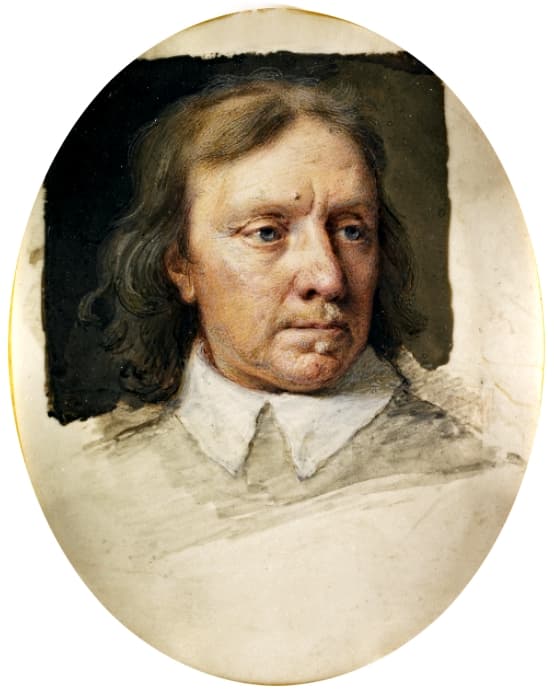
Oliver Cromwell — portrait by Samuel Cooper, c.1653 · Samuel Cooper (1609–1672), Portrait of Oliver Cromwell, c.1653. Public domain (PD-Art). Wikimedia Commons.
The king's Royalist army suffered decisive defeats at the Battles of Marston Moor and Naseby. By 1646 it was clear that Parliament's forces had won the Civil War. Charles was held as a prisoner of the parliamentary army; he continued to refuse a settlement, and in 1649 he was tried and executed.
With the king executed, England declared itself a republic — the Commonwealth. For a period it was genuinely unclear how the country was to be governed. Effective power rested with the army. One of the army's senior generals, Oliver Cromwell, was dispatched to Ireland, where a Catholic revolt that had begun in 1641 was still in progress and where Royalist forces remained in the field. Cromwell succeeded in re-establishing the authority of the English Parliament in Ireland, but did so with such severity that he remains, to this day, a deeply controversial figure in Irish memory.
The Scots had not accepted Charles I's execution and had proclaimed his son Charles II their king. Charles II was crowned king of Scotland and led a Scottish army into England. Cromwell defeated that army at the Battles of Dunbar and Worcester. Charles II escaped from the field at Worcester — famously, at one point during his flight, hiding in an oak tree — and eventually reached safety on the Continent. With Scotland now in parliamentary hands alongside England and Wales, Cromwell and Parliament controlled the whole island.
Following his Irish campaign and his victory over Charles II at Worcester, Cromwell was formally recognised as leader of the new republic. Under the title Lord Protector he ruled until his death in 1658. His son Richard Cromwell inherited the office but proved unable to control either the army or the government. Britain had by now been a republic for 11 years, but without Oliver Cromwell it lacked a clear leader or a settled form of government, and the country wanted stability. Support grew for restoring the monarchy.
Key Facts
- •The king's army was defeated at the Battles of Marston Moor and Naseby
- •By 1646 it was clear Parliament had won the war
- •Charles I was executed in 1649
- •England declared itself a republic called the Commonwealth
- •Oliver Cromwell was sent to Ireland, where he established the authority of the English Parliament with violent suppression
- •Cromwell remains a controversial figure in Ireland today
- •The Scots declared Charles II king and led an army into England; Cromwell defeated them at Dunbar and Worcester
- •Charles II famously hid in an oak tree on one occasion after Worcester
- •Cromwell was given the title Lord Protector and ruled until his death in 1658
- •His son Richard Cromwell became Lord Protector but could not control the army or government
- •Britain was a republic for 11 years
Key Dates
The Restoration
In May 1660, Parliament formally invited Charles II back from exile in the Netherlands. He was crowned King of England, Wales, Scotland and Ireland. Charles made it clear, in the words later attributed to him, that he had 'no wish to go on his travels again'; he understood that in practice he would have to reach agreement with Parliament rather than rule over its head. Parliament in the event was broadly supportive of his policies. The Church of England was re-established as the official state Church, and both Roman Catholics and Puritans were kept out of political office.
Two disasters struck London during Charles II's reign. In 1665 a serious outbreak of plague ran through the capital, killing very large numbers of people, especially in the poorer districts. The following year, 1666, a great fire burned through much of the city, destroying many churches and the old St Paul's Cathedral among other landmarks. London was then rebuilt, and a new St Paul's was commissioned from the architect Sir Christopher Wren. The diarist Samuel Pepys recorded both the plague and the Fire in the diary which was later published; it is still widely read.
A landmark piece of legal reform followed in 1679 with the Habeas Corpus Act. 'Habeas corpus' is a Latin phrase meaning 'you must present the person in court'; the Act guaranteed that no one could be held as a prisoner without due process and gave every prisoner a right to have his case heard in court. The Act remains significant in British law today.
Charles II himself took a strong personal interest in science. The Royal Society was founded during his reign for the promotion of 'natural knowledge', and is the oldest surviving scientific society in the world. Its early members included Sir Edmund Halley, who correctly predicted the return of the comet now named after him, and Sir Isaac Newton.
Isaac Newton (1643–1727), born in Lincolnshire in eastern England, first became seriously interested in science as a student at Cambridge University, where he later rose to prominence as a mathematician and natural philosopher. His most famous published work was Philosophiae Naturalis Principia Mathematica ('Mathematical Principles of Natural Philosophy'), which set out the mathematical description of gravity and showed that gravity applied universally. Newton also showed experimentally that white light is made up of the spectrum of colours of the rainbow. A great many of his scientific results remain foundational for physics and astronomy today.
Key Facts
- •In May 1660 Parliament invited Charles II to come back from exile in the Netherlands
- •Charles II said he had 'no wish to go on his travels again'
- •The Church of England again became the established official Church
- •Both Roman Catholics and Puritans were kept out of power
- •In 1665 a major outbreak of plague hit London
- •In 1666 the Great Fire destroyed much of London, including St Paul's Cathedral
- •Sir Christopher Wren designed the new St Paul's
- •Samuel Pepys's diary describes these events and is still read today
- •The Habeas Corpus Act became law in 1679
- •'Habeas corpus' is Latin for 'you must present the person in court'
- •The Royal Society was formed in Charles II's reign — the oldest surviving scientific society in the world
- •Early members included Sir Edmund Halley (predicted the return of Halley's Comet) and Sir Isaac Newton
- •Isaac Newton's most famous work was Philosophiae Naturalis Principia Mathematica
- •Newton showed how gravity applied to the whole universe
- •Newton also discovered that white light is made up of the colours of the rainbow
Key Dates
A Catholic King
Charles II left no legitimate children. On his death in 1685, the throne passed to his brother James, a Roman Catholic, who became King James II in England, Wales and Ireland and King James VII in Scotland. James immediately began to favour Roman Catholics in his appointments — notably permitting Catholics to serve as army Officers, a practice that an Act of Parliament had explicitly forbidden. He refused to seek compromise with Parliament, and he even ordered the arrest of some senior Church of England bishops. A growing body of English opinion feared that James was preparing to restore Catholicism as the state religion. For the time being, though, James's heirs were his two daughters, both of them committed Protestants, so most onlookers assumed that the next monarch would in any case be Protestant again. Then James's wife gave birth to a son. With a Catholic heir suddenly in prospect, the assumption that Protestantism would soon return no longer held.
Key Facts
- •Charles II died in 1685 without legitimate children
- •His brother James, a Roman Catholic, became King James II in England, Wales and Ireland and King James VII of Scotland
- •James favoured Roman Catholics and allowed them to be army Officers (forbidden by an Act of Parliament)
- •James arrested some of the bishops of the Church of England
- •James's heirs were his two firmly Protestant daughters — until his wife had a son
Key Dates
The Glorious Revolution
James II's elder daughter, Mary, was married to her cousin William of Orange, the Protestant ruler of the Netherlands. In 1688 a group of leading English Protestants wrote to William inviting him to invade England and claim the throne. When William landed, no meaningful resistance materialised. James fled to France, and William took the crown as William III of England, Wales and Ireland and William II of Scotland. He ruled jointly with Mary. The whole episode came to be called the 'Glorious Revolution' — glorious because there was no actual fighting in England, and revolutionary because it definitively secured the authority of Parliament and ended the prospect of a monarch ruling against Parliament's wishes. James II then attempted to reclaim the throne by invading Ireland with French military backing. William defeated James at the Battle of the Boyne in Ireland in 1690 — a victory still commemorated by some in Northern Ireland today. William re-conquered Ireland, James fled back to France, and a set of legal restrictions was imposed on the Roman Catholic Church in Ireland; Irish Catholics were excluded from participation in government.
There was also pro-Jacobite support in Scotland. An armed attempt at rebellion on James's behalf was defeated at Killiecrankie. As a follow-up, all Scottish clans were formally required to swear an oath accepting William as king. The MacDonalds of Glencoe submitted the oath late — and were massacred in response, an event which subsequently became known as the Glencoe Massacre and which kept many Scots distrustful of the new government.
Some continued to believe that James II had been the rightful king, particularly in Scotland. Some joined him in exile in France; others remained in Britain as secret sympathisers. James's followers, across this long political movement, became known collectively as Jacobites.
Key Facts
- •Mary, James II's elder daughter, was married to William of Orange, the Protestant ruler of the Netherlands
- •In 1688 important Protestants in England asked William to invade England and proclaim himself king
- •James II fled to France; William became William III (William II of Scotland), ruling jointly with Mary
- •It was called the 'Glorious Revolution' because there was no fighting in England
- •The Glorious Revolution guaranteed the power of Parliament
- •William defeated James II at the Battle of the Boyne in Ireland in 1690
- •The Battle of the Boyne is still celebrated by some in Northern Ireland today
- •Many restrictions were placed on the Roman Catholic Church in Ireland
- •Irish Catholics were unable to take part in the government
- •An armed rebellion in Scotland in support of James was quickly defeated at Killiecrankie
- •All Scottish clans were required to formally accept William as king by taking an oath
- •The MacDonalds of Glencoe were late in taking the oath and were all killed (the Glencoe Massacre)
- •James's supporters became known as Jacobites
Key Dates
Chapter Summary
All key facts from this chapter at a glance — read this to revise the full chapter quickly.
Chapter Summary
Quick revision- ✓Henry VII strengthened central administration, reduced the power of the nobles and built up the monarchy's financial reserves
- ✓Henry VIII was most famous for breaking away from the Church of Rome and marrying six times
- ✓Henry VIII's six wives: Catherine of Aragon (divorced), Anne Boleyn (executed — mother of Elizabeth I), Jane Seymour (mother of Edward VI, died shortly after birth), Anne of Cleves (divorced), Catherine Howard (executed), Catherine Parr (survived him)
- ✓When the Pope refused to approve Henry VIII's divorce, Henry established the Church of England — in which the king (not the Pope) appoints bishops and orders worship
- ✓The Reformation was a movement against the authority of the Pope and the Roman Catholic Church; Protestants read the Bible in their own languages and did not pray to saints or at shrines
- ✓During Henry VIII's reign, Wales was formally united with England by the Act for the Government of Wales
- ✓Edward VI was strongly Protestant; the Book of Common Prayer was written during his reign
- ✓Edward VI died aged 15; his half-sister Mary ('Bloody Mary') persecuted Protestants
- ✓Queen Elizabeth I re-established the Church of England as the official Church; everyone had to attend their local church
- ✓Elizabeth balanced Catholic and extreme Protestant views, avoiding serious religious conflict in England
- ✓1588 — the English defeated the Spanish Armada, a large Spanish fleet sent to conquer England and restore Catholicism
- ✓Elizabeth became one of the most popular monarchs in English history
- ✓1560 — the Scottish Parliament abolished the authority of the Pope in Scotland; Roman Catholic services became illegal
- ✓A Protestant Church of Scotland was established — unlike in England, this was not a state Church
- ✓Mary Stuart ('Mary, Queen of Scots') was a Catholic and became queen when she was only a week old; much of her childhood was spent in France
- ✓Mary fled to England after her husband was murdered and gave her throne to her Protestant son, James VI of Scotland
- ✓Mary was Elizabeth I's cousin but was kept a prisoner for 20 years and was eventually executed, accused of plotting against Elizabeth
- ✓The Elizabethan period was a time of growing patriotism — pride in being English; English explorers sought new trade routes into Spanish colonies in the Americas
- ✓Sir Francis Drake was one of the commanders in the defeat of the Spanish Armada; his ship the Golden Hind was one of the first to circumnavigate the world
- ✓English settlers first began to colonise the eastern coast of America in Elizabeth I's time
- ✓William Shakespeare (1564–1616) was born in Stratford-upon-Avon; his most famous plays include A Midsummer Night's Dream, Hamlet, Macbeth and Romeo and Juliet
- ✓Shakespeare was one of the first to portray ordinary Englishmen and women on stage
- ✓Famous Shakespeare lines still quoted: 'Once more unto the breach' (Henry V); 'To be or not to be' (Hamlet); 'A rose by any other name' (Romeo and Juliet); 'All the world's a stage' (As You Like It); 'The darling buds of May' (Sonnet 18)
- ✓The Globe Theatre in London is a modern copy of the theatres in which Shakespeare's plays were first performed
- ✓Elizabeth I never married and had no children; 1603 — her cousin James VI of Scotland became King James I of England, Wales and Ireland (but Scotland remained a separate country)
- ✓The 'King James Version' ('Authorised Version') Bible was a new English translation made in James's reign; still used in many Protestant churches today
- ✓Ireland was an almost completely Catholic country; Henry VIII took the title 'King of Ireland'
- ✓Under Elizabeth I and James I, the English government encouraged Scottish and English Protestants to settle in Ulster — these settlements were called 'plantations'
- ✓Plantation settlers mostly came from south-west Scotland; other land went to companies based in London; James organised similar plantations in several other parts of Ireland
- ✓Elizabeth I was very skilled at managing Parliament; James I and Charles I believed in the 'Divine Right of Kings' — that the king was directly appointed by God
- ✓Charles I tried to rule without Parliament for 11 years; trouble in Scotland eventually forced him to recall Parliament in 1640
- ✓Charles I tried to impose a revised Prayer Book on the Presbyterian Church in Scotland, causing serious unrest
- ✓1640 — Charles I recalled Parliament to ask for funds; many in Parliament were Puritans (strict and simple in religious doctrine)
- ✓Charles I entered the House of Commons and tried to arrest five parliamentary leaders who had been warned; no monarch has set foot in the Commons since
- ✓1642 — English Civil War began: supporters of the king were called Cavaliers; supporters of Parliament were called Roundheads
- ✓The king's army was defeated at the Battles of Marston Moor and Naseby; by 1646 Parliament had won the war
- ✓1649 — Charles I was executed; England declared itself a republic called the Commonwealth
- ✓Oliver Cromwell established the authority of the English Parliament in Ireland with violent suppression; he remains a controversial figure in Ireland today
- ✓Cromwell defeated the Scots (who had declared Charles II king) at the Battles of Dunbar and Worcester; Charles II famously hid in an oak tree before fleeing to Europe
- ✓Cromwell was given the title Lord Protector and ruled until his death in 1658; Britain was a republic for 11 years
- ✓1660 — Parliament invited Charles II back from exile; the Church of England again became the established official Church; Roman Catholics and Puritans were kept out of power
- ✓1665 — a major outbreak of plague hit London; 1666 — the Great Fire of London destroyed much of the city including St Paul's Cathedral
- ✓Sir Christopher Wren designed the new St Paul's; Samuel Pepys's diary describes these events and is still read today
- ✓1679 — the Habeas Corpus Act became law: 'habeas corpus' is Latin for 'you must present the person in court'; it guaranteed that no one could be held prisoner unlawfully
- ✓The Royal Society was formed in Charles II's reign — the oldest surviving scientific society in the world
- ✓Early Royal Society members included Sir Edmund Halley (predicted the return of Halley's Comet) and Sir Isaac Newton
- ✓Isaac Newton (1643–1727) published Principia Mathematica, showing how gravity applied to the whole universe; he also discovered that white light is made up of the colours of the rainbow
- ✓Charles II died in 1685 without legitimate children; his Catholic brother became King James II (James VII of Scotland)
- ✓James II favoured Roman Catholics, allowing them to be army Officers (forbidden by Parliament), and arrested some bishops of the Church of England
- ✓1688 — Glorious Revolution: important Protestants asked William of Orange (Protestant ruler of the Netherlands) to invade; James II fled to France with no fighting in England
- ✓William became William III ruling jointly with Mary — guaranteeing the power of Parliament
- ✓1690 — William defeated James II at the Battle of the Boyne in Ireland; still celebrated by some in Northern Ireland today
- ✓Many restrictions were placed on the Roman Catholic Church in Ireland; Irish Catholics were unable to take part in government
- ✓All Scottish clans were required to swear loyalty to William; the MacDonalds of Glencoe were late in taking the oath and were all killed (the Glencoe Massacre)
- ✓James's supporters became known as Jacobites
Test Yourself on This Chapter
Ready to practice? Take a focused test on this topic.