The UK Today
8 min read·Last updated: April 2026
In this chapter
The Nations of the UK and Cities
Four capitals sit at the centres of the UK's four nations. London is the capital of the United Kingdom as a whole; Edinburgh is the capital of Scotland; Cardiff the capital of Wales; and Belfast the capital of Northern Ireland. Each is also a principal political and cultural hub for its own nation, though none stands alone as its country's only significant city.
England's major cities extend well beyond London and include Birmingham, Liverpool, Leeds, Sheffield, Bristol, Manchester, Bradford, Newcastle upon Tyne, Plymouth, Southampton and Norwich. In Wales the major cities are Cardiff, Swansea and Newport; in Scotland they are Edinburgh, Glasgow, Dundee and Aberdeen; and Belfast is the major city of Northern Ireland. Although the bulk of the population lives in urban areas, a large share of Britain's geography remains rural.
The country occupies the north-western edge of Europe. At its longest, the mainland measures roughly 870 miles — about 1,400 kilometres — running between John O'Groats at the northern tip of Scotland and Land's End at the south-western corner of England. A century of movement into and across these islands has shaped a multinational and multiracial society: close to one in ten residents now has a parent or grandparent who was born outside the UK.
Key Facts
- •The capital city of the UK is London
- •The capital city of Scotland is Edinburgh
- •The capital city of Wales is Cardiff
- •The capital city of Northern Ireland is Belfast
- •Major cities of England include London, Birmingham, Liverpool, Leeds, Sheffield, Bristol, Manchester, Bradford, Newcastle upon Tyne, Plymouth, Southampton and Norwich
- •Major cities of Wales include Cardiff, Swansea and Newport
- •Major cities of Scotland include Edinburgh, Glasgow, Dundee and Aberdeen
- •Post-war immigration means that nearly 10% of the UK population has a parent or grandparent born outside the UK
- •The longest distance on the UK mainland is from John O'Groats (north Scotland) to Land's End (south-west England) — about 870 miles (approximately 1,400 kilometres)
UK Currency
The UK's currency is the pound sterling, written as £ and divided into 100 pence. Coins are issued in values of 1p, 2p, 5p, 10p, 20p, 50p, £1 and £2, and banknotes come in denominations of £5, £10, £20 and £50. Scotland and Northern Ireland each print their own banknotes as well. These are legal tender throughout the UK, though individual shops and businesses are under no obligation to accept them.
Key Facts
- •The currency in the UK is the pound sterling (£); there are 100 pence in a pound
- •Coins: 1p, 2p, 5p, 10p, 20p, 50p, £1 and £2
- •Notes: £5, £10, £20 and £50
- •Northern Ireland and Scotland have their own banknotes, which are valid everywhere in the UK, but shops and businesses do not have to accept them
Languages and Dialects
English is spoken across the UK in a wide variety of regional accents and dialects. Beyond English, three of the devolved nations preserve their own long-standing languages. Welsh, which is unrelated to English and structurally quite distinct from it, is spoken widely in Wales and forms part of the school and university curriculum there. Gaelic survives as a community language in parts of the Scottish Highlands and Islands, and in sections of Northern Ireland Irish Gaelic is also spoken.
Key Facts
- •In Wales, many people speak Welsh (a completely different language from English) and it is taught in schools and universities
- •In Scotland, Gaelic is spoken in some parts of the Highlands and Islands
- •In Northern Ireland, some people speak Irish Gaelic
Population
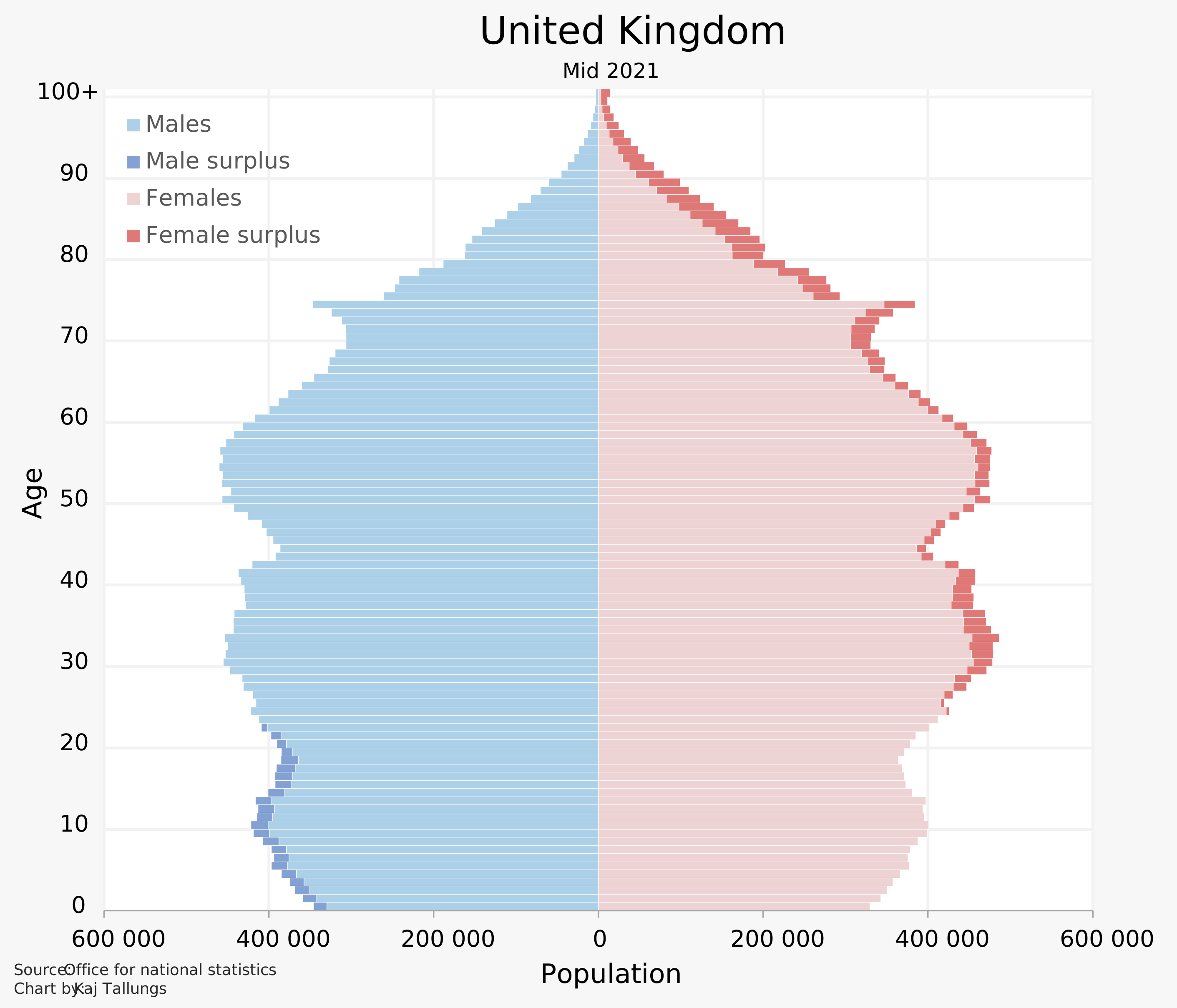
UK population pyramid showing age and gender distribution, based on 2021 ONS data · Kaj Tallungs, 2022 (data from UK Office for National Statistics, updated 2024). CC-BY-SA-4.0. Wikimedia Commons.
Britain's population has risen dramatically over the past four centuries. From around 4 million in 1600, it climbed to 40 million by the start of the 20th century and has kept rising, with the sharpest increases occurring in the decades closest to the present day. More recent growth has been driven largely by migration into the UK and by people living longer than previous generations did.
This population is distributed very unevenly across the four nations. England alone accounts for roughly 84% of everyone who lives in the UK, with Scotland at just over 8%, Wales at close to 5%, and Northern Ireland at under 3%.
Better living conditions and advances in medicine have pushed life expectancy to its highest level ever. The country now has a record number of residents aged 85 or above, and the size of this older age group is placing increasing pressure on the state pension system and the health service.
Key Facts
- •The UK population in 1600 was just over 4 million
- •The UK population in 1700 was 5 million
- •The UK population in 1801 was 8 million
- •The UK population in 1851 was 20 million
- •The UK population in 1901 was 40 million
- •The UK population in 1951 was 50 million
- •The UK population in 1998 was 57 million
- •The UK population in 2005 was just under 60 million
- •The UK population in 2010 was just over 62 million
- •The estimated UK population in 2022 was 67.6 million
- •England makes up about 84% of the total UK population; Wales around 5%; Scotland just over 8%; Northern Ireland less than 3%
- •Migration into the UK and longer life expectancy have contributed to population growth
- •There are now a record number of people aged 85 and over in the UK, impacting the cost of pensions and health care
Key Dates
Ethnic Diversity
Modern Britain is ethnically varied, and London together with the other largest cities has changed most rapidly as that diversity has grown. When UK residents are asked in surveys to pick the ethnic description that fits them best, 'white' is still chosen most often; that grouping takes in people with European heritage alongside those whose families came from Australia, Canada, New Zealand or the United States. Substantial communities also identify as Asian, as black, or as of mixed heritage, and beyond these, people whose family origins lie in almost every country in the world have made their lives here.
Key Facts
- •The UK population is ethnically diverse, especially in large cities such as London
- •The most common ethnic description in surveys is white, including people of European, Australian, Canadian, New Zealand and American descent
- •Other significant ethnic groups include those of Asian, black and mixed descent
An Equal Society
Equality between women and men is written into UK law, which also forbids discrimination on grounds of marital status. Neither gender may lawfully be disadvantaged because of being male or female, or because of being married or single; both sexes share identical legal rights to take employment, to own property, and to enter into or dissolve a marriage. Where a couple are married, raising any children of the marriage is the shared legal duty of both parents.
Women now account for close to half of the working population in Britain. Girls as a group tend to finish school with stronger qualifications than boys, and a larger share of women than men go on to university studies. Employment horizons for women have widened beyond recognition: women are active in every sector of the economy, and the number in senior positions — including at the head of industries once considered men's work — stands at a record high.
The corresponding change on the men's side has been an equivalent broadening of the kinds of work men now take on. The older assumption that a wife would step back from paid employment after marriage is largely gone. Many women return to or stay in work once their children are born, and in a great many households both partners hold paying jobs and share the day-to-day work of looking after the children and keeping the home running.
Key Facts
- •It is a legal requirement in the UK that men and women should not be discriminated against because of their gender or marital status
- •Men and women have equal rights to work, own property, marry and divorce
- •Both parents are equally responsible for their children
- •Women in Britain make up about half of the workforce
- •On average, girls leave school with better qualifications than boys; more women than men study at university
- •Women work in all sectors of the economy including senior management roles in traditionally male-dominated occupations
- •In many families today, both partners work and share responsibility for childcare and household chores
Chapter Summary
All key facts from this chapter at a glance — read this to revise the full chapter quickly.
Chapter Summary
Quick revision- ✓The capital city of the UK is London; Scotland — Edinburgh; Wales — Cardiff; Northern Ireland — Belfast
- ✓Major cities of England: London, Birmingham, Liverpool, Leeds, Sheffield, Bristol, Manchester, Bradford, Newcastle upon Tyne, Plymouth, Southampton and Norwich
- ✓Major cities of Wales: Cardiff, Swansea and Newport; Scotland: Edinburgh, Glasgow, Dundee and Aberdeen
- ✓Post-war immigration means that nearly 10% of the UK population has a parent or grandparent born outside the UK
- ✓The longest distance on the UK mainland is from John O'Groats (north Scotland) to Land's End (south-west England) — about 870 miles (approximately 1,400 kilometres)
- ✓The currency in the UK is the pound sterling (£); there are 100 pence in a pound
- ✓Coins: 1p, 2p, 5p, 10p, 20p, 50p, £1 and £2; Notes: £5, £10, £20 and £50
- ✓Northern Ireland and Scotland have their own banknotes, valid everywhere in the UK, but shops do not have to accept them
- ✓In Wales, many people speak Welsh (a completely different language from English); it is taught in schools and universities
- ✓In Scotland, Gaelic is spoken in some parts of the Highlands and Islands; in Northern Ireland, some people speak Irish Gaelic
- ✓UK population growth: just over 4 million (1600) → 5 million (1700) → 8 million (1801) → 20 million (1851) → 40 million (1901) → 50 million (1951) → 57 million (1998) → just under 60 million (2005) → just over 62 million (2010) → estimated 67.6 million (2022)
- ✓England makes up about 84% of the total UK population; Wales around 5%; Scotland just over 8%; Northern Ireland less than 3%
- ✓Migration into the UK and longer life expectancy have contributed to population growth
- ✓There are now a record number of people aged 85 and over in the UK, impacting the cost of pensions and health care
- ✓The UK population is ethnically diverse, especially in large cities such as London; the most common ethnic description in surveys is white
- ✓Other significant ethnic groups include those of Asian, black and mixed descent; there are people in the UK with ethnic origins from all over the world
- ✓It is a legal requirement in the UK that men and women should not be discriminated against because of their gender or marital status
- ✓Men and women have equal rights to work, own property, marry and divorce; both parents are equally responsible for their children
- ✓Women in Britain make up about half of the workforce; on average, girls leave school with better qualifications than boys; more women than men study at university
- ✓Women work in all sectors of the economy including senior management roles in traditionally male-dominated occupations
- ✓In many families today, both partners work and share responsibility for childcare and household chores
Test Yourself on This Chapter
Ready to practice? Take a focused test on this topic.