Sport
12 min read·Last updated: April 2026
In this chapter
Sport and Famous Venues
Organised sport is a significant part of daily life across the UK, with a number of disciplines commanding especially broad followings. Many of the biggest professional fixtures are staged in large purpose-built national stadiums — Wembley Stadium in north-west London, and the Millennium Stadium in central Cardiff, are the two most frequently mentioned venues for exam purposes.
A wide range of participatory facilities — municipal gymnasiums, swimming pools, local tennis courts, football and rugby pitches, and in colder regions dry ski slopes — is provided through a mix of local councils and private operators. An observer of British sporting history quickly notices how many of the world's most widely played games actually began on these islands: football and rugby, cricket, lawn tennis and golf all trace their origins back to Britain.
Key Facts
- •Many famous sports began in Britain, including cricket, football, lawn tennis, golf and rugby
- •Major sporting venues include Wembley Stadium in London and the Millennium Stadium in Cardiff
The Olympic and Paralympic Games
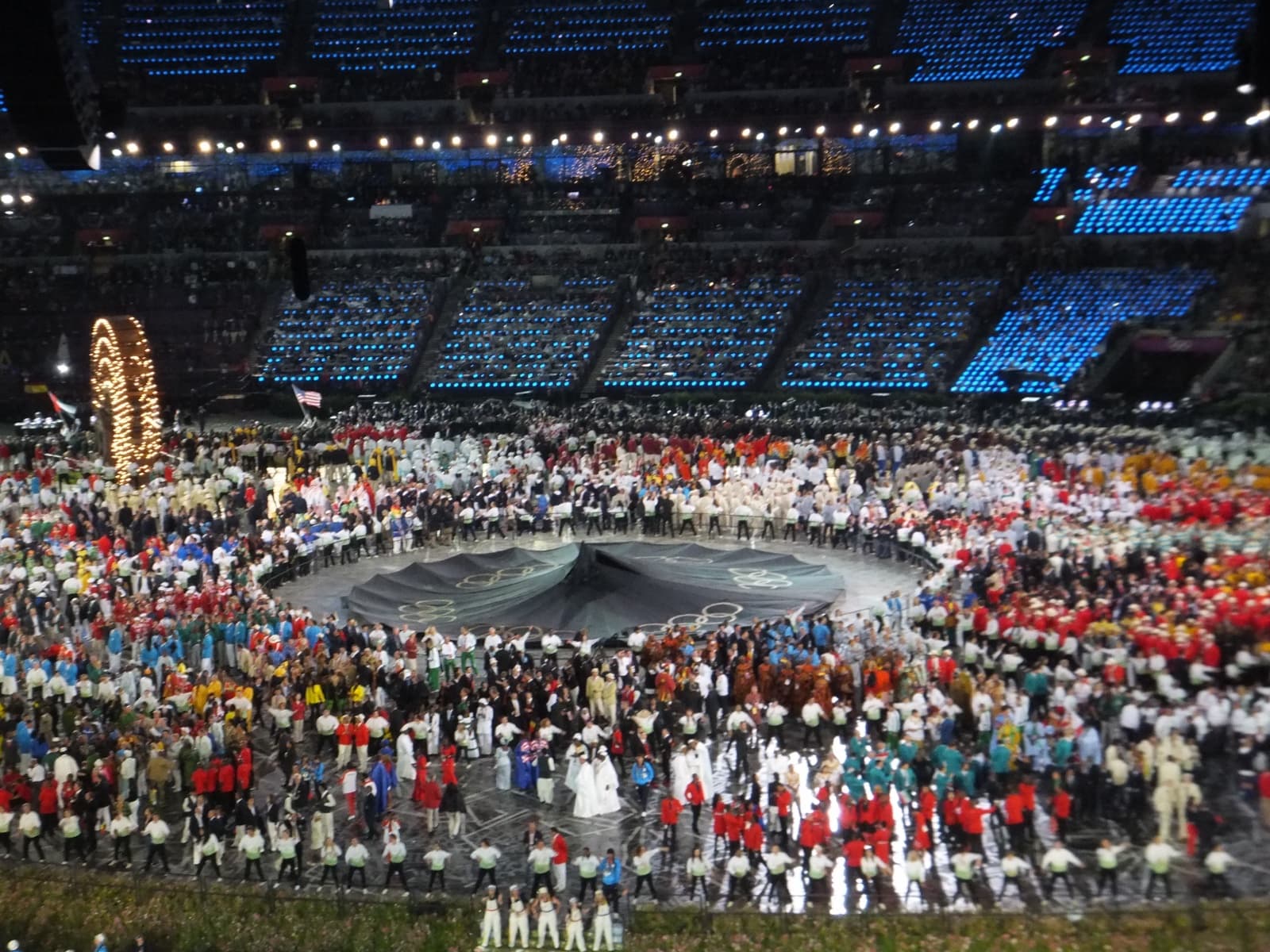
Parade of Nations during the London 2012 Olympic Games Opening Ceremony · Photograph by Richj1209, 2012. CC-BY-SA-3.0. Wikimedia Commons.
The UK has been the host nation for the Olympic Games on three occasions across the 20th and 21st centuries: first in 1908, again after the Second World War in 1948, and most recently in 2012. The central Olympic precinct for the 2012 Games was built on reclaimed industrial land in Stratford, in East London — the area was redeveloped into a new park with several permanent venues. The Games themselves were a success for Team GB: the British team finished third in the medal table across a wide span of Olympic disciplines, behind only the United States and China.
London also staged the 2012 Paralympic Games in the same set of venues over the weeks that followed. The Paralympic movement itself traces its origins to the clinical work of Dr Sir Ludwig Guttman, a German-born refugee who practised at the Stoke Mandeville hospital in Buckinghamshire during and after the Second World War. Guttman pioneered new treatments for patients with spinal injuries and actively encouraged them to pursue competitive exercise and sport as part of their recovery. The organised games he set up for his patients at Stoke Mandeville in the late 1940s are widely regarded as the direct antecedent of the modern Paralympic Games.
Key Facts
- •The UK has hosted the Olympic Games three times: 1908, 1948 and 2012
- •The main Olympic site for the 2012 Games was in Stratford, East London; the British team finished third in the medal table
- •The Paralympic Games for 2012 were also hosted in London
- •The Paralympics have their origin in the work of Dr Sir Ludwig Guttman at Stoke Mandeville hospital in Buckinghamshire, where he developed new treatment methods for people with spinal injuries
Key Dates
Notable British Sportsmen and Women
British athletes across many disciplines have accumulated an impressive haul of records, Olympic titles and world championship wins over the past century. The selective roll-call below — a mix of household names and question-material standards — spans athletics, motor racing, football, cricket, ice dancing, rowing, Paralympic competition, yachting, cycling, tennis and swimming. A striking number of the individuals listed below have been honoured by the state for their sporting achievement, with knighthoods (Sir), damehoods (Dame) or life peerages (Baroness) appearing against their names, and the chapter's question material occasionally turns on those titles.
A few patterns are worth tracking as you read through the list. First, the 2012 Olympic and Paralympic Games in London were a notable high-water mark for British sport — several of the athletes named here won their headline medals during that single home-soil Games. Second, Paralympic sport is represented at length, including distance wheelchair racing and competitive swimming. Third, motor racing, cycling and yachting — each a technology-intensive discipline — feature repeatedly, reflecting the UK's strength in engineering as well as in athletic performance.
Notable British Sportspeople
In order of birth year — years shown are born–died or born–present
- b. 1929–Sir Roger BannisterAthletics
First to run a mile under 4 minutes (1954)
- b. 1939–Sir Jackie StewartMotor racing
Three Formula 1 world championships
- b. 1941–93Bobby MooreFootball
Captained England to World Cup victory (1966)
- b. 1955–Sir Ian BothamCricket
Captained England; holds multiple Test records
- b. 1957–Jayne Torvill & Chris DeanIce dancing
Olympic gold (1984); four world championship titles
- b. 1962–Sir Steve RedgraveRowing
Gold medals in five consecutive Olympic Games
- b. 1969–Baroness Tanni Grey-ThompsonParalympic
16 Paralympic medals including 11 gold; wheelchair racing
- b. 1970–Dame Kelly HolmesAthletics
Two gold medals at the 2004 Olympic Games (running)
- b. 1976–Dame Ellen MacArthurSailing
Fastest solo circumnavigation of the world (2004)
- b. 1976–Sir Chris HoyCycling
Six gold and one silver Olympic medals
- b. 1979–David WeirParalympic
Six Paralympic gold medals; wheelchair racing
- b. 1980–Sir Bradley WigginsCycling
First Briton to win Tour de France (2012)
- b. 1983–Sir Mo FarahAthletics
Olympic gold in 5,000m and 10,000m (2012)
- b. 1986–Dame Jessica Ennis-HillAthletics
Olympic heptathlon gold (2012)
- b. 1987–Andy MurrayTennis
US Open and Olympic gold (2012); Wimbledon champion
- b. 1994–Ellie SimmondsParalympic
Gold medals for swimming (2008 and 2012 Paralympics)
Notable British sportspeople mentioned in the Life in the UK test.
Key Facts
- •Sir Roger Bannister (1929–) was the first man in the world to run a mile in under four minutes, in 1954
- •Sir Jackie Stewart (1939–) is a Scottish former racing driver who won the Formula 1 world championship three times
- •Bobby Moore (1941–93) captained the English football team that won the World Cup in 1966
- •Sir Ian Botham (1955–) captained the English cricket team and holds a number of English Test cricket records, both for batting and for bowling
- •Jayne Torvill (1957–) and Christopher Dean (1958–) won gold medals for ice dancing at the Olympic Games in 1984 and in four consecutive world championships
- •Sir Steve Redgrave (1962–) won gold medals in rowing in five consecutive Olympic Games and is one of Britain's greatest Olympians
- •Baroness Tanni Grey-Thompson (1969–) is an athlete who uses a wheelchair and won 16 Paralympic medals including 11 gold medals across five Paralympic Games; won the London Marathon six times; broke 30 world records
- •Dame Kelly Holmes (1970–) won two gold medals for running in the 2004 Olympic Games and has held a number of British and European records
- •Dame Ellen MacArthur (1976–) is a yachtswoman who in 2004 became the fastest person to sail around the world singlehanded
- •Sir Chris Hoy (1976–) is a Scottish cyclist who has won six gold and one silver Olympic medals and 11 world championship titles
- •David Weir (1979–) is a Paralympian who uses a wheelchair and has won six gold medals over two Paralympic Games; won the London Marathon six times
- •Bradley Wiggins (1980–) is a cyclist who in 2012 became the first Briton to win the Tour de France; has won seven Olympic medals including gold in 2004, 2008 and 2012
- •Mo Farah (1983–) is a British distance runner born in Somalia; won gold medals in the 2012 Olympics for the 5,000 and 10,000 metres; first Briton to win the Olympic gold in the 10,000 metres
- •Jessica Ennis (1986–) won the 2012 Olympic gold medal in the heptathlon (seven track and field events) and holds a number of British athletics records
- •Andy Murray (1987–) is a Scottish tennis player who in 2012 won the men's singles at the US Open, the first British man to win a singles Grand Slam title since 1936; also won Olympic gold and silver medals in 2012
- •Ellie Simmonds (1994–) is a Paralympian who won gold medals for swimming at the 2008 and 2012 Paralympic Games; holds world records; was the youngest member of the British team at the 2008 Games
Key Dates
Cricket
Cricket is an English invention that has since spread across much of the Commonwealth and beyond. One of the game's distinctive features is its format: a single match can stretch to five days of play and still finish as a draw, a trait that has lent the game its reputation for patience, nuance and gentlemanly conduct. British English draws heavily on cricket for everyday idiom; among the phrases that have made the jump from the field of play into general use are 'rain stopped play', 'batting on a sticky wicket', 'playing a straight bat', 'bowled a googly' and the dismissive 'it's just not cricket'. The most closely followed international fixture in the sport is the Ashes, a series of Test matches contested between the English and Australian national sides.
Key Facts
- •Cricket originated in England and is now played in many countries
- •Games can last up to five days but still result in a draw
- •The most famous cricket competition is the Ashes — a series of Test matches between England and Australia
- •Everyday expressions from cricket include 'it's just not cricket', 'batting on a sticky wicket' and 'playing a straight bat'
Football
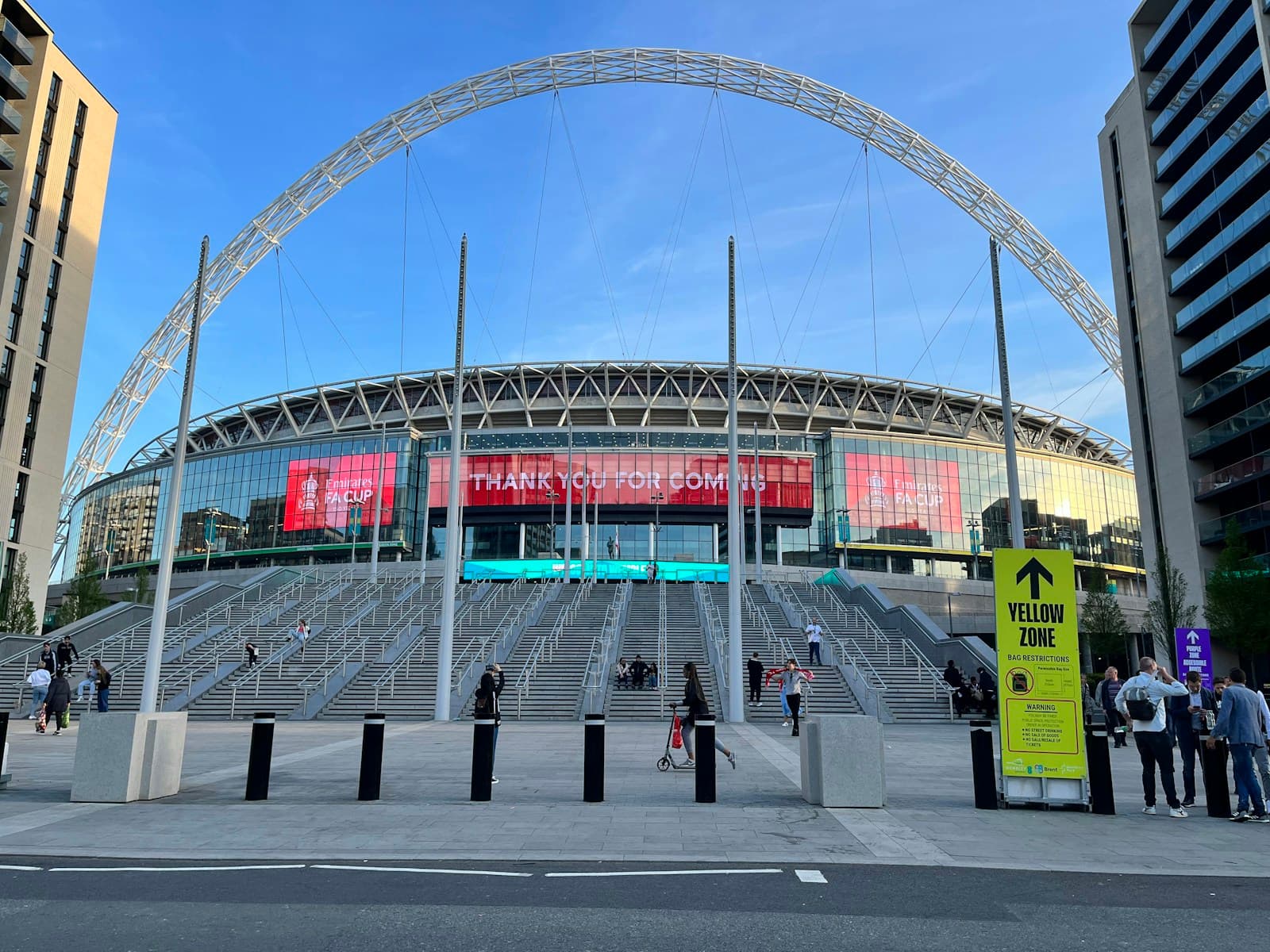
Wembley Stadium exterior — home of England football matches and FA Cup finals · Photograph by Alfie Basford. Unsplash Licence. unsplash.com
Football is the single most popular sport in the UK, with a deep institutional history stretching back into the late 19th century, which is when the first professional clubs were established. The four nations of the UK — England, Scotland, Wales and Northern Ireland — each run their own separate league systems. Of these, the English Premier League commands the largest international television audience and attracts many of the most decorated players in the world.
A number of UK clubs also play in the UEFA Champions League alongside the top sides from other European countries. At international level, each of the four UK nations fields a separate national team for tournaments such as the FIFA World Cup and the UEFA European Football Championships. England's sole victory at a senior international tournament came at the 1966 World Cup, which was itself held in the UK.
Beyond the professional game, football is also a major amateur sport played every week in parks and on community pitches the length of the country.
Key Facts
- •Football is the UK's most popular sport
- •The first professional football clubs were formed in the late 19th century
- •England, Scotland, Wales and Northern Ireland each have separate football leagues
- •The English Premier League attracts a huge international audience
- •Many UK teams compete in the UEFA Champions League
- •England's only international tournament victory was at the 1966 FIFA World Cup, hosted in the UK
Key Dates
Rugby
Rugby is an English invention of the early 19th century and remains a major sport in the UK today. Two codes with distinct rules have developed alongside one another: rugby union and rugby league. Each code has its own club leagues and national teams, and in both codes the four UK nations field separately — though Northern Ireland plays together with the Republic of Ireland. The headline rugby union tournament is the Six Nations Championship, which brings together England, Ireland, Scotland, Wales, France and Italy. The equivalent flagship club competition in rugby league is the Super League.
Key Facts
- •Rugby originated in England in the early 19th century
- •There are two types of rugby: union and league, with different rules
- •The most famous rugby union competition is the Six Nations Championship between England, Ireland, Scotland, Wales, France and Italy
- •The Super League is the most well-known rugby league club competition
Horse-racing
Horse racing has a very long history in Britain — evidence of races being run on these islands reaches back to the Roman period. The sport has also long been bound up with the monarchy, and racecourses exist across the four nations. Among the most famous fixtures are Royal Ascot, a five-day summer meeting in Berkshire attended each year by members of the Royal Family; the Grand National, held at Aintree near Liverpool; and the Scottish Grand National, which is run at Ayr. The National Horseracing Museum is based in Newmarket in Suffolk.
Key Facts
- •Horse racing in Britain dates back to at least Roman times
- •Famous horse-racing events include Royal Ascot (five-day meeting in Berkshire, attended by the Royal Family), the Grand National at Aintree near Liverpool, and the Scottish Grand National at Ayr
- •There is a National Horseracing Museum in Newmarket, Suffolk
Golf
The modern game of golf has its origins in 15th-century Scotland and remains widely played today, both socially and at a professional level. Public and private golf courses are found across the UK, and the Scottish town of St Andrews is traditionally recognised as the home of the sport. Of the four 'Major' golf tournaments in the professional calendar, only one — The Open Championship — is held outside the United States, and it rotates between a different British golf course each year.
Key Facts
- •The modern game of golf can be traced back to 15th century Scotland
- •St Andrews in Scotland is known as the home of golf
- •The Open Championship is the only 'Major' golf tournament held outside the United States and is hosted by a different golf course every year
Tennis
Modern tennis was codified in England during the late 19th century. The first organised tennis club in the country was founded in Leamington Spa in 1872. Britain's pre-eminent tournament is The Wimbledon Championships, held every summer at the All England Lawn Tennis and Croquet Club in south-west London. Wimbledon is the oldest tennis tournament of its kind anywhere in the world, and it is the only one of the four 'Grand Slam' events still played on natural grass courts.
Key Facts
- •Modern tennis evolved in England in the late 19th century
- •The first tennis club was founded in Leamington Spa in 1872
- •The Wimbledon Championships takes place at the All England Lawn Tennis and Croquet Club
- •Wimbledon is the oldest tennis tournament in the world and the only Grand Slam event played on grass
Key Dates
Water Sports
Sailing remains a widely followed sport in the UK — a reflection of the country's long maritime history and its extensive coastline. Two milestones from the 1960s are particularly notable and often turn up in exam question material. In 1966/67 the British sailor Sir Francis Chichester became the first person to sail solo around the world; he made one stopover for repairs along the route. Two years later Sir Robin Knox-Johnston pushed the achievement a step further by becoming the first person to accomplish the same feat without stopping anywhere along the way. Sailing events take place on British waters throughout the summer season, the most widely followed being the annual regatta held at Cowes on the Isle of Wight.
Rowing is similarly popular in the UK, practised both as a recreational activity and as a competitive sport at school, club and university level. One of the longest-running fixtures in the entire British sporting calendar is the annual Boat Race, which pits crews from Oxford and Cambridge Universities against one another on a stretch of the River Thames in west London — a fixture that dates from 1829 and now draws substantial crowds along the banks each spring.
Key Facts
- •Sir Francis Chichester was the first person to sail single-handed around the world (1966/67)
- •Sir Robin Knox-Johnston was the first person to sail single-handed around the world without stopping (two years after Chichester)
- •The most famous sailing event in the UK is at Cowes on the Isle of Wight
- •There is a popular yearly Oxford vs Cambridge rowing race on the River Thames
Key Dates
Motor Sports and Skiing
The UK has a long history in both car and motorcycle racing. Organised motor-car racing on British soil dates from 1902. The country remains a world leader in the design and manufacture of motor-sport technology: a large share of Formula 1 team bases and specialist suppliers are located in Britain, and the UK hosts one of the Formula 1 Grand Prix events every year. Successive generations of British drivers have claimed the Formula 1 World Championship; recent title-holders include Damon Hill, Lewis Hamilton and Jenson Button.
Skiing is also a growing leisure pursuit in the UK, though many participants travel abroad to the Alps or similar ranges. Dry ski slopes operate throughout the UK; Scotland alone has five full-function ski centres, and the longest dry ski slope anywhere in Europe is located near Edinburgh.
Key Facts
- •Motor-car racing in the UK started in 1902
- •The UK is a world leader in the development and manufacture of motor-sport technology
- •A Formula 1 Grand Prix is held in the UK each year
- •Recent British Formula 1 World Championship winners include Damon Hill, Lewis Hamilton and Jenson Button
- •There are five ski centres in Scotland, as well as Europe's longest dry ski slope near Edinburgh
Key Dates
Chapter Summary
All key facts from this chapter at a glance — read this to revise the full chapter quickly.
Chapter Summary
Quick revision- ✓Many famous sports began in Britain, including cricket, football, lawn tennis, golf and rugby
- ✓Major sporting venues include Wembley Stadium in London and the Millennium Stadium in Cardiff
- ✓The UK has hosted the Olympic Games three times: 1908, 1948 and 2012
- ✓The main Olympic site for the 2012 Games was in Stratford, East London; the British team finished third in the medal table
- ✓The 2012 Paralympic Games were also hosted in London
- ✓The Paralympics have their origin in the work of Dr Sir Ludwig Guttman at Stoke Mandeville hospital in Buckinghamshire, where he developed new treatment methods for people with spinal injuries
- ✓Sir Roger Bannister (1929–) was the first man to run a mile in under four minutes, in 1954
- ✓Sir Jackie Stewart (1939–) is a Scottish racing driver who won the Formula 1 world championship three times
- ✓Bobby Moore (1941–93) captained the English football team that won the World Cup in 1966
- ✓Sir Ian Botham (1955–) captained the English cricket team and holds records for both batting and bowling
- ✓Jayne Torvill (1957–) and Christopher Dean (1958–) won Olympic gold for ice dancing at the 1984 Games and in four consecutive world championships
- ✓Sir Steve Redgrave (1962–) won gold medals in rowing in five consecutive Olympic Games and is one of Britain's greatest Olympians
- ✓Baroness Tanni Grey-Thompson (1969–) won 16 Paralympic medals including 11 gold medals across five Games; won the London Marathon six times; broke 30 world records
- ✓Dame Kelly Holmes (1970–) won two gold medals for running at the 2004 Olympics
- ✓Dame Ellen MacArthur (1976–) became the fastest person to sail around the world single-handed in 2004
- ✓Sir Chris Hoy (1976–) is a Scottish cyclist who won six gold and one silver Olympic medals and 11 world championship titles
- ✓David Weir (1979–) won six Paralympic gold medals over two Games; won the London Marathon six times
- ✓Bradley Wiggins (1980–) became the first Briton to win the Tour de France in 2012; has won seven Olympic medals including gold in 2004, 2008 and 2012
- ✓Mo Farah (1983–) won gold at the 2012 Olympics for the 5,000m and 10,000m; first Briton to win Olympic gold in the 10,000m
- ✓Jessica Ennis (1986–) won the 2012 Olympic gold in the heptathlon
- ✓Andy Murray (1987–) won the 2012 US Open — first British man to win a singles Grand Slam title since 1936; also won Olympic gold and silver in 2012
- ✓Ellie Simmonds (1994–) won Paralympic gold for swimming at the 2008 and 2012 Games; holds world records; was the youngest member of the British team at the 2008 Games
- ✓Cricket originated in England and is now played in many countries; games can last up to five days but still result in a draw
- ✓The most famous cricket competition is the Ashes — a series of Test matches between England and Australia
- ✓Everyday expressions from cricket include 'it's just not cricket', 'batting on a sticky wicket' and 'playing a straight bat'
- ✓Football is the UK's most popular sport; the first professional clubs were formed in the late 19th century
- ✓England, Scotland, Wales and Northern Ireland each have separate football leagues; the English Premier League attracts a huge international audience
- ✓England's only international tournament victory was at the 1966 FIFA World Cup, hosted in the UK
- ✓Rugby originated in England in the early 19th century; there are two types: union and league, with different rules
- ✓The most famous rugby union competition is the Six Nations Championship between England, Ireland, Scotland, Wales, France and Italy
- ✓The Super League is the most well-known rugby league club competition
- ✓Horse racing in Britain dates back to at least Roman times; famous events include Royal Ascot (five-day meeting in Berkshire, attended by the Royal Family), the Grand National at Aintree near Liverpool, and the Scottish Grand National at Ayr
- ✓There is a National Horseracing Museum in Newmarket, Suffolk
- ✓The modern game of golf can be traced back to 15th century Scotland; St Andrews is known as the home of golf
- ✓The Open Championship is the only 'Major' golf tournament held outside the United States and is hosted by a different golf course every year
- ✓Modern tennis evolved in England in the late 19th century; the first tennis club was founded in Leamington Spa in 1872
- ✓The Wimbledon Championships at the All England Lawn Tennis and Croquet Club is the oldest tennis tournament in the world and the only Grand Slam event played on grass
- ✓Sir Francis Chichester was the first person to sail single-handed around the world (1966/67); Sir Robin Knox-Johnston was the first to do so without stopping
- ✓The most famous sailing event in the UK is at Cowes on the Isle of Wight; there is a popular yearly Oxford vs Cambridge rowing race on the River Thames
- ✓Motor-car racing in the UK started in 1902; the UK is a world leader in motor-sport technology; a Formula 1 Grand Prix is held in the UK each year
- ✓Recent British Formula 1 world championship winners include Damon Hill, Lewis Hamilton and Jenson Button
- ✓There are five ski centres in Scotland, as well as Europe's longest dry ski slope near Edinburgh
Test Yourself on This Chapter
Ready to practice? Take a focused test on this topic.