Religion in the UK
5 min read·Last updated: April 2026
Christian Churches
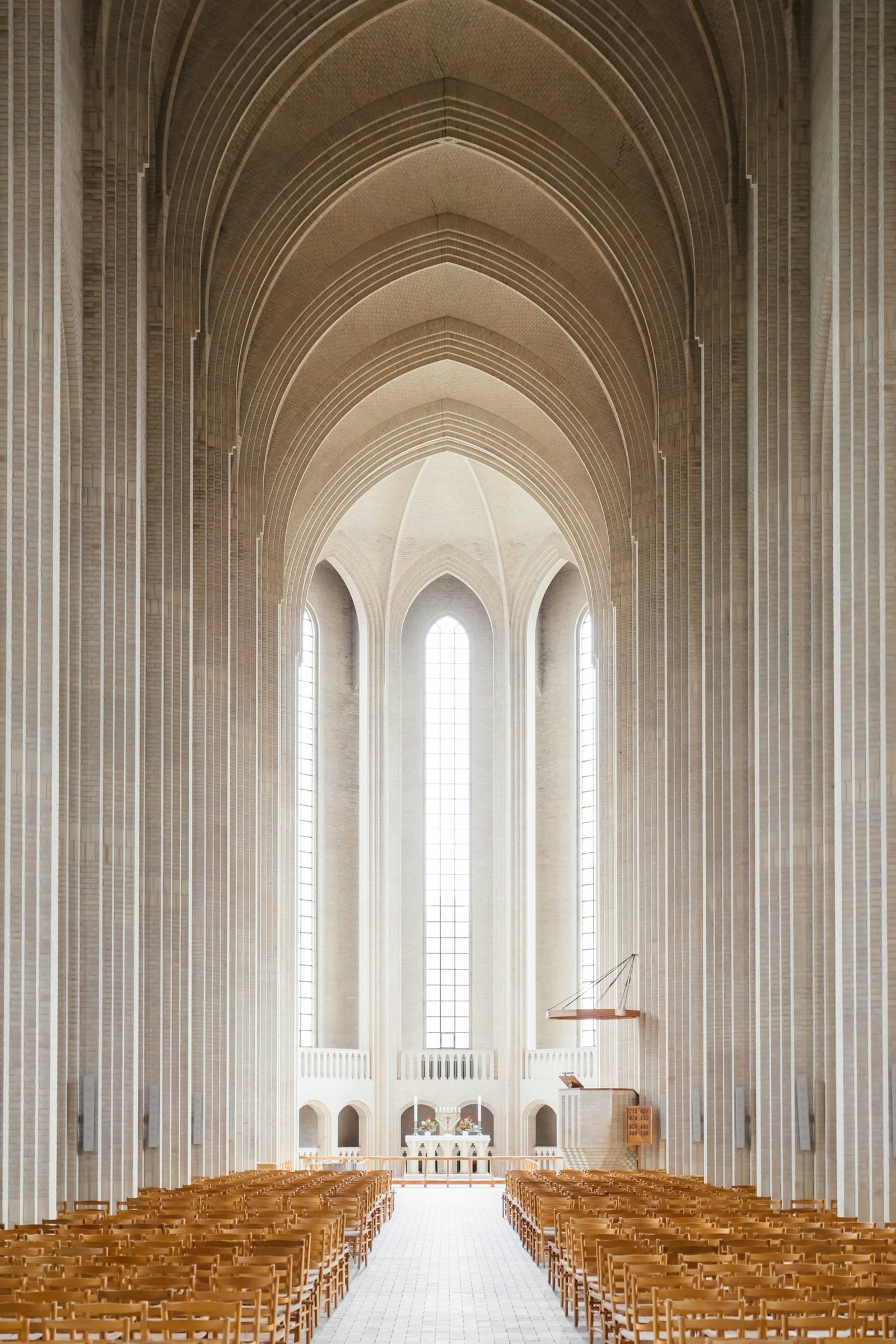
Empty cathedral interior showing pews, columns and vaulted ceiling · Photograph by John Towner. Unsplash Licence. unsplash.com
Christianity is the largest religion in the UK by a wide margin. Data from the 2009 Citizenship Survey found that 70% of respondents identified as Christian, 4% as Muslim, 2% as Hindu, 1% as Sikh, fewer than 0.5% each as Jewish or Buddhist, 2% as following another religion and 21% as having no religion. Mosques, temples, synagogues, gurdwaras and Buddhist centres are present across the country, and everyone in the UK has a legal right to practise the religion of their choice — or to practise none.
England has a constitutional link between Church and state. The Church of England is the established Church there — a Protestant body dating from the Reformation of the 1530s, and known as the Anglican Church elsewhere in the world (or the Episcopal Church in Scotland and the United States). The monarch serves as the Church's head, while its spiritual leader is the Archbishop of Canterbury; the Archbishop and other senior appointments are formally made by the monarch but nominated in practice by the Prime Minister with a Church-appointed committee. Several of the Church of England's bishops sit in the House of Lords.
Scotland's national Church is the Church of Scotland — a Presbyterian body governed by ministers and elders rather than bishops. Its General Assembly is chaired by the Moderator, a one-year post whose holder frequently acts as the public voice of the Scottish Church.
Neither Wales nor Northern Ireland has an established Church. Beyond Anglicanism and Presbyterianism, the UK contains many other Protestant traditions — notably Baptists, Methodists, Presbyterians and Quakers — along with the Roman Catholic Church, which is the largest Christian denomination outside the established Protestant churches.
Key Facts
- •In the 2009 Citizenship Survey, 70% of people in the UK identified themselves as Christian; 21% said they had no religion
- •Other religious groups include Muslim (4%), Hindu (2%), Sikh (1%), Jewish and Buddhist (both less than 0.5%)
- •Everyone in the UK has the legal right to choose their religion or to choose not to practise a religion
- •The Church of England (Anglican Church) is the official Church of the state in England; it is a Protestant Church that has existed since the Reformation in the 1530s
- •The monarch is the head of the Church of England
- •The spiritual leader of the Church of England is the Archbishop of Canterbury
- •Several Church of England bishops sit in the House of Lords
- •In Scotland, the national Church is the Church of Scotland, which is a Presbyterian Church governed by ministers and elders
- •The chairperson of the General Assembly of the Church of Scotland is the Moderator, appointed for one year only
- •There is no established Church in Wales or Northern Ireland
- •Other Protestant groups in the UK include Baptists, Methodists, Presbyterians and Quakers
- •The biggest non-Protestant denomination of Christianity in the UK is Roman Catholic
Key Dates
Patron Saints' Days
Each of the four UK nations has its own patron saint, and each saint's feast day is marked on a fixed date: St David's Day on 1 March for Wales, St Patrick's Day on 17 March for Northern Ireland, St George's Day on 23 April for England, and St Andrew's Day on 30 November for Scotland.
Only two of these — St Patrick's Day in Northern Ireland and St Andrew's Day in Scotland — are official public holidays, and in Scotland not every business actually closes. Celebrations take place wherever communities of Scottish, Northern Irish or Irish heritage are concentrated.
In England and Wales, St George's Day and St David's Day are not public holidays, but local parades and small festivals continue to mark them each year.
What is the Union Jack made of?
Why isn't Wales in the Union Jack? Wales was already united with England when the Union Flag was first created in 1606 (combining England and Scotland). Wales is represented by the red dragon flag (Y Ddraig Goch).
Key Facts
- •1 March is St David's Day — the patron saint's day of Wales
- •17 March is St Patrick's Day — the patron saint's day of Northern Ireland
- •23 April is St George's Day — the patron saint's day of England
- •30 November is St Andrew's Day — the patron saint's day of Scotland
- •Only Scotland and Northern Ireland have their patron saint's day as an official public holiday
- •Patron saints' days are no longer public holidays in England and Wales, but parades and small festivals are still held
- •Events are held especially where there are large numbers of people of Scottish, Northern Irish and Irish heritage
Chapter Summary
All key facts from this chapter at a glance — read this to revise the full chapter quickly.
Chapter Summary
Quick revision- ✓In the 2009 Citizenship Survey, 70% of people in the UK identified themselves as Christian; 21% said they had no religion
- ✓Other religious groups in the UK: Muslim (4%), Hindu (2%), Sikh (1%), Jewish and Buddhist (both less than 0.5%)
- ✓There are Islamic mosques, Hindu temples, Jewish synagogues, Sikh gurdwaras and Buddhist temples all over the UK
- ✓Everyone in the UK has the legal right to choose their religion or to choose not to practise a religion
- ✓The Church of England (Anglican Church) is the official Church of the state in England; it is a Protestant Church that has existed since the Reformation in the 1530s
- ✓The monarch is the head of the Church of England
- ✓The spiritual leader of the Church of England is the Archbishop of Canterbury
- ✓Several Church of England bishops sit in the House of Lords
- ✓In Scotland, the national Church is the Church of Scotland — a Presbyterian Church governed by ministers and elders
- ✓The chairperson of the General Assembly of the Church of Scotland is the Moderator, appointed for one year only
- ✓There is no established Church in Wales or Northern Ireland
- ✓Other Protestant Christian groups in the UK include Baptists, Methodists, Presbyterians and Quakers
- ✓The biggest non-Protestant denomination of Christianity in the UK is Roman Catholic
- ✓1 March — St David's Day: patron saint's day of Wales
- ✓17 March — St Patrick's Day: patron saint's day of Northern Ireland
- ✓23 April — St George's Day: patron saint's day of England
- ✓30 November — St Andrew's Day: patron saint's day of Scotland
- ✓Only Scotland and Northern Ireland have their patron saint's day as an official public holiday
- ✓Patron saints' days are no longer public holidays in England and Wales, but parades and small festivals are still held
Test Yourself on This Chapter
Ready to practice? Take a focused test on this topic.