The Middle Ages
10 min read·Last updated: April 2026
In this chapter
War at Home and Abroad (Middle Ages)
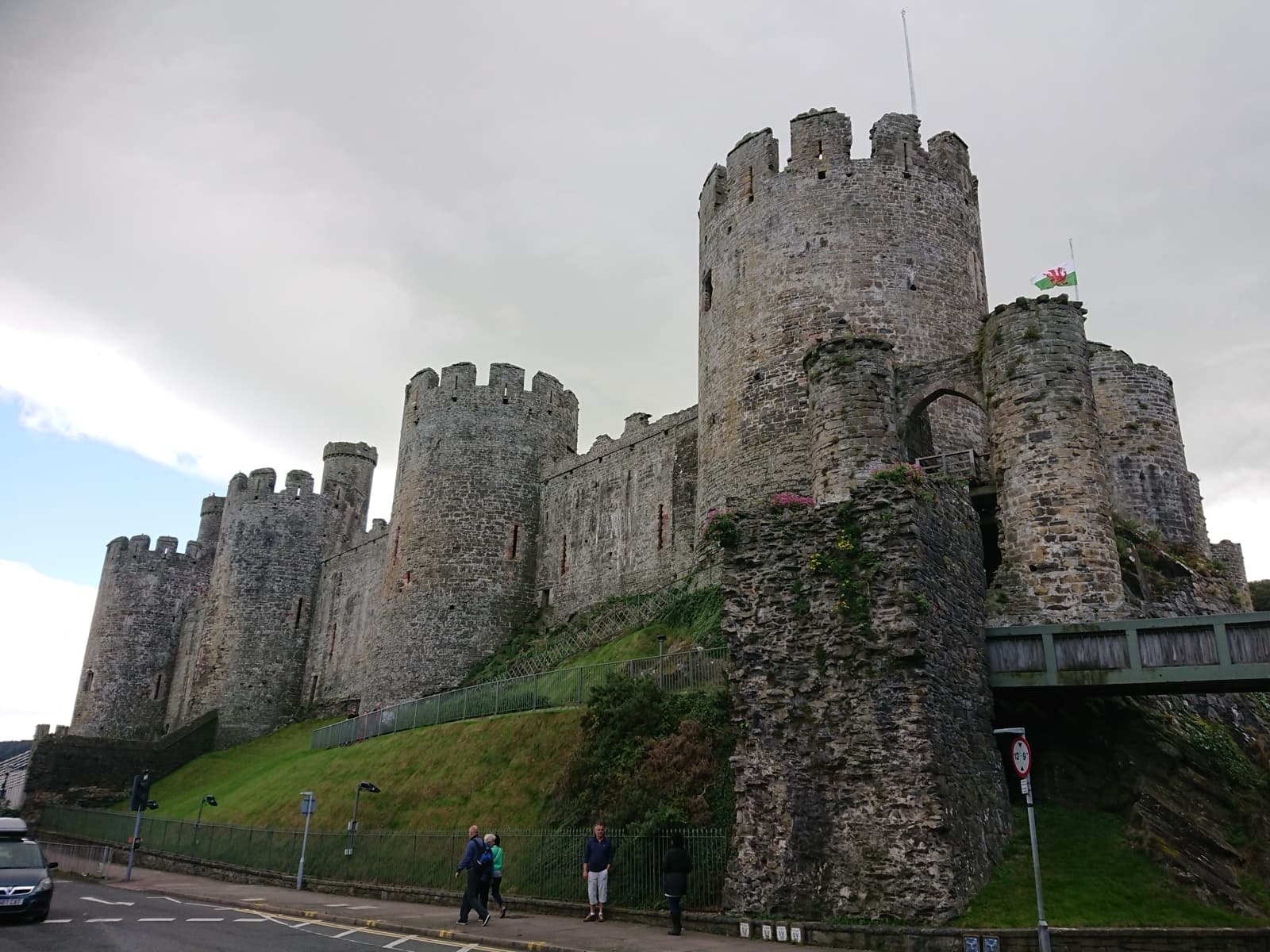
Conwy Castle, North Wales, built by Edward I 1283–1289 · Leestuartsherriff, 2019. CC-BY-SA-4.0. Wikimedia Commons.
The stretch of British history running from the Norman Conquest to roughly 1485 is conventionally called the Middle Ages, or the medieval period. Very little of it was peaceful — war, whether between the English crown and its Celtic neighbours or between England and France, was a near-constant feature of the era.
Within the British Isles, the English kings pressed Welsh, Scottish and Irish rulers for control of territory. In Wales the pressure succeeded: in 1284 Edward I of England issued the Statute of Rhuddlan, which folded Wales into the English crown. A chain of enormous royal castles — Conwy and Caernarvon among the largest — was thrown up to enforce the new rule, and the last Welsh rebellions had been suppressed by the middle of the 15th century. English law and the English language followed the soldiers into Welsh public life.
Scotland proved a harder adversary. In 1314 the Scottish army under Robert the Bruce defeated an English force at the Battle of Bannockburn, and from that defeat onwards Scotland remained outside English rule for the rest of the medieval period.
Ireland entered the Middle Ages as an independent kingdom. The first English presence there arrived as hired troops in support of an Irish king, and many of them stayed on to build settlements of their own. By 1200, an English-controlled district around Dublin known as the Pale had taken shape, and some of the greater lords elsewhere in Ireland formally acknowledged the authority of the English crown.
Abroad, the medieval English kings were also drawn into distant wars. Many English knights took their swords to the Crusades — the long-running attempts by European Christian armies to take control of the Holy Land. The longest foreign commitment was the Hundred Years War against France — a struggle that, despite its name, actually ran for 116 years. Its most celebrated single moment came at the Battle of Agincourt in 1415, when Henry V's heavily outnumbered English army inflicted a famous defeat on the French. English forces finally withdrew from France in the 1450s.
Key Facts
- •The Middle Ages covers the period from the Norman Conquest up until about 1485
- •In 1284 King Edward I introduced the Statute of Rhuddlan, annexing Wales to the Crown of England
- •Huge castles including Conwy and Caernarvon were built to maintain English power in Wales
- •In 1314 the Scottish, led by Robert the Bruce, defeated the English at the Battle of Bannockburn
- •By 1200 the English ruled an area of Ireland known as the Pale, around Dublin
- •Many knights took part in the Crusades for control of the Holy Land
- •The Hundred Years War with France actually lasted 116 years
- •At the Battle of Agincourt in 1415, Henry V's vastly outnumbered English army defeated the French
- •The English left France in the 1450s
Key Dates
The Black Death
The Normans imposed their own system of land tenure on England — feudalism. Under feudal arrangements the king granted land to his senior lords in exchange for military service; the lords in turn were required to raise set numbers of soldiers for the king's armies when called upon. Beneath the noble class lived the working population: a small number of peasants held their own land independently, but most were serfs. A serf was given the use of a small plot of the lord's land to grow food on, and in return was obliged to work the rest of the lord's estate and was forbidden to leave. The same pattern of feudal tenure developed in southern Scotland. Further north, and in Ireland, land was held instead by extended kinship groups — the 'clans' of prominent families.
In 1348 an outbreak of disease, thought to have been a form of bubonic plague, reached Britain. Contemporaries named it the Black Death. Around one in three people in England died in the epidemic, and the death toll was proportionally similar across Scotland and Wales, making the outbreak one of the worst single disasters the country has ever suffered. The demographic collapse that followed had profound economic consequences. With a smaller population to feed, there was less need to grow cereal crops; labour was suddenly scarce, and surviving peasants could bargain for higher wages than before. New social classes rose on the back of that dislocation — most notably the owners of large consolidated estates who came to be known as the gentry — and many country people migrated into the towns in search of work, where the new urban wealth fed the emergence of a solid middle class.
In Ireland the Black Death struck the Pale particularly hard, and for some years afterwards the English-controlled zone contracted.
Key Facts
- •The Normans used a system of land ownership known as feudalism
- •The king gave land to his lords in return for help in war
- •Most peasants were serfs — they worked their lord's land and could not move away
- •In the north of Scotland and Ireland, land was owned by 'clans' (prominent families)
- •In 1348 the Black Death (probably a form of plague) came to Britain
- •One third of the population of England died and a similar proportion in Scotland and Wales
- •Labour shortages after the Black Death allowed peasants to demand higher wages
- •New social classes appeared, including owners of large areas of land (later called the gentry)
- •In the towns, growing wealth led to the development of a strong middle class
Key Dates
Legal and Political Changes
Parliament traces its institutional roots to the Middle Ages. Its earliest form was the king's council of senior advisers — the great noblemen and the leaders of the Church whom the king gathered to hear counsel on major decisions.
Before 1215 there were almost no formal checks on royal power. In that year King John was forced by his barons to agree to a set of written demands, and the resulting document, Magna Carta — which translates as the 'Great Charter' — became a foundational constitutional text. It asserted, for the first time in English practice, that the king himself was answerable to the law; it protected the rights of the nobility; and it placed explicit limits on the king's ability to raise taxes or to make or change laws on his own authority. From Magna Carta on, the king had to consult his noblemen on major matters of state.
The king's practice of summoning his nobles to hear and consent to major decisions — especially when he needed to raise money — gradually formalised into a parliament. Numbers grew and Parliament divided into two separate chambers, or Houses. The nobility, the larger landowners and the senior bishops sat in the House of Lords. Knights (usually the smaller landowners) and the wealthy townsmen sat, by election, in the House of Commons. Only a small minority of the population had any part in choosing members of the Commons.
Scotland developed a parliament along parallel but distinct lines. The Scottish Parliament had three chambers — called Estates — for the lords, the commons and the clergy.
This was also a period of real development in the legal system. The principle that judges must sit independent of the government took its initial shape in this period. In England, judges built up a body of 'common law' through a process of precedent — following previous rulings — rather than through any written statute. Scotland took a different route: Scots law was 'codified' — formally set down in writing.
Key Facts
- •Parliament's origins can be traced to the king's council of advisers (noblemen and Church leaders)
- •In 1215 King John was forced to agree to Magna Carta (the 'Great Charter')
- •Magna Carta established that even the king was subject to the law
- •Magna Carta restricted the king's power to collect taxes or make or change laws
- •Two Houses of Parliament were established: House of Lords (nobility, landowners, bishops) and House of Commons (knights, wealthy townspeople)
- •The Scottish Parliament had three Houses (Estates): the lords, the commons and the clergy
- •In England, judges developed 'common law' by precedence and tradition
- •In Scotland, laws were 'codified' (written down)
Key Dates
A Distinct Identity
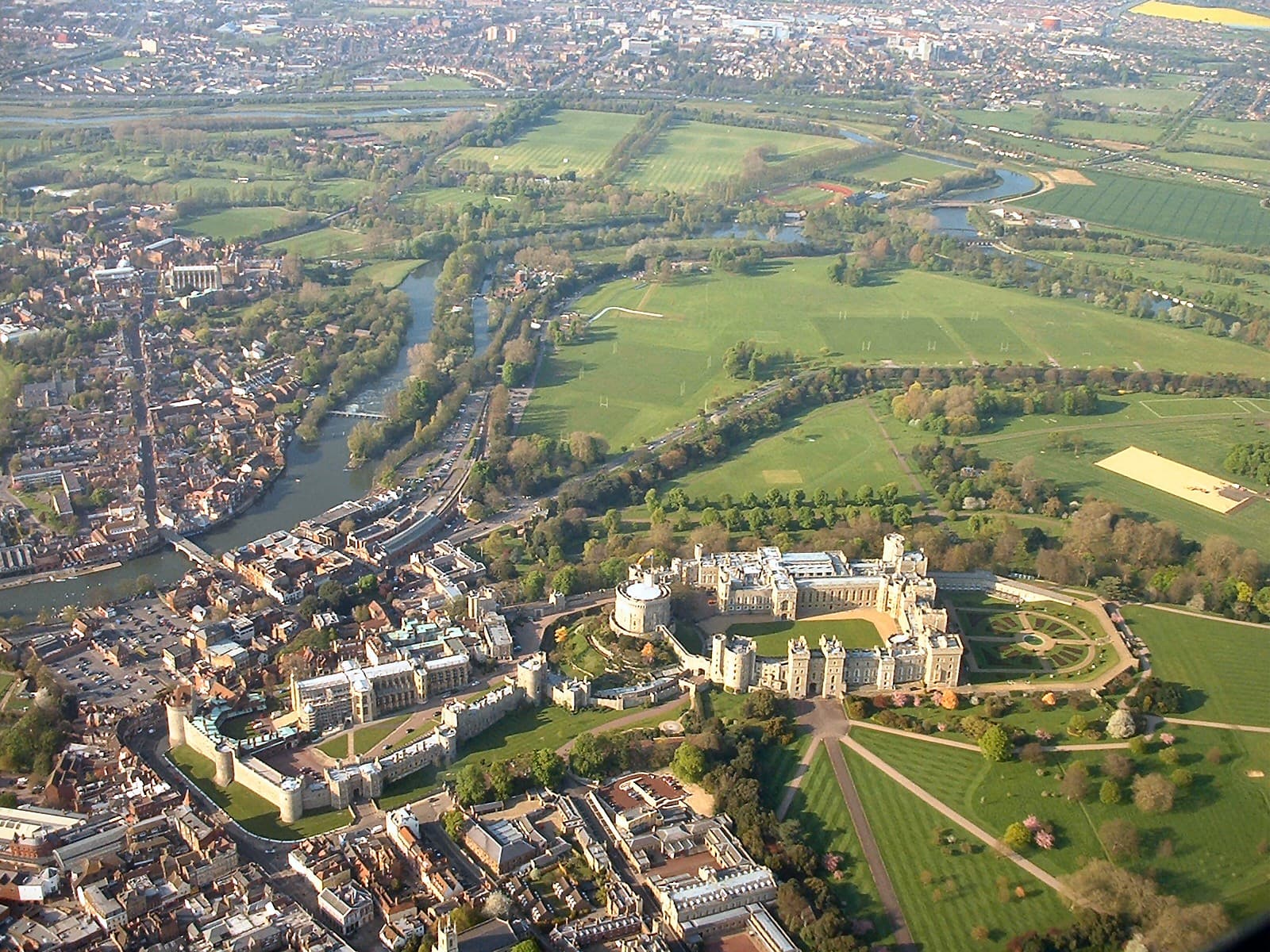
Aerial view of Windsor Castle · AndyScott, 2005. CC-BY-SA-4.0. Wikimedia Commons.
The Middle Ages were also the period in which a distinctly British national culture and identity began to take shape. After the Norman Conquest, the language of the new ruling class — Norman French — sat uneasily alongside the Anglo-Saxon English of the peasantry. Over several generations the two languages fused into a single successor tongue, modern English. Some words in English today — 'park' and 'beauty', for instance — are traceable to Norman French roots; others — 'apple', 'cow' and 'summer' are typical — come from the Anglo-Saxon side of that inheritance. In many cases modern English preserves near-synonyms drawn from both origins, with 'demand' (from the French) standing alongside 'ask' (from the Anglo-Saxon) as a typical pair. By 1400, official documents in England were being drafted in English, and English had displaced the older tongues as the preferred language of the royal court and of Parliament itself.
Shortly before that date, in the closing decades of the 14th century, Geoffrey Chaucer wrote a long sequence of poems in English about a company of travellers bound for Canterbury on a pilgrimage. The pilgrims had agreed to tell each other stories along the way, and Chaucer's poems describe the pilgrims and some of the tales they shared. The collection — known as The Canterbury Tales — became one of the first books ever printed in England, by William Caxton, who set up the country's first printing press. Many of the stories remain widely read today, and several have been adapted for stage and television.
In Scotland, Gaelic continued as the spoken language of many communities, and the distinct Scots language developed in parallel. Scots writers began to produce poetry in the language; John Barbour's long poem The Bruce, which narrates the Battle of Bannockburn, is a leading early example.
The architecture of Britain and Ireland changed in this period as well. Castles were raised across the landscape, partly for defence but also as statements of royal power; many stand as ruins today, though a number — Windsor Castle and Edinburgh Castle among them — remain in continuous use. The age also saw the construction of great cathedrals — Lincoln Cathedral among them — and a great many of these are still used for worship. Several of the cathedrals were fitted with stained-glass windows illustrating stories from the Bible or from the lives of Christian saints; the glass at York Minster is perhaps the most celebrated surviving example.
England was also, through this period, an important trading nation, and English wool was the most valuable of its exports. Foreign specialists came to settle here as well: weavers from France, engineers from Germany, glass manufacturers from Italy and canal builders from Holland all made their mark on the country's economic life.
Key Facts
- •After the Norman Conquest, the king and nobles spoke Norman French; peasants continued to speak Anglo-Saxon
- •Modern English words like 'park' and 'beauty' are based on Norman French; 'apple', 'cow' and 'summer' are based on Anglo-Saxon
- •'Demand' (French) and 'ask' (Anglo-Saxon) are examples of similar-meaning word pairs
- •By 1400 official documents in England were written in English and English had become the preferred language of the royal court and Parliament
- •Geoffrey Chaucer wrote The Canterbury Tales — poems in English about pilgrims to Canterbury
- •The Canterbury Tales was one of the first books printed by William Caxton — the first person in England to print books using a printing press
- •In Scotland many people continued to speak Gaelic and the Scots language developed
- •John Barbour wrote The Bruce in the Scots language about the Battle of Bannockburn
- •Castles such as Windsor and Edinburgh are still in use today
- •Great cathedrals such as Lincoln Cathedral were built and are still used for worship
- •The stained glass in York Minster is a famous example
- •English wool became a very important export
- •Specialist workers came from abroad: weavers from France, engineers from Germany, glass manufacturers from Italy, canal builders from Holland
The Wars of the Roses
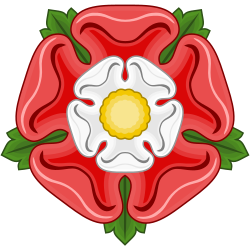
The Tudor rose — a white rose of York inside a red rose of Lancaster · Sodacan, 2011, Tudor Rose heraldic badge. CC-BY-SA-3.0. Wikimedia Commons.
In 1455 a civil war broke out in England over which family's claim to the throne should prevail. The two sides were the supporters of the House of Lancaster and the supporters of the House of York. The conflict has gone down in history as the Wars of the Roses, because the emblem of Lancaster was a red rose and that of York a white rose. The war ended at the Battle of Bosworth Field in 1485. King Richard III, the Yorkist monarch at the time, was killed on the battlefield, and Henry Tudor — the Lancastrian leader — took the throne as Henry VII. Henry then married Richard's niece, Elizabeth of York, which joined the two warring families together. Henry was the founding king of the House of Tudor, and the heraldic badge the new dynasty chose — a red rose with a white rose nested inside it — stood as a symbol of the reconciliation of York and Lancaster.
Key Facts
- •In 1455 a civil war began to decide who should be king of England
- •It was fought between the House of Lancaster and the House of York
- •The symbol of Lancaster was a red rose; the symbol of York was a white rose
- •The war ended with the Battle of Bosworth Field in 1485
- •King Richard III of the House of York was killed in the battle
- •Henry Tudor, leader of the House of Lancaster, became King Henry VII
- •Henry married Richard III's niece, Elizabeth of York, uniting the two families
- •Henry was the first king of the House of Tudor
- •The Tudor symbol was a red rose with a white rose inside it
Key Dates
Chapter Summary
All key facts from this chapter at a glance — read this to revise the full chapter quickly.
Chapter Summary
Quick revision- ✓The Middle Ages covers the period from the Norman Conquest (1066) up until about 1485
- ✓1284 — King Edward I introduced the Statute of Rhuddlan, annexing Wales to the Crown of England
- ✓Huge castles including Conwy and Caernarvon were built to maintain English power in Wales
- ✓By the middle of the 15th century the last Welsh rebellions had been defeated; English laws and language were introduced
- ✓1314 — the Scottish, led by Robert the Bruce, defeated the English at the Battle of Bannockburn; Scotland remained unconquered
- ✓By 1200 the English ruled an area of Ireland known as the Pale, around Dublin
- ✓Many knights took part in the Crusades — European Christians fighting for control of the Holy Land
- ✓The Hundred Years War with France actually lasted 116 years
- ✓1415 — at the Battle of Agincourt, Henry V's vastly outnumbered English army defeated the French
- ✓The English left France in the 1450s
- ✓The Normans used a system of land ownership known as feudalism: the king gave land to lords in return for help in war
- ✓Most peasants were serfs — they worked their lord's land and could not move away
- ✓In the north of Scotland and Ireland, land was owned by 'clans' (prominent families)
- ✓1348 — the Black Death (probably a form of plague) came to Britain; one third of the population of England died and a similar proportion in Scotland and Wales
- ✓Labour shortages after the Black Death allowed peasants to demand higher wages
- ✓New social classes appeared, including owners of large areas of land (later called the gentry)
- ✓In the towns, growing wealth led to the development of a strong middle class
- ✓Parliament's origins can be traced to the king's council of advisers (noblemen and Church leaders)
- ✓1215 — King John was forced to agree to Magna Carta ('the Great Charter')
- ✓Magna Carta established that even the king was subject to the law
- ✓Magna Carta restricted the king's power to collect taxes or make or change laws
- ✓Two Houses of Parliament were established: the House of Lords (nobility, landowners, bishops) and the House of Commons (knights, wealthy townspeople)
- ✓The Scottish Parliament had three Houses called Estates: the lords, the commons and the clergy
- ✓In England, judges developed 'common law' by precedence and tradition; in Scotland, laws were 'codified' (written down)
- ✓After the Norman Conquest, Norman French and Anglo-Saxon combined over time into one English language
- ✓Modern English words like 'park' and 'beauty' are based on Norman French; 'apple', 'cow' and 'summer' are based on Anglo-Saxon
- ✓'Demand' (French) and 'ask' (Anglo-Saxon) are examples of similar-meaning word pairs from the two languages
- ✓By 1400 official documents in England were written in English and English had become the preferred language of the royal court and Parliament
- ✓Geoffrey Chaucer wrote The Canterbury Tales — poems in English about pilgrims telling stories on a journey to Canterbury
- ✓The Canterbury Tales was one of the first books printed by William Caxton — the first person in England to print books using a printing press
- ✓In Scotland, many people continued to speak Gaelic and the Scots language developed; John Barbour wrote The Bruce in the Scots language
- ✓Castles such as Windsor and Edinburgh are still in use today; great cathedrals such as Lincoln Cathedral are still used for worship
- ✓The stained glass windows in York Minster are a famous example of medieval craftsmanship
- ✓English wool became a very important export in the Middle Ages
- ✓Specialist workers came from abroad: weavers from France, engineers from Germany, glass manufacturers from Italy, canal builders from Holland
- ✓1455 — the Wars of the Roses began: a civil war between the House of Lancaster (red rose) and the House of York (white rose)
- ✓1485 — the Battle of Bosworth Field ended the Wars of the Roses; King Richard III of York was killed
- ✓Henry Tudor (Lancaster) became King Henry VII — the first king of the House of Tudor
- ✓Henry VII married Richard III's niece, Elizabeth of York, uniting the two families
- ✓The Tudor symbol was a red rose with a white rose inside it, signifying the union of York and Lancaster
Test Yourself on This Chapter
Ready to practice? Take a focused test on this topic.