Leisure and Places of Interest
15 min read·Last updated: April 2026
In this chapter
Gardening
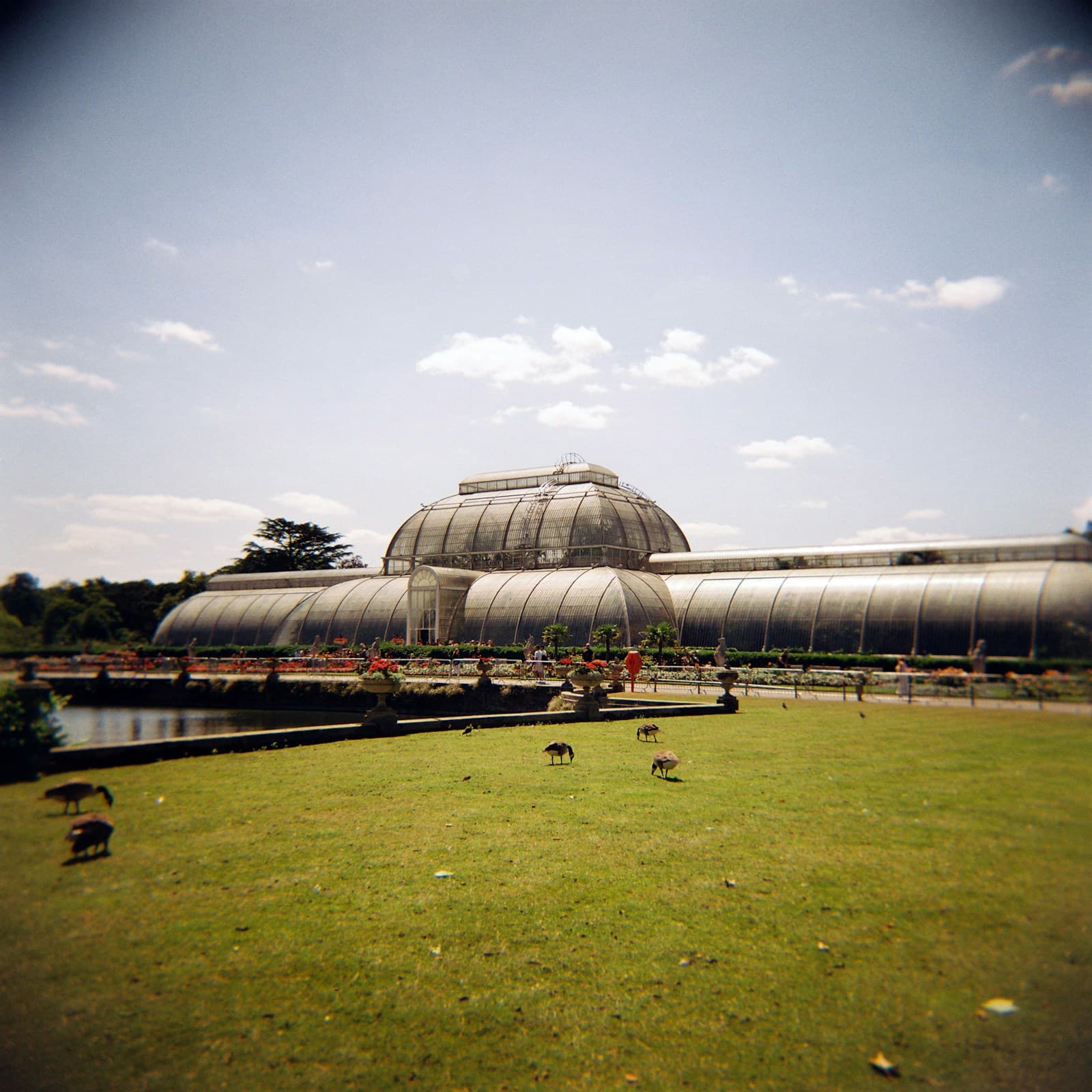
Kew Gardens — the Royal Botanic Gardens in London, one of the UK's most famous gardens · Photograph by Nick Page. Unsplash Licence. unsplash.com
Many households in the UK have a garden of their own and spend spare hours tending to it. Where a home garden is small or absent, an additional patch of public or council-owned land — traditionally called an 'allotment' — can be rented for growing fruit and vegetables. Flower and gardening shows punctuate the calendar at every scale, from major national exhibitions down to small village fairs, and most towns of any size support at least one garden centre selling plants and equipment.
The UK is also home to a number of famous formal gardens open to visitors. In England these include Kew Gardens, Sissinghurst and Hidcote; in Scotland, Crathes Castle and Inveraray Castle; in Wales, Bodnant Garden; and in Northern Ireland, Mount Stewart.
Each of the four nations has a national flower that is worn on the corresponding patron saint's day. The emblems are: the Rose for England, the Thistle for Scotland, the Daffodil for Wales, and the Shamrock for Northern Ireland.
Key Facts
- •Some people rent additional land called 'an allotment' to grow fruit and vegetables
- •Famous gardens to visit in the UK include Kew Gardens, Sissinghurst and Hidcote in England; Crathes Castle and Inveraray Castle in Scotland; Bodnant Garden in Wales; and Mount Stewart in Northern Ireland
- •England's national flower is the Rose
- •Scotland's national flower is the Thistle
- •Wales's national flower is the Daffodil
- •Northern Ireland's national flower is the Shamrock
Shopping
Shopping in the UK takes a few distinct forms. Nearly every town and city has a central retail district — usually called the town centre — where the majority of independent shops and larger chain stores are concentrated. Undercover shopping centres, found either in town centres or at edge-of-town sites, offer a weather-proof alternative. Most British shops trade every day of the week, although Sunday opening hours and the hours on public holidays are in general shorter than weekday hours. Street or covered markets still operate in many towns on one or more days a week, where stallholders offer a mix of fresh produce, clothing and general goods.
Key Facts
- •Most shops in the UK are open seven days a week, though trading hours on Sundays and public holidays are generally reduced
- •Many towns have markets on one or more days a week where stallholders sell a variety of goods
Cooking and Food
Cooking at home is a popular activity in the UK, and inviting friends round for dinner is a common form of hospitality. The variety of food eaten in Britain today is broad — a reflection of both long trading links and the cultural diversity of the modern population.
A handful of dishes are strongly associated with specific parts of the UK. In England the classic Sunday roast centres on roast beef, potatoes, vegetables, Yorkshire puddings and accompanying sauces — and fish and chips, deep-fried, is a long-running popular staple. Welsh cakes — small griddled cakes made from flour, dried fruits and spices — are eaten hot or cold and are the best-known traditional snack of Wales. In Scotland, haggis is the classic traditional dish: a sheep's stomach stuffed with offal, suet, onions and oatmeal. Northern Ireland's fried 'Ulster fry' brings bacon, eggs, sausage, black pudding, white pudding, tomatoes, mushrooms, soda bread and potato bread onto a single plate.
Key Facts
- •Traditional food of England includes roast beef with potatoes, vegetables and Yorkshire puddings; fish and chips are also popular
- •Traditional food of Wales includes Welsh cakes — made from flour, dried fruits and spices, served hot or cold
- •Traditional food of Scotland includes haggis — a sheep's stomach stuffed with offal, suet, onions and oatmeal
- •Traditional food of Northern Ireland includes Ulster fry — a fried meal with bacon, eggs, sausage, black pudding, white pudding, tomatoes, mushrooms, soda bread and potato bread
Films
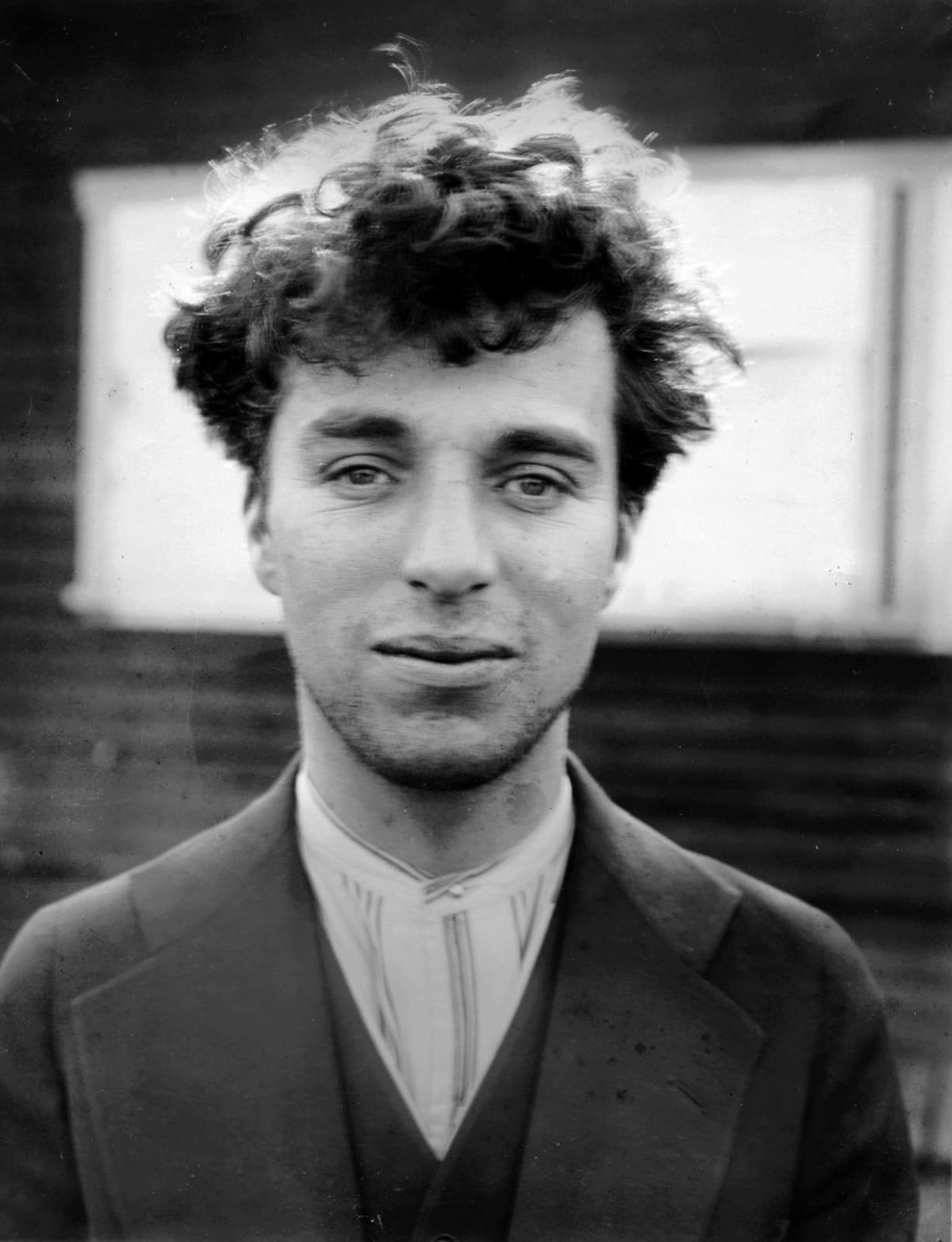
Portrait photograph of Charlie Chaplin, c.1916 · Unknown photographer, c.1916 (National Media Museum / Daily Herald Archive). Public domain (PD-US, pre-1931 publication). Wikimedia Commons.
British cinema has had a serious influence on the form of the medium internationally. The first public film screenings in the UK took place in 1896, and screenings caught on rapidly with audiences. British film-makers have been recognised from the early decades for inventive work in visual effects, and special-effects craft has remained an area of UK strength. British actors, too, have worked across the Atlantic almost since the industry began.
Sir Charles (Charlie) Chaplin established himself as a silent-era star through his tramp character and was among the first British performers to build a Hollywood career. UK-based studios went through a strong expansion in the 1930s, and the eminent directors of that period included Sir Alexander Korda and Sir Alfred Hitchcock — Hitchcock eventually moved to Hollywood and kept directing at a high level until his death in 1980. During the Second World War, British cinema played a substantive part in boosting public morale. The post-war decades saw directors such as Sir David Lean and Ridley Scott achieve both domestic and international success.
Comedy had a particular high point in the 1950s and 1960s. Passport to Pimlico, The Ladykillers and, slightly later, the Carry On series are from this wave. Much of the film work currently produced in the UK is actually the product of foreign studios using British technical expertise, crews and locations. Some of the commercially most successful pictures ever made — including the world's two highest-grossing film franchises, Harry Potter and James Bond — have been produced here. Ealing Studios can reasonably claim to be the oldest continuously working film studio facility anywhere in the world. In animation and in practical visual effects, Britain remains especially strong: Nick Park has picked up four Oscars for his animated work, three of them for films featuring the Wallace and Gromit characters.
Star actors of the classic British cinema generation — Sir Laurence Olivier, David Niven, Sir Rex Harrison and Richard Burton among them — took leading roles in a wide range of successful films. More recent British Oscar winners include Colin Firth, Sir Anthony Hopkins, Dame Judi Dench, Kate Winslet and Tilda Swinton. The British counterpart to the Oscars is the annual British Academy Film Awards (the BAFTAs), hosted by the British Academy of Film and Television Arts.
Key Facts
- •Films were first shown publicly in the UK in 1896
- •Sir Charles (Charlie) Chaplin became famous in silent movies for his tramp character and made a career in Hollywood
- •British studios flourished in the 1930s; eminent directors included Sir Alexander Korda and Sir Alfred Hitchcock
- •Sir Alfred Hitchcock later left for Hollywood and remained an important film director until his death in 1980
- •British directors including Sir David Lean and Ridley Scott found great success both in the UK and internationally
- •The 1950s and 1960s were a high point for British comedies, including Passport to Pimlico, The Ladykillers and the Carry On films
- •The two highest-grossing film franchises (Harry Potter and James Bond) have been produced in the UK
- •Ealing Studios has a claim to being the oldest continuously working film studio facility in the world
- •Nick Park has won four Oscars for his animated films, including three for films featuring Wallace and Gromit
- •Recent British Oscar winners include Colin Firth, Sir Anthony Hopkins, Dame Judi Dench, Kate Winslet and Tilda Swinton
- •The BAFTA (British Academy Film Awards) are the British equivalent of the Oscars
- •Some Famous British Films: The 39 Steps (1935) — directed by Alfred Hitchcock
- •Brief Encounter (1945) — directed by David Lean
- •The Third Man (1949) — directed by Carol Reed
- •The Belles of St Trinian's (1954) — directed by Frank Launder
- •Lawrence of Arabia (1962) — directed by David Lean
- •Women in Love (1969) — directed by Ken Russell
- •Don't Look Now (1973) — directed by Nicolas Roeg
- •Chariots of Fire (1981) — directed by Hugh Hudson
- •The Killing Fields (1984) — directed by Roland Joffé
- •Four Weddings and a Funeral (1994) — directed by Mike Newell
- •Touching the Void (2003) — directed by Kevin MacDonald
Key Dates
British Comedy
A long-running tradition of comedy and satire — and a willingness to laugh at national foibles — runs through British cultural life. Medieval monarchs and great lords kept jesters whose professional remit was to crack jokes at the court's expense; later, Shakespeare built comic characters into his serious plays; and in the 18th century political cartoons skewering prominent politicians became a widely shared form of popular entertainment. Satirical magazines followed in the 19th century: the most famous of them, Punch, first appeared in the 1840s. Political cartoons remain a fixture of the press today, and magazines such as Private Eye carry the satirical tradition forward.
In the first half of the 20th century, comedians were a central component of the British music hall — a variety-theatre tradition that dominated popular entertainment until television eventually replaced it. A number of the leading music-hall performers of the 1940s and 1950s, Morecambe and Wise among them, made a successful transition to television. Television itself then developed a distinctive British comedy style. Situation comedies (sitcoms), typically built around family life or around relationships at work, have been a mainstay ever since. The political satire strand continued on the small screen with programmes such as That Was The Week That Was in the 1960s and Spitting Image through the 1980s and 1990s. The year 1969 saw the debut of Monty Python's Flying Circus, which introduced an unconventional, progressive style of comedy that has been broadly influential since. Stand-up comedy — a single comedian performing live to a paying audience — has had a fresh resurgence in recent years.
Key Facts
- •Comedy and satire are an important part of the UK character
- •The satirical magazine Punch was first published in the 1840s; today Private Eye continues the tradition
- •British music hall was a form of variety theatre featuring comedians; performers such as Morecambe and Wise became television stars
- •Situation comedies (sitcoms) about family life and workplace relationships remain popular on British television
- •That Was The Week That Was (1960s) and Spitting Image (1980s and 1990s) continued the tradition of political satire on TV
- •In 1969, Monty Python's Flying Circus introduced a new type of progressive comedy
- •Stand-up comedy, where a solo comedian talks to a live audience, has become popular again in recent years
Television and Radio
The UK television landscape takes in many different channels — some free to view, others behind a paid subscription. Popular output includes long-running soap operas such as Coronation Street and EastEnders. Some programmes are produced in Gaelic for Scottish audiences; Wales has a dedicated Welsh-language channel of its own; and Northern Ireland carries programmes in Irish Gaelic as well as English.
A television licence is legally required of everyone in the UK who has a TV set, a computer or any other device capable of being used to watch TV content. A single licence covers all such equipment in one household, with the exception of shared houses in which the residents each hold separate tenancy agreements. People aged over 75 can apply for a free licence, and blind viewers are entitled to a 50% concession. Watching television without a current licence risks a fine of up to £1,000.
The licence fee itself underwrites the British Broadcasting Corporation (BBC). The BBC is a British public-service broadcaster that supplies both television and radio output. It is the largest broadcaster in the world and is the only fully state-funded media organisation that is independent of direct government editorial control. Other UK television channels rely principally on advertising and subscription income.
Radio in the UK is similarly plural, with a large number of stations operating at either national or regional and city level. The BBC's radio stations are paid for out of the TV licence fee, while the remaining stations derive their income primarily from commercial advertising.
Key Facts
- •Everyone in the UK with a TV, computer or medium for watching TV must have a television licence
- •People over 75 can apply for a free TV licence; blind people can get a 50% discount
- •You will receive a fine of up to £1,000 if you watch TV without a TV licence
- •TV licence money is used to pay for the BBC (British Broadcasting Corporation)
- •The BBC is the largest broadcaster in the world and the only wholly state-funded media organisation independent of government
- •Popular soap operas include Coronation Street and EastEnders
- •Scotland has some Gaelic-language programmes; Wales has a Welsh-language channel; Northern Ireland has some Irish Gaelic programmes
Social Networking
Social networking platforms such as Facebook and Twitter are widely used in the UK as a way of keeping up with friends, co-ordinating social events, and sharing photos, video clips and personal opinions. Usage is heavily mobile-led — many people check and post on these services from a smartphone while out and about.
Key Facts
- •Social networking websites such as Facebook and Twitter are popular for staying in touch with friends, organising events and sharing photos, videos and opinions
Pubs and Night Clubs
Public houses — pubs — are a long-standing fixture of British social life. Meeting friends at the pub is one of the most common informal social activities, and most residential neighbourhoods have a 'local' pub that acts as a neighbourhood focal point. Quiz nights are widely run in pubs, and pool and darts are traditional in-house pub games.
Alcohol-purchase rules at pubs and nightclubs are tightly regulated. Only customers aged 18 or over may buy alcohol, though pubs may admit under-18s with an adult in some cases. From age 16 onwards, wine or beer may be consumed alongside a meal in a hotel, restaurant or designated pub eating area, provided an adult over 18 is present. Pubs typically open from 11.00 am on weekdays and from 12 noon on Sundays. Nightclubs with music and dancing open later than pubs and close correspondingly later.
Key Facts
- •Pubs are an important part of UK social culture; pub quizzes, pool and darts are popular pub activities
- •To buy alcohol in a pub or night club you must be 18 or over
- •People aged 16 can drink wine or beer with a meal in a restaurant or pub eating area as long as they are with someone over 18
- •Pubs are usually open from 11.00 am (12 noon on Sundays)
Betting and Gambling
Betting on sporting events and other outcomes is a familiar pastime in the UK, and casinos operate in many of the larger cities. Entry to a licensed betting shop or a gambling club requires a customer to be at least 18 years of age. The UK also runs a weekly National Lottery: participation is by purchase of a numbered ticket or an instant-win scratch card. The minimum age for participating in the National Lottery rose from 16 to 18 in April 2021; people below that threshold are not allowed to buy tickets or scratch cards.
Key Facts
- •You must be 18 to go into betting shops or gambling clubs
- •There is a National Lottery with weekly draws; you can enter by buying a ticket or scratch card
- •People under 18 are not allowed to participate in the National Lottery (minimum age rose from 16 to 18 from April 2021)
Pets
Pet-keeping is widespread in the UK, with cats and dogs the most common companion animals. Cruelty or neglect towards a pet is a criminal offence. Dogs in public spaces must wear a collar displaying the name and address of their owner, and owners are legally responsible both for keeping the dog under control and for cleaning up any mess the dog makes in public. Routine vaccinations and general veterinary treatment are provided by qualified veterinary surgeons — vets — and there are registered charities that help owners with the cost of veterinary care if they cannot afford the fees themselves.
Key Facts
- •It is against the law to treat a pet cruelly or to neglect it
- •All dogs in public places must wear a collar showing the owner's name and address
- •The dog owner is responsible for keeping the dog under control and cleaning up after the animal in public
UK Landmarks
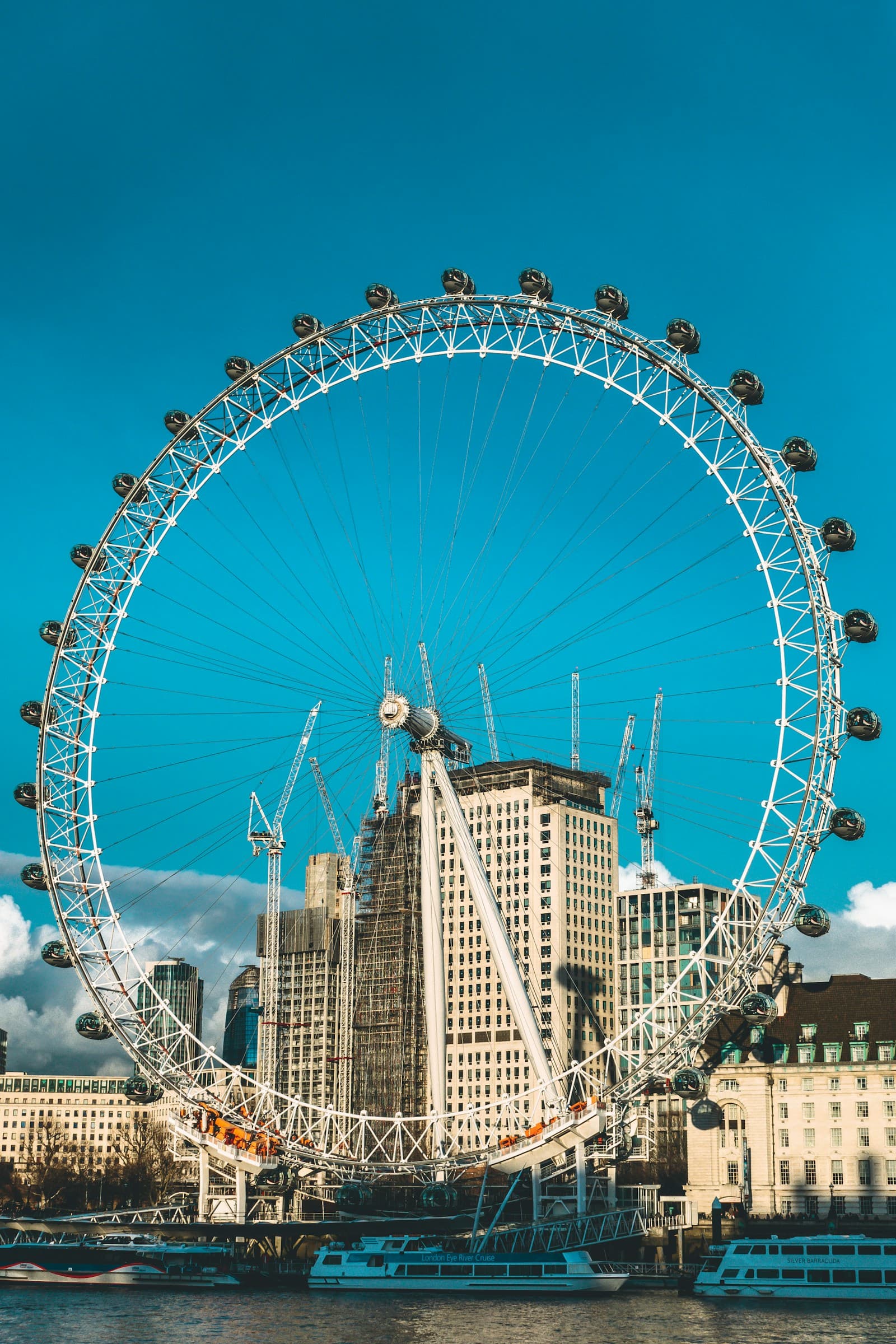
The London Eye Ferris wheel on the South Bank of the River Thames at night, used as part of New Year celebrations · Photograph by Xavier Coiffic. Unsplash Licence. unsplash.com
The UK is well-served by public footpaths across the countryside, and the uplands in particular support a strong mountain-biking, mountaineering and hill-walking culture. England, Wales and Scotland between them contain 15 national parks — protected landscapes in which people continue to live and work while the countryside itself is preserved for public visits.
Museums of every scale — from small community collections up to major national institutions — are a feature of towns and cities across the country. Many of the most visited countryside locations, together with historic buildings of national importance, are kept open to the public by the National Trust (covering England, Wales and Northern Ireland) and by the separately constituted National Trust for Scotland. Both are registered charities whose mission is the preservation of significant buildings, stretches of coastline and open country. The National Trust was founded by three volunteers in 1895, and the organisation now counts more than 61,000 active volunteers among its supporters.
Of the many landmark buildings and sites in the UK, the following commonly feature in study material. 'Big Ben' is the popular name for the great bell of the clock at the Houses of Parliament in Westminster; the clock itself is well over 150 years old and the clock tower that houses it was renamed 'Elizabeth Tower' in 2012 to mark Queen Elizabeth II's Diamond Jubilee.
The Eden Project, in Cornwall in the south-west of England, is an environmental attraction whose signature biomes function as vast climate-controlled greenhouses containing plants drawn from every part of the world. The Eden Project also operates as a charity running environmental and social-development projects internationally.
Edinburgh Castle is the dominant feature of the Edinburgh skyline, in Scotland, with a continuous history stretching back to the early Middle Ages. It is maintained and operated today by Historic Scotland.
On the north-east coast of Northern Ireland is the Giant's Causeway — a geological formation of tightly packed columns of volcanic lava that was produced some 50 million years ago.
Loch Lomond and the Trossachs National Park extends across 720 square miles of western Scotland. Within it, Loch Lomond is the single largest body of fresh water anywhere on the British mainland.
On the south bank of the River Thames, the London Eye is a giant Ferris wheel 443 feet (135 metres) high. It was put up originally as part of the UK's millennium celebrations at the turn of the century and has since become an ongoing feature of the London New Year firework display.
In north Wales, Snowdonia forms a national park covering 838 square miles; the park's best-known feature is Snowdon itself, the highest peak in Wales.
The Tower of London began life as a royal fortress put up by William the Conqueror after his accession in 1066. Guided tours are led by the Yeoman Warders — known colloquially as Beefeaters — and the Crown Jewels are on permanent public display there.
Key Facts
- •There are 15 national parks in England, Wales and Scotland
- •The National Trust was founded in 1895 by three volunteers and now has more than 61,000 volunteers; it preserves important buildings, coastline and countryside in England, Wales and Northern Ireland
- •Big Ben is the nickname for the great bell of the clock at the Houses of Parliament in London; the clock tower is named 'Elizabeth Tower' after Queen Elizabeth II's Diamond Jubilee in 2012
- •The Eden Project in Cornwall has biomes (giant greenhouses) housing plants from all over the world and is also a charity running environmental projects internationally
- •Edinburgh Castle has a long history dating back to the early Middle Ages and is looked after by Historic Scotland
- •The Giant's Causeway on the north-east coast of Northern Ireland is a formation of volcanic lava columns formed about 50 million years ago
- •Loch Lomond and the Trossachs National Park covers 720 square miles in the west of Scotland; Loch Lomond is the largest expanse of fresh water in mainland Britain
- •The London Eye on the southern bank of the River Thames is a Ferris wheel 443 feet (135 metres) tall, originally built for the UK's millennium celebrations
- •Snowdonia is a national park in North Wales covering 838 square miles; Snowdon is the highest mountain in Wales
- •The Tower of London was first built by William the Conqueror after he became king in 1066; guided by Yeoman Warders (Beefeaters); the Crown Jewels are kept there
Key Dates
National Parks and Countryside
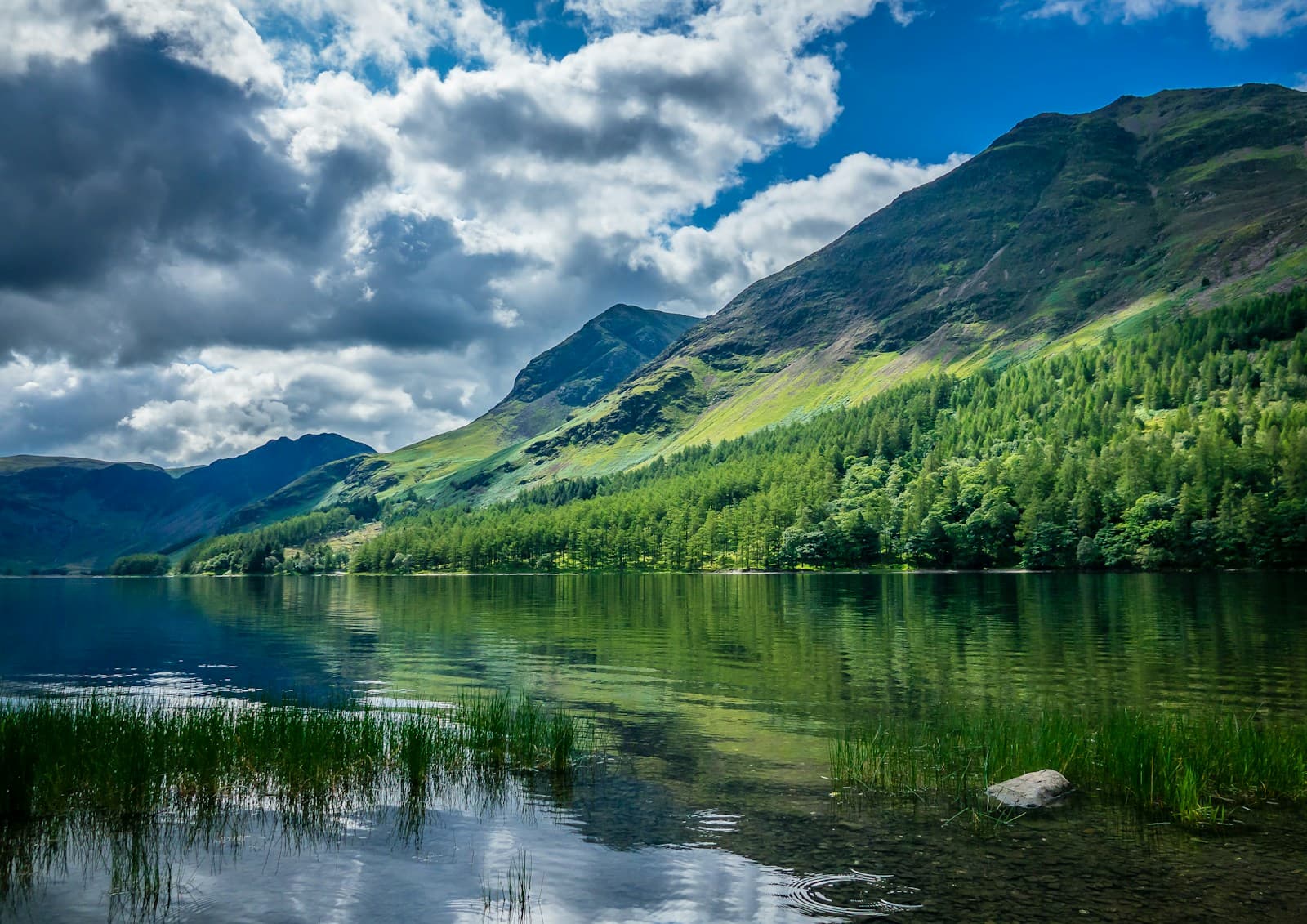
Scenic lake and mountain landscape typical of the Lake District national park in England · Photograph by James Armes. Unsplash Licence. unsplash.com
The largest of the English national parks is the Lake District, which extends across 885 square miles (2,292 square kilometres) in the north-west of the country. It is known for its string of long glacial lakes set among steep uplands, and it draws climbers, walkers and sailors in large numbers each year. Windermere, set in the southern part of the park, is the single biggest lake. In 2007 a public television vote in the UK named Wastwater — a remote Cumbrian lake in the same park — as Britain's favourite view.
The British countryside remains a sizeable part of the national territory, and many people head out of the towns at weekends and on holidays for walking, camping, fishing and similar leisure activities. The mainland of the country runs at its longest between John O'Groats on the northern coast of Scotland and Land's End at the south-western tip of England — a distance of about 870 miles, approximately 1,400 kilometres.
Key Facts
- •The Lake District is England's largest national park, covering 885 square miles; famous for its lakes and mountains; popular with climbers, walkers and sailors
- •The biggest stretch of water in the Lake District is Windermere
- •In 2007, television viewers voted Wastwater as Britain's favourite view
- •The longest distance on the mainland is from John O'Groats (north Scotland) to Land's End (south-west England) — about 870 miles (approximately 1,400 kilometres)
Chapter Summary
All key facts from this chapter at a glance — read this to revise the full chapter quickly.
Chapter Summary
Quick revision- ✓Some people rent additional land called 'an allotment' to grow fruit and vegetables
- ✓Famous gardens include Kew Gardens, Sissinghurst and Hidcote (England); Crathes Castle and Inveraray Castle (Scotland); Bodnant Garden (Wales); Mount Stewart (Northern Ireland)
- ✓National flowers: England — Rose; Scotland — Thistle; Wales — Daffodil; Northern Ireland — Shamrock
- ✓Most shops in the UK are open seven days a week, though trading hours on Sundays and public holidays are generally reduced
- ✓Many towns have markets on one or more days a week where stallholders sell a variety of goods
- ✓Traditional food of England: roast beef with potatoes, vegetables and Yorkshire puddings; fish and chips also popular
- ✓Traditional food of Wales: Welsh cakes — made from flour, dried fruits and spices, served hot or cold
- ✓Traditional food of Scotland: haggis — a sheep's stomach stuffed with offal, suet, onions and oatmeal
- ✓Traditional food of Northern Ireland: Ulster fry — bacon, eggs, sausage, black pudding, white pudding, tomatoes, mushrooms, soda bread and potato bread
- ✓Films were first shown publicly in the UK in 1896
- ✓Sir Charles (Charlie) Chaplin became famous in silent movies for his tramp character and made a career in Hollywood
- ✓British studios flourished in the 1930s; eminent directors included Sir Alexander Korda and Sir Alfred Hitchcock (who later left for Hollywood and remained an important director until his death in 1980)
- ✓British directors including Sir David Lean and Ridley Scott found great success both in the UK and internationally
- ✓The 1950s and 1960s were a high point for British comedies: Passport to Pimlico, The Ladykillers and the Carry On films
- ✓The two highest-grossing film franchises (Harry Potter and James Bond) have been produced in the UK
- ✓Ealing Studios has a claim to being the oldest continuously working film studio facility in the world
- ✓Nick Park has won four Oscars for his animated films, including three for films featuring Wallace and Gromit
- ✓Recent British Oscar winners include Colin Firth, Sir Anthony Hopkins, Dame Judi Dench, Kate Winslet and Tilda Swinton
- ✓The BAFTA (British Academy Film Awards) are the British equivalent of the Oscars
- ✓Famous British films: The 39 Steps (1935); Brief Encounter (1945); The Third Man (1949); Lawrence of Arabia (1962); Chariots of Fire (1981); Four Weddings and a Funeral (1994)
- ✓Comedy and satire are an important part of the UK character; the satirical magazine Punch was first published in the 1840s; Private Eye continues the tradition today
- ✓British music hall was a form of variety theatre; performers such as Morecambe and Wise became television stars
- ✓Situation comedies (sitcoms) about family life and workplace relationships remain popular on British television
- ✓That Was The Week That Was (1960s) and Spitting Image (1980s–1990s) continued political satire on TV; in 1969 Monty Python's Flying Circus introduced a new type of progressive comedy
- ✓Everyone in the UK with a TV or medium for watching TV must have a television licence
- ✓People over 75 can apply for a free TV licence; blind people can get a 50% discount
- ✓You will receive a fine of up to £1,000 if you watch TV without a TV licence
- ✓TV licence money is used to pay for the BBC (British Broadcasting Corporation) — the largest broadcaster in the world and the only wholly state-funded media organisation independent of government
- ✓Popular soap operas include Coronation Street and EastEnders; Scotland has Gaelic programmes; Wales has a Welsh-language channel; Northern Ireland has Irish Gaelic programmes
- ✓Social networking websites such as Facebook and Twitter are popular for staying in touch, organising events and sharing content
- ✓Pubs are an important part of UK social culture; pub quizzes, pool and darts are popular pub activities
- ✓To buy alcohol in a pub or night club you must be 18 or over
- ✓People aged 16 can drink wine or beer with a meal in a restaurant or pub eating area as long as they are with someone over 18
- ✓Pubs are usually open from 11.00 am (12 noon on Sundays)
- ✓You must be 18 to go into betting shops or gambling clubs
- ✓There is a National Lottery with weekly draws; you can enter by buying a ticket or scratch card; people under 18 cannot participate (minimum age rose from 16 to 18 in April 2021)
- ✓It is against the law to treat a pet cruelly or to neglect it; all dogs in public must wear a collar showing the owner's name and address; owners must clean up after dogs in public
- ✓There are 15 national parks in England, Wales and Scotland
- ✓The National Trust was founded in 1895 by three volunteers and now has more than 61,000 volunteers; it preserves important buildings, coastline and countryside in England, Wales and Northern Ireland
- ✓Big Ben is the nickname for the great bell of the clock at the Houses of Parliament in London; the clock tower is named 'Elizabeth Tower' in honour of Queen Elizabeth II's Diamond Jubilee in 2012
- ✓The Eden Project in Cornwall has biomes (giant greenhouses) housing plants from all over the world and is also a charity running environmental projects internationally
- ✓Edinburgh Castle has a long history dating back to the early Middle Ages and is looked after by Historic Scotland
- ✓The Giant's Causeway on the north-east coast of Northern Ireland is a formation of volcanic lava columns formed about 50 million years ago
- ✓Loch Lomond and the Trossachs National Park covers 720 square miles in the west of Scotland; Loch Lomond is the largest expanse of fresh water in mainland Britain
- ✓The London Eye on the southern bank of the River Thames is a Ferris wheel 443 feet (135 metres) tall, originally built for the UK's millennium celebrations
- ✓Snowdonia is a national park in North Wales covering 838 square miles; Snowdon is the highest mountain in Wales
- ✓The Tower of London was first built by William the Conqueror after 1066; tours are given by Yeoman Warders (Beefeaters); the Crown Jewels are kept there
- ✓The Lake District is England's largest national park, covering 885 square miles; famous for lakes and mountains; the biggest stretch of water is Windermere
- ✓In 2007, television viewers voted Wastwater as Britain's favourite view
- ✓The longest distance on the mainland is from John O'Groats (north Scotland) to Land's End (south-west England) — about 870 miles (approximately 1,400 kilometres)
Test Yourself on This Chapter
Ready to practice? Take a focused test on this topic.