Britain since 1945
20 min read·Last updated: April 2026
In this chapter
- 1. Chapter Overview
- 2. The Welfare State
- 3. R A Butler and the Education Act 1944
- 4. Dylan Thomas
- 5. Migration in Post-war Britain
- 6. Social Change in the 1960s
- 7. Some Great British Inventions of the 20th Century
- 8. Problems in the Economy in the 1970s
- 9. Europe and the Common Market
- 10. Conservative Government from 1979 to 1997
- 11. Labour Government from 1997 to 2010
- 12. Conflicts in Afghanistan and Iraq
- 13. Coalition Government from 2010 to 2015
- 14. Conservative Government from 2015 to 2024
- 15. Labour Government from 2024
- 16. Chapter Summary
Chapter Overview
This is the 'modern history' chapter of the study guide, running from 1945 to the present. It covers the post-war Labour government, the creation of the welfare state and the NHS, decolonisation, migration, the cultural and legal changes of the 1960s, the 1970s economic and Northern Ireland troubles, the Thatcher and Blair eras, and the full run of UK prime ministers through to the present day. Students should expect exam questions that turn on specific dates — so read the dates carefully, not just the events.
Particularly worth remembering: who was Prime Minister during which period, which party introduced which reform, the names and inventions of the 20th-century British inventors profiled in the chapter, and the specific post-war laws (Education Act 1944, Habeas Corpus is covered elsewhere, the Good Friday Agreement) and moments of constitutional change.
Key Facts
- •The history of early Britain
- •The medieval period
- •The Tudor and Stuart monarchs of the UK
- •The establishment of Parliament
- •The unification of the United Kingdom
- •The Enlightenment and Industrial Revolution
- •The Victorian Age and the British Empire
- •The First World War
- •The Great Depression
- •The Second World War
- •Britain since 1945 and the welfare state
- •Great British inventions and sporting figures
- •Government since the Second World War
The Welfare State
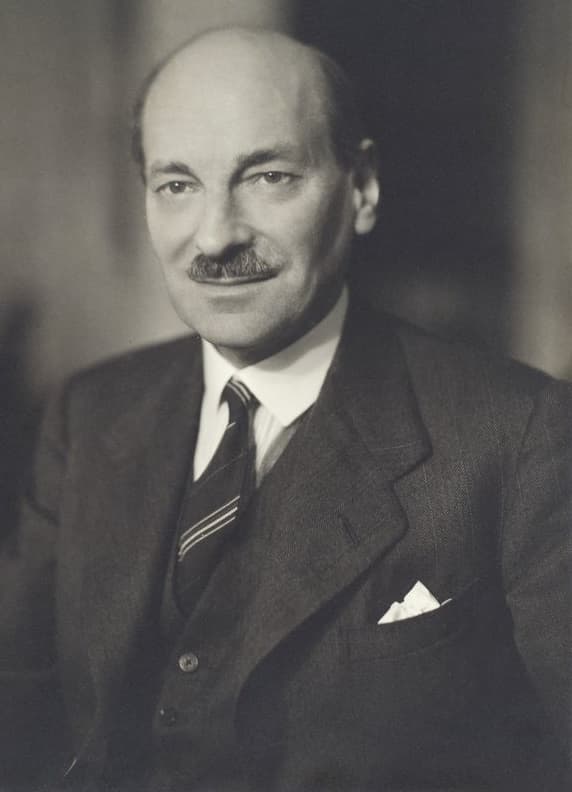
Clement Attlee, Prime Minister 1945–1951 · Unknown photographer, 1945, portrait of Clement Attlee. Public domain (PD-Australia). Wikimedia Commons.
Britain emerged from the Second World War on the winning side but economically shattered, and the public mood was strongly in favour of deep social reform. Significant changes to the education system had been put in place during the war itself, and there was now appetite for a much wider set of social measures.
At the 1945 general election, the British people returned a Labour government; the new Prime Minister was Clement Attlee, who had pledged to implement the welfare state proposed in the Beveridge Report. In 1948, Aneurin Bevan — the Labour Minister for Health — led the establishment of the National Health Service (NHS), which guaranteed a minimum standard of medical care to everyone, free at the point of use. Alongside the NHS, a national social-security system was introduced to protect the population, in the phrase of the period, from 'cradle to the grave'. The Attlee government also took a series of major industries into public ownership — nationalising the railways, the coal mines, and the gas, water and electricity supplies.
A parallel strand of post-war change was the granting of self-government to former British colonies. In 1947 independence was given to nine separate countries, including India, Pakistan and Ceylon (now known as Sri Lanka). Further colonies across Africa, the Caribbean and the Pacific went on to achieve independence over the following 20 years.
Britain also developed its own atomic bomb during this period and joined the newly established North Atlantic Treaty Organization (NATO) — a Western military alliance created to resist the perceived risk of invasion by the Soviet Union and its Warsaw Pact allies.
Between 1951 and 1964 the UK was governed by the Conservatives. The 1950s were a decade of economic recovery after the war, with rising real prosperity for working people. Harold Macmillan, Prime Minister during the later part of this period, is particularly remembered for his 'wind of change' speech on decolonisation and the move of former colonies to independence.
Clement Attlee (1883–1967) was born in London. His father was a solicitor and, after studying at Oxford University, he himself trained and practised as a barrister. He gave up the law to take up social work in London's East End, and eventually entered the House of Commons as a Labour MP. Under the wartime coalition he served as Winston Churchill's Deputy Prime Minister, and in 1945 he became Prime Minister in his own right after Labour won the general election. He served as Prime Minister from 1945 to 1951 and led the Labour Party as a whole for 20 years. His government carried out the nationalisation of major industries (including coal and steel), founded the National Health Service, and implemented most of William Beveridge's welfare proposals, along with a range of measures to improve working conditions.
William Beveridge (1879–1963), later Lord Beveridge, was a British economist and social reformer. He had a brief career as a Liberal MP and later led the Liberals in the House of Lords, but his lasting reputation rests on his 1942 report Social Insurance and Allied Services — almost always referred to simply as the Beveridge Report. The report, which had been commissioned by the wartime government in 1941, argued that the state should organise itself to defeat what it described as the five 'Giant Evils': Want, Disease, Ignorance, Squalor and Idleness. It became the intellectual blueprint for the modern British welfare state.
Key Facts
- •In 1945 the British people elected a Labour government with Clement Attlee as Prime Minister
- •In 1948, Aneurin Bevan, the Minister for Health, led the establishment of the National Health Service (NHS)
- •The NHS guaranteed a minimum standard of health care for all, free at the point of use
- •The government nationalised the railways, coal mines and gas, water and electricity supplies
- •In 1947, independence was granted to nine countries, including India, Pakistan and Ceylon (now Sri Lanka)
- •The UK developed its own atomic bomb and joined NATO
- •Britain had a Conservative government from 1951 to 1964
- •Prime Minister Harold Macmillan was famous for his 'wind of change' speech about decolonisation
- •Clement Attlee was Prime Minister from 1945 to 1951 and led the Labour Party for 20 years
- •The Beveridge Report (1942) targeted the five 'Giant Evils' of Want, Disease, Ignorance, Squalor and Idleness
Key Dates
R A Butler and the Education Act 1944
Richard Austen Butler, later ennobled as Lord Butler, was born in 1902. He entered Parliament as a Conservative MP in 1923 and held a series of front-bench positions before being given responsibility for education in 1941. In that role Butler steered the Education Act 1944 — often referred to informally as 'The Butler Act' — through Parliament. The Act made secondary education free to pupils in England and Wales for the first time. The detailed shape of the education system has changed a great deal since the Act came into force, but the basic structural division between primary and secondary schools that it imposed remains the norm in most parts of Britain today.
Key Facts
- •R A Butler (1902–82) became a Conservative MP in 1923
- •The Education Act 1944 ('The Butler Act') introduced free secondary education in England and Wales
- •The division between primary and secondary schools that the Butler Act enforced still remains in most of Britain
Key Dates
Dylan Thomas
Dylan Thomas (1914–53) was a Welsh poet and writer, notable for the musicality of his verse and for the directness of his public-reading style — he frequently read and performed his own work in public, often for BBC radio broadcasts. His most widely known works are the radio play Under Milk Wood, which was first performed after his death in 1954, and the poem Do Not Go Gentle into That Good Night, written in 1952 for his dying father. Thomas himself died in New York at the age of 39. Several memorials to him exist in his birthplace of Swansea, including a statue of the poet and the Dylan Thomas Centre.
Key Facts
- •Dylan Thomas (1914–53) was a Welsh poet and writer
- •He often read and performed his work in public, including for the BBC
- •His radio play Under Milk Wood was first performed after his death in 1954
- •He wrote the poem Do Not Go Gentle into That Good Night for his dying father in 1952
- •He died at the age of 39 in New York
- •There are memorials to him in his birthplace Swansea, including a statue and the Dylan Thomas Centre
Migration in Post-war Britain
Rebuilding Britain after the war was an undertaking of enormous scale. The country faced serious labour shortages, and the British government actively encouraged workers from Ireland and from other parts of Europe to come to the UK to help with reconstruction. In 1948, a formal invitation was also extended to people from the West Indies to come and work.
Through the 1950s the UK's labour shortage persisted, and further economic migration was encouraged as a matter of policy. Many industries advertised abroad for staff: recruitment centres were established in the West Indies to hire drivers for UK bus services, and textile and engineering firms in northern England and the Midlands sent their own recruitment agents out to India and Pakistan to find workers. For roughly a quarter of a century from the late 1940s, people from the West Indies, India, Pakistan and (later) Bangladesh travelled to work and to settle in Britain.
Key Facts
- •The British government encouraged workers from Ireland and other parts of Europe to come to the UK after WWII
- •In 1948, people from the West Indies were invited to come and work
- •Centres were set up in the West Indies to recruit people to drive buses
- •Textile and engineering firms from northern England and the Midlands sent agents to India and Pakistan to find workers
- •For about 25 years, people from the West Indies, India, Pakistan and (later) Bangladesh travelled to work and settle in Britain
Key Dates
Social Change in the 1960s
The 1960s marked a period of significant social change, popularly known at the time (and after) as 'the Swinging Sixties'. British fashion, cinema and popular music all grew rapidly in international stature; two of the era's defining pop acts — The Beatles and The Rolling Stones — broke out of the UK to a worldwide audience. Rising post-war prosperity meant that many families were, for the first time, able to afford cars and other consumer goods.
The decade also saw a significant liberalisation of social laws. Laws on divorce and on abortion were eased in England, Wales and Scotland. At the same time, the legal position of women in the workplace improved substantially: at the start of the decade it was still common practice for employers to expect women to leave their jobs upon marriage, but Parliament passed new legislation giving women the right to equal pay and making it unlawful for employers to discriminate against female staff on the basis of gender.
Technologically, the 1960s were also a productive decade. The UK and France jointly developed Concorde, the world's only supersonic commercial passenger airliner. In the built environment, new architectural styles — high-rise buildings, and the wide use of concrete and steel in public and private construction — became widespread.
Inward migration from the West Indies, India, Pakistan and what is now Bangladesh slowed in the late 1960s as successive governments tightened the immigration rules, requiring prospective immigrants to demonstrate a close personal connection to Britain by birth or by ancestry. Despite the restriction, Britain did admit 28,000 people of Indian origin in the early 1970s after they were expelled from Uganda.
Key Facts
- •The 1960s was known as 'the Swinging Sixties'
- •Two well-known pop music groups were The Beatles and The Rolling Stones
- •Social laws were liberalised, including divorce and abortion in England, Wales and Scotland
- •Parliament passed new laws giving women the right to equal pay
- •Employer discrimination against women because of their gender was made illegal
- •Britain and France developed Concorde, the world's only supersonic commercial airliner
- •New styles of architecture, including high-rise buildings using concrete and steel, became common
- •Late-1960s immigration laws required a strong connection to Britain through birth or ancestry
- •In the early 1970s, Britain admitted 28,000 people of Indian origin who had been forced to leave Uganda
Some Great British Inventions of the 20th Century
The 20th century saw a remarkable run of technological and scientific firsts originating in Britain, many of them still central to modern life. A selection of the most important:
Key Facts
- •Television — developed by Scotsman John Logie Baird (1888–1946) in the 1920s; in 1932 he made the first television broadcast between London and Glasgow
- •Radar — developed by Scotsman Sir Robert Watson-Watt (1892–1973); the first successful radar test took place in 1935
- •Jodrell Bank — Sir Bernard Lovell (1913–2012) built a radio telescope at Jodrell Bank in Cheshire that was for many years the biggest in the world and continues to operate today
- •Turing machine — a theoretical mathematical device invented by Alan Turing (1912–54) in the 1930s; influential in the development of computer science and the modern-day computer
- •Insulin — the Scottish physician and researcher John MacLeod (1876–1935) was the co-discoverer of insulin, used to treat diabetes
- •Structure of the DNA molecule — discovered in 1953 through work at British universities in London and Cambridge; Francis Crick (1916–2004), one of those awarded the Nobel Prize for this discovery, was British
- •Jet engine — developed in Britain in the 1930s by Sir Frank Whittle (1907–96), a British Royal Air Force engineer Officer
- •Hovercraft — invented by Sir Christopher Cockerell (1910–99) in the 1950s
- •Concorde — the world's only supersonic passenger aircraft; first flew in 1969, began carrying passengers in 1976, retired in 2003
- •Harrier jump jet — an aircraft capable of taking off vertically, designed and developed in the UK
- •Cash-dispensing ATM — invented by James Goodfellow (1937–) in the 1960s; the first was put into use by Barclays Bank in Enfield, north London in 1967
- •IVF (in-vitro fertilisation) therapy — pioneered in Britain by physiologist Sir Robert Edwards (1925–) and gynaecologist Patrick Steptoe (1913–88); the world's first 'test-tube baby' was born in Oldham, Lancashire in 1978
- •Cloning — in 1996, Sir Ian Wilmot (1944–) and Keith Campbell (1954–2012) led a team which was the first to clone a mammal, Dolly the sheep
- •MRI scanner — Sir Peter Mansfield (1933–) is the co-inventor of the MRI (magnetic resonance imaging) scanner
- •World Wide Web — invented by Sir Tim Berners-Lee (1955–); information was successfully transferred via the web for the first time on 25 December 1990
Key Dates
Problems in the Economy in the 1970s
By the late 1970s the long post-war economic boom had finally come to an end. Prices of consumer goods and of raw materials were rising sharply, and the sterling exchange rate against other currencies was unstable. The combination produced serious balance-of-payments difficulties: the value of goods the UK was importing consistently exceeded the value of what it was able to export.
Industrial relations deteriorated. Many key industries and public services were hit by strikes, and tensions between the trade union movement and successive governments grew acute. By the end of the decade there was a widely shared view in the country that the unions had become too powerful and that their industrial action was damaging the UK as a whole.
The 1970s were also a decade of severe conflict in Northern Ireland. In 1972 the Northern Ireland Parliament at Stormont was suspended and the province was placed under direct rule from Westminster. Roughly 3,000 people would lose their lives in Northern Ireland as a result of the sectarian violence that began in 1969 and ran for the following three decades.
Mary Peters (1939–), born in Manchester, moved with her family to Northern Ireland as a child. She became a gifted athlete and won an Olympic gold medal in the pentathlon at the 1972 Munich Games. After her competitive career she raised funds for athletics in Northern Ireland and served as team manager of the women's British Olympic team. She has continued to promote sport and tourism in Northern Ireland and was made a Dame of the British Empire in 2000 in recognition of her work.
Key Facts
- •The post-war economic boom came to an end in the late 1970s
- •Rising prices and an unstable exchange rate caused problems with the 'balance of payments'
- •Many industries were affected by strikes, causing friction between trade unions and the government
- •In 1972, the Northern Ireland Parliament was suspended and Northern Ireland was directly ruled by the UK government
- •Some 3,000 people lost their lives in the violence in Northern Ireland after 1969
- •Mary Peters (1939–) won an Olympic gold medal in the pentathlon in 1972
- •Mary Peters was made a Dame of the British Empire in 2000
Key Dates
Europe and the Common Market
In 1957 West Germany, France, Belgium, Italy, Luxembourg and the Netherlands together founded the European Economic Community (EEC). The UK initially stood outside the new community, and it was not until 1973 that Britain formally joined. The UK went on to become a full member of the European Union — the EEC's successor — but did not adopt the Euro as its currency.
Key Facts
- •The European Economic Community (EEC) was formed in 1957 by West Germany, France, Belgium, Italy, Luxembourg and the Netherlands
- •The UK joined the EEC in 1973
- •The UK is a full member of the European Union but does not use the Euro currency
Key Dates
Conservative Government from 1979 to 1997
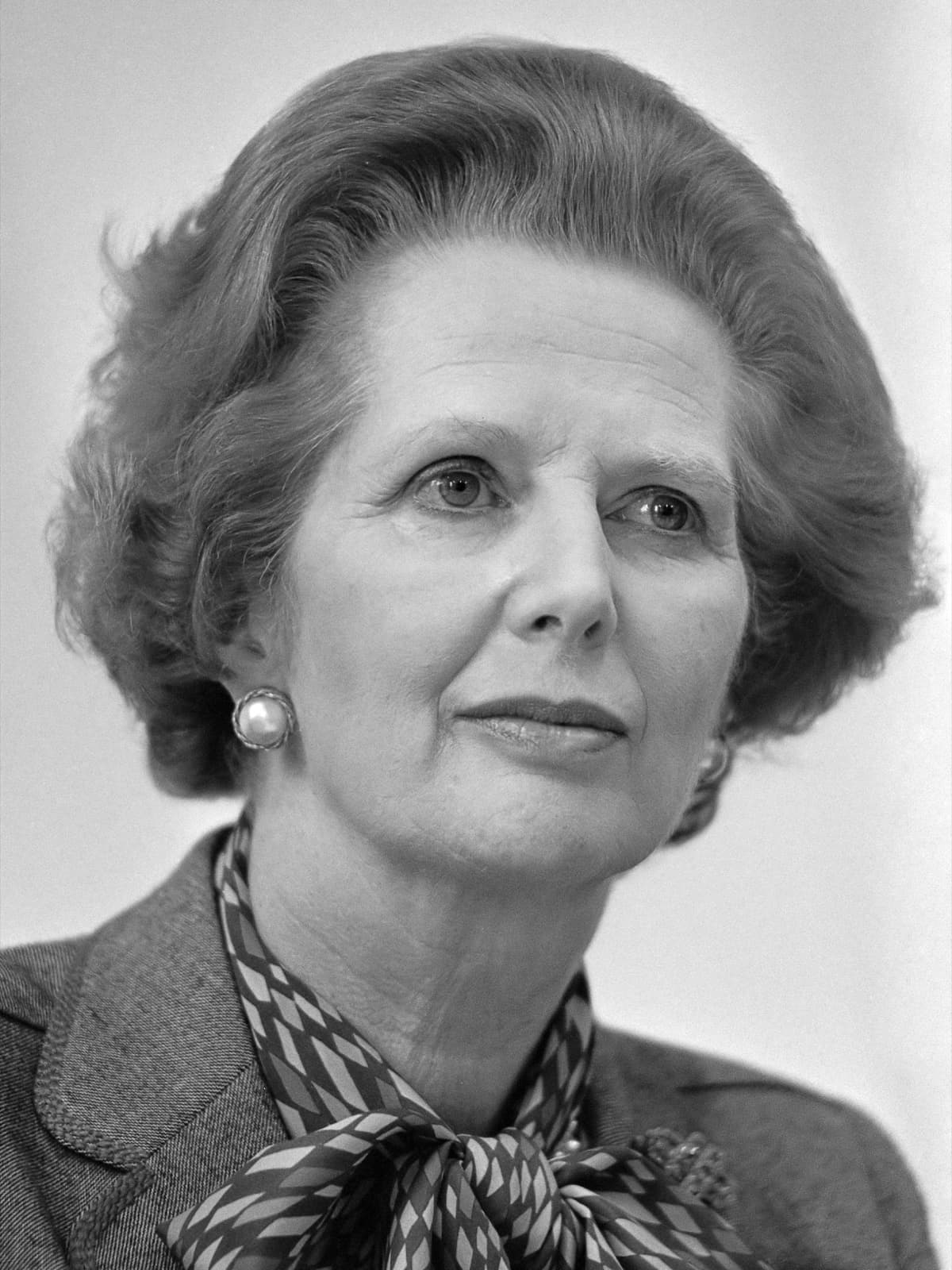
Margaret Thatcher, Britain's first woman Prime Minister · Rob Bogaerts (Anefo / Nationaal Archief), 1983, photograph of Margaret Thatcher. CC0 1.0 Universal. Wikimedia Commons.
Margaret Thatcher (1925–2013), the daughter of a grocer from Grantham in Lincolnshire, trained first as a chemist and later as a lawyer. She entered Parliament as a Conservative MP in 1959 and rose through the party to become a cabinet minister in 1970 as Secretary of State for Education and Science. In 1975 she was elected leader of the Conservative Party, and accordingly became Leader of the Opposition.
After the Conservatives won the 1979 general election, Margaret Thatcher took office as the UK's first woman Prime Minister. She went on to become the longest-serving Prime Minister of the 20th century, remaining in office until 1990. Under her government a series of significant economic reforms were carried out. She built a close working partnership with US President Ronald Reagan and was among the first Western heads of government to recognise — and to welcome — the reform programme of the Soviet Union's new leadership, which ultimately contributed to the end of the Cold War.
As Britain's first woman Prime Minister, Thatcher led the Conservative government between 1979 and 1990. Her government restructured the UK economy by privatising many of the industries that had been nationalised under Labour, and imposed tighter legal limits on the powers of trade unions. Deregulation of financial services transformed the City of London into one of the world's leading international centres for investment, insurance and related services. Traditional heavy industries, in particular shipbuilding and coal mining, declined steeply over the decade. In 1982, after Argentina invaded the Falkland Islands — a British overseas territory in the South Atlantic — a naval taskforce was dispatched from the UK, and military action recovered the islands. Thatcher's successor as Prime Minister, John Major, subsequently played an important role in laying the groundwork for the Northern Ireland peace process.
Roald Dahl (1916–90) was born in Wales to Norwegian parents. He served in the Royal Air Force during the Second World War, and began to publish books and short stories during the 1940s. He is best remembered today for his children's fiction — although he also wrote extensively for adults. His best-known titles include Charlie and the Chocolate Factory and George's Marvellous Medicine, several of which have been adapted for film.
Key Facts
- •Margaret Thatcher was Britain's first woman Prime Minister (from 1979)
- •She was the longest-serving Prime Minister of the 20th century, in office until 1990
- •Thatcher privatised nationalised industries and imposed legal controls on trade union powers
- •Deregulation increased the role of the City of London as a global financial centre
- •Traditional industries such as shipbuilding and coal mining declined under Thatcher
- •In 1982, Argentina invaded the Falkland Islands and a naval taskforce recovered them
- •John Major was Prime Minister after Mrs Thatcher and helped establish the Northern Ireland peace process
- •Roald Dahl (1916–90) was born in Wales to Norwegian parents and served in the RAF during WWII
- •Roald Dahl's best-known works include Charlie and the Chocolate Factory and George's Marvellous Medicine
Key Dates
Labour Government from 1997 to 2010
The Labour Party, under Tony Blair, won the 1997 general election by a landslide. The Blair government quickly introduced devolved bodies: a Scottish Parliament and a Welsh Assembly. The Scottish Parliament was given substantial legislative powers; the Welsh Assembly began with a narrower legislative remit but considerable administrative authority over Welsh public services. In Northern Ireland, the Blair government built on earlier work by the Major administration to take the peace process to a formal settlement — the Good Friday Agreement, signed in 1998. A Northern Ireland Assembly was elected in 1999 but was suspended in 2002 and was not restored until 2007. By that point most of the region's paramilitary organisations had formally decommissioned their weapons and become inactive. Gordon Brown took over from Tony Blair as Prime Minister in 2007.
Key Facts
- •In 1997 the Labour Party led by Tony Blair was elected
- •The Blair government introduced a Scottish Parliament and a Welsh Assembly
- •The Scottish Parliament has substantial powers to legislate; the Welsh Assembly has fewer legislative powers but considerable control over public services
- •The Good Friday Agreement was signed in 1998
- •The Northern Ireland Assembly was elected in 1999, suspended in 2002, and reinstated in 2007
- •Most paramilitary groups in Northern Ireland have decommissioned their arms and are inactive
- •Gordon Brown took over as Prime Minister in 2007
Key Dates
Conflicts in Afghanistan and Iraq
Through the 1990s Britain played a leading role in several international coalition operations — from the liberation of Kuwait following the Iraqi invasion in 1990, through to the conflicts in the former Republic of Yugoslavia. From 2000 onwards British armed forces have been heavily engaged in the global campaign against international terrorism and the prevention of weapons-of-mass-destruction proliferation, including sustained operations in Afghanistan and Iraq. British combat troops completed their withdrawal from Iraq in 2009. In Afghanistan, the UK has operated as a component of the International Security Assistance Force (ISAF) — a 50-nation United Nations-mandated coalition working at the invitation of the Afghan government. ISAF's mission has been to ensure that Afghan territory cannot again become a safe haven from which groups such as Al Qa'ida could plan international terrorist attacks; the force has also worked to build up the Afghan National Security Forces and to create the stable conditions required for governance and development to take root. International forces are progressively handing security responsibility over to Afghan forces, with the aim of full Afghan responsibility across every province by the end of 2014.
Key Facts
- •Britain played a leading role in the 1990s coalition forces that liberated Kuwait after the 1990 Iraqi invasion
- •Britain also took part in coalition forces in the Former Republic of Yugoslavia
- •Since 2000 British armed forces have been engaged in the global fight against international terrorism
- •British combat troops left Iraq in 2009
- •The UK operates in Afghanistan as part of the UN-mandated 50-nation International Security Assistance Force (ISAF)
Key Dates
Coalition Government from 2010 to 2015
The May 2010 general election produced a result that had not been seen in the UK since February 1974 — no single political party secured an overall majority of seats in the House of Commons. The Conservative Party and the Liberal Democrats negotiated and formed a coalition, and the leader of the Conservatives, David Cameron, took office as Prime Minister.
Key Facts
- •In May 2010 no political party won an overall majority — the first time since February 1974
- •The Conservative and Liberal Democrat parties formed a coalition
- •David Cameron, leader of the Conservative Party, became Prime Minister
Key Dates
Conservative Government from 2015 to 2024
The Conservative Party governed the United Kingdom between 2015 and 2024, a period during which the office of Prime Minister changed hands five times. David Cameron, Theresa May, Boris Johnson, Liz Truss and Rishi Sunak each served in turn. Among the defining events of this near-decade in office were the 2016 referendum on UK membership of the European Union — commonly called the 'Brexit' referendum — along with a sequence of leadership changes in the governing party and the national response to the COVID-19 pandemic. By the first half of 2024, with the Conservative Party's support in the polls having declined and the opposition Labour, Liberal Democrat and Green parties making substantial gains in local elections, Rishi Sunak called a general election for 4 July 2024.
Key Facts
- •Conservative Prime Ministers 2015–2024: David Cameron, Theresa May, Boris Johnson, Liz Truss, and Rishi Sunak
- •The 2016 EU membership referendum (Brexit) occurred during this period
- •The period included handling of the COVID-19 pandemic
- •Rishi Sunak called a general election for 4 July 2024
- •The Conservative Party's popularity declined, while Labour, the Liberal Democrats, and the Greens made substantial gains
Key Dates
Labour Government from 2024
The Labour Party, under the leadership of Sir Keir Starmer, won a majority at the general election of 4 July 2024 and formed a new Labour government.
Key Facts
- •The Labour party, led by Keir Starmer, won the majority in the 2024 general election
Key Dates
Chapter Summary
All key facts from this chapter at a glance — read this to revise the full chapter quickly.
Chapter Summary
Quick revision- ✓In 1945 the British people elected a Labour government with Clement Attlee as Prime Minister
- ✓In 1948 Aneurin Bevan, the Minister for Health, established the National Health Service (NHS) — minimum health care for all, free at the point of use
- ✓The government nationalised the railways, coal mines and gas, water and electricity supplies
- ✓The Beveridge Report (1942) targeted the five 'Giant Evils': Want, Disease, Ignorance, Squalor and Idleness — the basis of the modern welfare state
- ✓In 1947 independence was granted to nine countries, including India, Pakistan and Ceylon (now Sri Lanka)
- ✓The UK developed its own atomic bomb and joined NATO
- ✓Britain had a Conservative government from 1951 to 1964; Harold Macmillan was famous for his 'wind of change' speech about decolonisation
- ✓The Education Act 1944 ('The Butler Act') introduced free secondary education in England and Wales; the division between primary and secondary schools still remains
- ✓Dylan Thomas (1914–53) was a Welsh poet; his radio play Under Milk Wood was first performed after his death in 1954; he wrote Do Not Go Gentle into That Good Night for his dying father in 1952
- ✓From 1948, people from the West Indies, India, Pakistan and Bangladesh were encouraged to come to Britain to fill labour shortages — for about 25 years
- ✓The 1960s was known as 'the Swinging Sixties'; The Beatles and The Rolling Stones were well-known pop groups
- ✓Social laws were liberalised in the 1960s including divorce and abortion in England, Wales and Scotland; women gained the right to equal pay
- ✓Britain and France developed Concorde, the world's only supersonic commercial airliner (first flight 1969, passengers 1976, retired 2003)
- ✓In the early 1970s, Britain admitted 28,000 people of Indian origin forced to leave Uganda
- ✓Great British inventions: television (John Logie Baird, first broadcast London–Glasgow 1932); radar (Watson-Watt, 1935); Turing machine (Alan Turing, 1930s); insulin (John MacLeod); DNA structure discovered 1953 (Francis Crick); jet engine (Frank Whittle, 1930s); hovercraft (Christopher Cockerell, 1950s); cash ATM (James Goodfellow, first at Barclays Enfield 1967); IVF (Robert Edwards & Patrick Steptoe, first test-tube baby Oldham 1978); Dolly the sheep cloned 1996 (Ian Wilmut & Keith Campbell); MRI scanner (Peter Mansfield); World Wide Web (Tim Berners-Lee, 25 December 1990)
- ✓In 1972 the Northern Ireland Parliament was suspended; about 3,000 people died in the violence in Northern Ireland after 1969
- ✓Mary Peters won Olympic pentathlon gold in 1972 and was made a Dame in 2000
- ✓The EEC was formed in 1957; the UK joined in 1973 but does not use the Euro
- ✓Margaret Thatcher became Britain's first woman Prime Minister in 1979 — the longest-serving PM of the 20th century, in office until 1990
- ✓Thatcher privatised nationalised industries, imposed legal controls on trade union powers and increased the role of the City of London as a global financial centre
- ✓In 1982 Argentina invaded the Falkland Islands; a naval taskforce recovered them
- ✓John Major was PM after Thatcher and helped establish the Northern Ireland peace process
- ✓Roald Dahl (1916–90) was born in Wales to Norwegian parents; best-known works include Charlie and the Chocolate Factory and George's Marvellous Medicine
- ✓In 1997 Labour under Tony Blair was elected; the Blair government introduced a Scottish Parliament and a Welsh Assembly
- ✓The Good Friday Agreement was signed in 1998; the Northern Ireland Assembly was elected in 1999, suspended in 2002 and reinstated in 2007
- ✓Gordon Brown became Prime Minister in 2007
- ✓In May 2010 no party won an overall majority (first time since February 1974); a Conservative–Liberal Democrat coalition was formed under David Cameron
- ✓Conservative PMs from 2015–2024: David Cameron, Theresa May, Boris Johnson, Liz Truss and Rishi Sunak; the 2016 Brexit referendum and COVID-19 pandemic occurred in this period
- ✓In 2024 Labour under Keir Starmer won the general election
Test Yourself on This Chapter
Ready to practice? Take a focused test on this topic.