The UK Government, the Law and Your Role
25 min read·Last updated: April 2026
In this chapter
- 1. The Development of British Democracy
- 2. The British Constitution
- 3. The Monarchy
- 4. Parliament and Government
- 5. The House of Lords
- 6. Fundamental Principles and Rights
- 7. Taxation and Driving
- 8. The Legal System
- 9. The Government and Devolution
- 10. Voting and Elections
- 11. The UK and International Institutions
- 12. Your Role in the Community
- 13. Chapter Summary
The Development of British Democracy
Democracy, in a simple working definition, is a political system in which the whole adult population has a say in how the country is governed — whether directly by voting on issues, or indirectly by electing representatives who take decisions on their behalf.
Britain's democracy in its current form is a relatively recent achievement. At the beginning of the 19th century the UK was certainly not a democracy as we understand the word today. Elections to return members of Parliament (MPs) did take place, but only a narrow fraction of the population was entitled to take part — specifically, adult men over 21 who met a property-ownership qualification. Women could not vote at all.
The franchise — the right to vote — was progressively widened through the course of the 19th century, and the emerging political parties began to draw ordinary men and women into active membership.
The most significant early reform movement was the Chartist movement of the 1830s and 1840s, a mass popular movement with a programme of six democratic demands. At the time the campaign looked to observers like a failure; most of the six demands had, however, been conceded through legislation by 1918.
Key Facts
- •The Chartists campaigned for six changes: for every man to have the vote; elections every year; for all regions to be equal in the electoral system; secret ballots; for any man to be able to stand as an MP; for MPs to be paid
- •At the turn of the 19th century, only men over 21 who owned a certain amount of property could vote
- •By 1918, most Chartist reforms had been adopted, and women over 30 gained the right to vote
- •In 1928, the right to vote was extended to men and women over 21
- •In 1969, the voting age was reduced to 18 for men and women
Key Dates
The British Constitution
A country's constitution is the set of principles by which the country is run. It specifies the institutions responsible for the government of the state, defines the relationships between them, and sets out how power is checked. The constitutional settlement also includes the body of the country's laws and its accumulated conventions.
The British constitution is unusual in being described as 'unwritten' — it is not set out in a single authoritative document. That historical feature reflects the fact that, unlike the United States or France, Britain has never undergone a revolution that led permanently to a ground-up redesign of the system of government. Instead, Britain's key institutions have evolved incrementally over many centuries.
There is an ongoing debate in the country over whether this matters. Some argue that a written constitution in a single document would make the rules of the game clearer; others argue that the absence of a single text allows the system to adapt and makes for better practical government.
Within the UK, political authority is distributed across several different institutions at the centre, and in recent decades has also been partly transferred to devolved governments in Scotland, Wales and Northern Ireland, which have legislative authority over defined subject areas.
Key Facts
- •The British constitution is described as 'unwritten' because it is not contained in a single document
- •The main constitutional institutions of the UK are: the monarchy; Parliament (the House of Commons and the House of Lords); the Prime Minister; the cabinet; the judiciary (courts); the police; the civil service; local government
- •Devolved governments in Scotland, Wales and Northern Ireland have the power to legislate on certain issues
The Monarchy
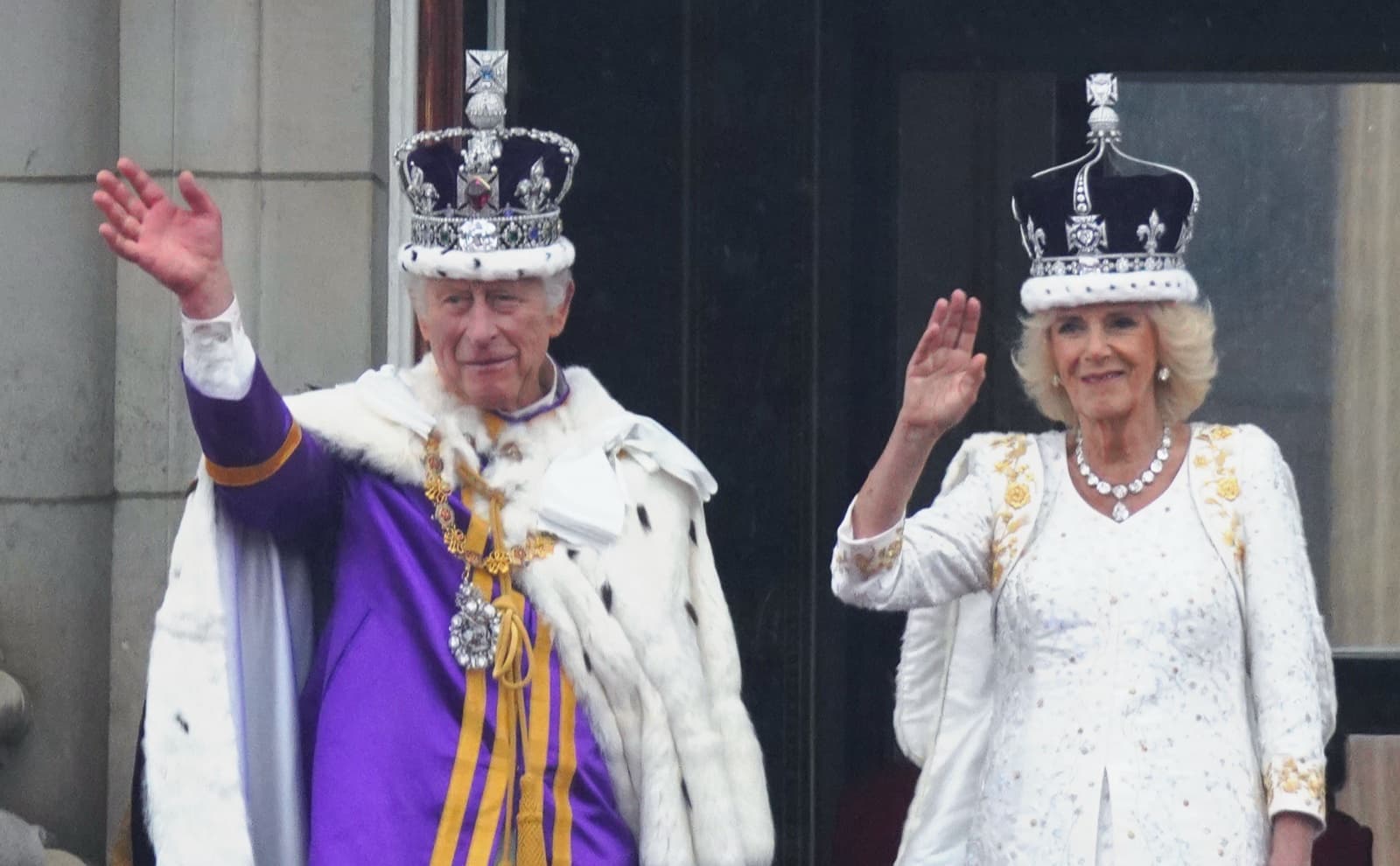
The royal family waving from the Buckingham Palace balcony during King Charles III's coronation, 6 May 2023 · Isaac Mayne / UK Department for Culture, Media and Sport, 2023. Public Domain Mark 1.0. Wikimedia Commons.
The head of state of the United Kingdom is the monarch, who is also head of state for many of the other countries that make up the Commonwealth. Britain is a constitutional monarchy — a system in which the king or queen does not personally rule the country, but formally appoints the government that the people have chosen through democratic elections.
In practical terms, the monarch invites the leader of the party that has won the largest number of seats in Parliament, or the leader of a coalition of parties, to form a government as Prime Minister. The monarch meets regularly with the Prime Minister and, in the well-known constitutional formulation, has the right to 'advise, warn and encourage' — but day-to-day policy decisions are taken by the Prime Minister and cabinet.
The monarch performs a range of important ceremonial functions. Each year the monarch opens the new parliamentary session with a speech that sets out the government's policy agenda for the coming year. All Acts of Parliament are enacted formally in the monarch's name.
Internationally, the monarch serves as the UK's senior representative: receiving foreign ambassadors and high commissioners, entertaining visiting heads of state, and undertaking state visits overseas in support of the UK's diplomatic and economic relationships.
Finally, the monarchy provides the UK with a source of continuity and stability at the top of its constitutional structure. While governments and prime ministers change at regular intervals, the monarch remains in place as head of state across those transitions.
Key Facts
- •Queen Elizabeth II reigned since her father's death in 1952, and in 2012 she celebrated her Diamond Jubilee (60 years as queen). She died on 8 September 2022
- •King Charles III has been the sovereign since 2022; his heir apparent is his elder son, William, Prince of Wales
- •William's three children are next in line in order of birth: Prince George, Princess Charlotte, and Prince Louis
- •Prince Edward became the Duke of Edinburgh in 2023
- •The National Anthem of the UK is 'God Save the King (or Queen)'; it is played at important national occasions and events attended by the Royal Family
- •The first verse of the National Anthem: 'God save our gracious King! Long live our noble King! God save the King! Send her victorious, Happy and glorious, Long to reign over us, God save the King!'
- •New citizens swear or affirm loyalty to the King as part of the citizenship ceremony
- •The Oath of Allegiance: 'I (name) swear by Almighty God that on becoming a British citizen, I will be faithful and bear true allegiance to His Majesty King Charles the Third, his Heirs and Successors, according to law'
- •The Affirmation of Allegiance: 'I (name) do solemnly, sincerely and truly declare and affirm that on becoming a British citizen, I will be faithful and bear true allegiance to His Majesty King Charles the Third, his Heirs and Successors, according to law'
- •All Acts of Parliament are made in the Majesty's name
- •The monarch opens the new parliamentary session each year with a speech summarising the government's policies
Key Dates
Parliament and Government
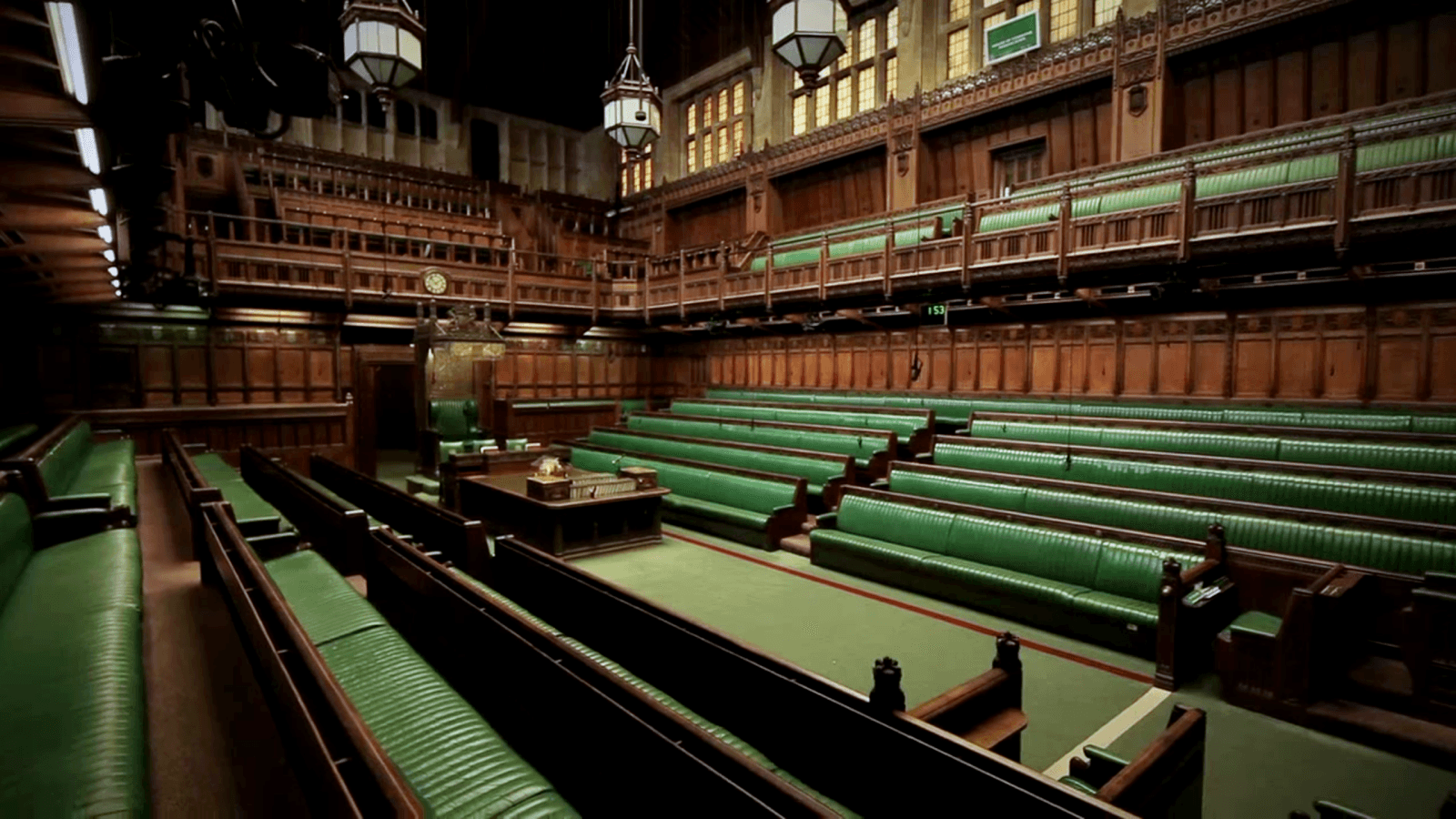
The chamber of the House of Commons, Palace of Westminster · UK Parliament, 2012. CC-BY-3.0. Wikimedia Commons.
The UK is a parliamentary democracy. For electoral purposes the country is divided into geographical parliamentary constituencies; voters in each constituency elect a single member of Parliament (MP) at a General Election. The full set of elected MPs makes up the House of Commons. Most MPs are members of an organised political party, and the party that wins a majority of Commons seats forms the government. If no single party has a majority, two or more parties can negotiate a coalition to form a government between them.
Of the two Houses of Parliament, the House of Commons is regarded as the more important chamber, because it is elected democratically. The Prime Minister and virtually all cabinet ministers sit as MPs in the Commons. Each MP formally represents a parliamentary constituency.
Commons debates are chaired by the Speaker. The Speaker is politically neutral and does not represent a party in the chamber, although he or she remains an elected MP representing a constituency and continues to handle that constituency's casework like any other MP. The Speaker is selected from among the MPs in a secret ballot of the Commons.
General Elections must be held at least every five years. If an MP dies or resigns between General Elections, a separate local election — a by-election — is held in that MP's constituency to choose a successor. British Parliamentary elections use a voting system known as 'first past the post': in each constituency, the candidate with the largest share of votes wins the seat.
Elections to the European Parliament were held every five years on a different basis, using a system of proportional representation under which seats were allocated in proportion to the votes each party had received. Members elected to the European Parliament are called MEPs.
Every elected representative has a duty to serve the constituents who elected them. Many MPs, Assembly members, MSPs and MEPs hold regular 'surgeries' in their constituencies, at which residents can come in person to raise issues of personal or local concern.
UK Government Structure
The Monarch is Head of State. Parliament makes laws. The PM leads the government.
Key Facts
- •MPs have four responsibilities: represent everyone in their constituency; help to create new laws; scrutinise and comment on what the government is doing; debate important national issues
- •A General Election is held at least every five years
- •If an MP dies or resigns, a fresh election called a by-election is held in their constituency
- •MPs are elected through the 'first past the post' system: the candidate with the most votes wins
- •The Speaker chairs debates in the House of Commons, is neutral and does not represent a political party
- •The Speaker is chosen by other MPs in a secret ballot and represents Parliament on ceremonial occasions
- •Elections for the European Parliament use proportional representation; elected members are called MEPs
- •You can contact your MP at: The House of Commons, Westminster, London SW1A 0AA
The House of Lords
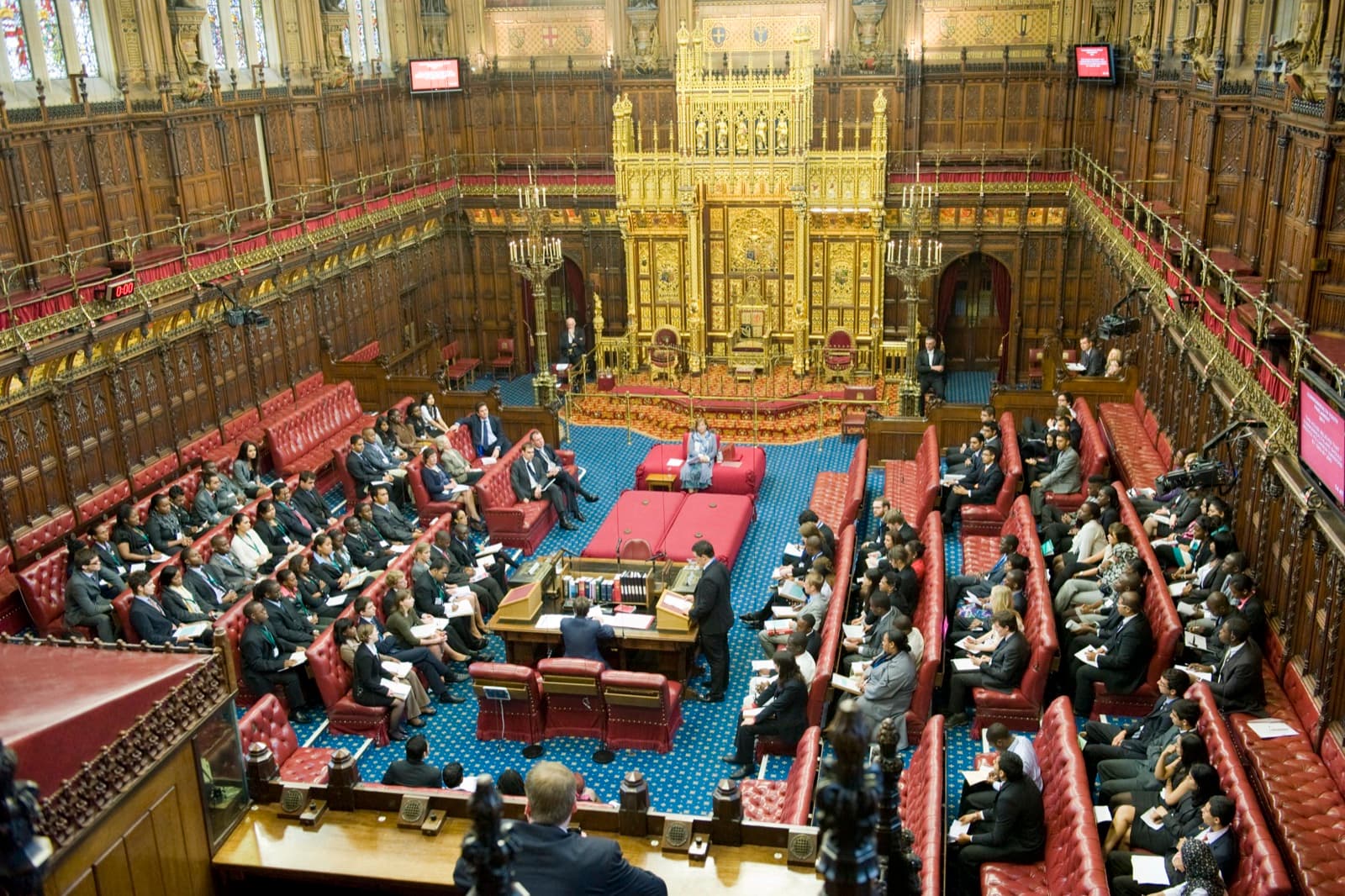
The House of Lords chamber, Palace of Westminster · UK Government (Cabinet Office), 2011. Open Government Licence v3.0. Wikimedia Commons.
The members of the House of Lords are known as peers. Unlike MPs they are not elected by the public and do not represent geographical constituencies. The composition of the Lords, and its role relative to the elected Commons, have both evolved substantially over the past 50 years.
Prior to 1958, membership of the Lords consisted of three categories: 'hereditary' peers, who had inherited their seat through aristocratic title; the country's most senior judges; and bishops of the Church of England.
From 1958 onwards, the Prime Minister was given statutory power to nominate new peers who would hold their peerage only for their own lifetime. These are the life peers. Life peers are typically distinguished individuals from politics, business, law or another profession. The formal appointment is made by the monarch on the Prime Minister's advice. The leaders of the other main political parties are also able to nominate peers, and an independent House of Lords Appointments Commission nominates non-party peers.
A further reform in 1999 removed the automatic right of hereditary peers to sit in the Lords. A small number are now elected from among their own ranks to represent hereditary peers collectively.
The Lords tends to be more independent of government than the Commons. It can suggest amendments to legislation, or propose fresh legislation of its own, which is then debated in the Commons. Its key day-to-day role is to scrutinise laws that the Commons has passed, to ensure they are fit for purpose. It also holds the government to account and tests whether it is acting in the public interest. The Commons does have reserve powers to override the Lords, but uses them sparingly.
Key Facts
- •Members of the House of Lords are known as peers; they are not elected and do not represent a constituency
- •Until 1958, all peers were either hereditary (inherited their title), senior judges, or bishops of the Church of England
- •Since 1958, the Prime Minister has had the power to nominate life peers (peers for their own lifetime only)
- •Life peers are appointed by the monarch on the advice of the Prime Minister
- •Since 1999, hereditary peers have lost the automatic right to attend the House of Lords
- •The House of Lords can suggest amendments, propose new laws, and check laws passed by the House of Commons
- •The House of Commons has powers to overrule the House of Lords, but these are not used often
Key Dates
Fundamental Principles and Rights
The UK has a long tradition of respecting individual rights and protecting fundamental freedoms. The historical roots of that tradition reach back to Magna Carta, to the Habeas Corpus Act of 1679 and to the Bill of Rights of 1689; the modern body of rights has built up incrementally over the centuries since.
British diplomats and lawyers played a leading role in the drafting of the European Convention on Human Rights and Fundamental Freedoms in the aftermath of the Second World War. The UK was among the first nations to sign the Convention when it was opened for signature in 1950. Almost half a century later, the Human Rights Act of 1998 brought the Convention's rights directly into UK domestic law. Since that Act, UK courts, public bodies and government must conduct themselves in line with the Convention's principles.
UK legislation prohibits unfair treatment in many areas of life or work on the grounds of age, disability, sex, pregnancy and maternity, race, religion or belief, sexuality or marital status.
Within the UK, domestic violence is a serious criminal offence. Violence against a partner — whether the partner is male or female, and whether the two are married or simply living together — can be prosecuted. A husband who forces his wife to have sex may be charged with rape; the legal protection applies without qualification.
Female genital mutilation (FGM), sometimes called cutting or female circumcision, is a criminal offence in the UK. It is also a criminal offence to take a girl or woman abroad specifically for the purpose of FGM.
Marriage in the UK requires the full and free consent of both parties. Arranged marriages, in which both parties consent freely to the marriage, are lawful and accepted. A forced marriage — in which one or both parties do not, or cannot, give free consent — is illegal, and forcing another person into marriage is a criminal offence in its own right.
Key Facts
- •The European Convention on Human Rights includes: right to life; prohibition of torture; prohibition of slavery and forced labour; right to liberty and security; right to a fair trial; freedom of thought, conscience and religion; freedom of expression (speech)
- •The UK was one of the first countries to sign the European Convention on Human Rights in 1950
- •The Human Rights Act 1998 incorporated the European Convention on Human Rights into UK law
- •UK laws ensure that people are not treated unfairly because of their age, disability, sex, pregnancy and maternity, race, religion or belief, sexuality or marital status
- •Domestic violence is a serious crime in the UK; anyone who is violent towards their partner can be prosecuted
- •The 24-hour National Domestic Violence Freephone Helpline is 0808 2000 247
- •Female genital mutilation (FGM) is illegal in the UK; practising it or taking someone abroad for it is a criminal offence
- •Forced marriage is a criminal offence in the UK; arranged marriages (with full consent) are acceptable
- •Forced Marriage Protection Orders were introduced in 2008 for England, Wales and Northern Ireland under the Forced Marriage (Civil Protection) Act 2007
- •Similar Forced Marriage Protection Orders were introduced in Scotland in November 2011
- •Anyone found to have breached a Forced Marriage Protection Order can be jailed for up to two years
Key Dates
Taxation and Driving
Income in the UK attracts income tax. Taxable income includes wages from paid employment, profits from self-employment, taxable benefits, pensions, and income from property, savings and dividends. The revenue that central government raises through income tax pays for a range of essential services — roads, education, the police, the armed forces and more.
For most employees the right amount of income tax is deducted automatically from their pay by their employer and forwarded to HM Revenue & Customs (HMRC). This system is known as 'Pay As You Earn' — PAYE for short. The self-employed handle their own tax through a parallel system called 'self-assessment', which requires them to complete an annual tax return.
Almost everyone in paid work in the UK, the self-employed included, must pay National Insurance Contributions (NICs). The revenue from NICs is ring-fenced to pay for state benefits and services including the state retirement pension and the National Health Service. Each person has a unique National Insurance number — a personal identifier for the system. UK-born young people are sent their National Insurance number shortly before their 16th birthday.
Turning to driving: in the UK the minimum age for driving a car or a motorbike is 17, and a full driving licence is required to drive on public roads. Mopeds may be ridden from age 16. To earn a UK driving licence a learner must pass a theory test (which comprises a multiple-choice theory component and a hazard-perception component) and a practical driving test.
A UK driving licence is generally valid up to age 70; after 70 it is renewed on three-year terms. In Northern Ireland, newly qualified drivers must display an 'R' plate (for 'restricted driver') for the first year after passing their test.
If your driving licence was issued in an EU country, Iceland, Liechtenstein or Norway, it can be used in the UK for as long as it remains valid. A licence issued anywhere else is valid in the UK for up to 12 months from the date of your arrival; after that you must obtain a full UK driving licence to continue driving.
Key Facts
- •Income tax is paid on wages from paid employment, profits from self-employment, taxable benefits, pensions, and income from property, savings and dividends
- •Money raised from income tax pays for government services such as roads, education, police and the armed forces
- •The system where tax is automatically deducted from employment income by the employer is called 'Pay As You Earn' (PAYE)
- •Self-employed people pay their own tax through 'self-assessment', which includes completing a tax return
- •Almost everybody in paid work, including self-employed people, must pay National Insurance Contributions
- •National Insurance Contributions are used to pay for state benefits and services including the state retirement pension and the NHS
- •A National Insurance number is a unique personal account number; all young people in the UK are sent one just before their 16th birthday
- •A non-UK national looking for work in the UK needs a National Insurance number, but can start work without one
- •You must be at least 17 years old to drive a car or motorbike in the UK
- •You must be at least 16 years old to ride a moped
- •To get a UK driving licence you must pass a driving theory test (multiple choice and hazard perception) and a practical driving test
- •Drivers can use their driving licence until they are 70 years old; after that the licence is valid for three years at a time
- •In Northern Ireland, a newly qualified driver must display an 'R' plate for one year after passing the test
- •EU, Iceland, Liechtenstein and Norway licence holders can drive in the UK for as long as their licence is valid
- •Licence holders from any other country may use it in the UK for up to 12 months, then must get a UK full driving licence
- •If resident in the UK, your car or motorbike must be registered at the Driver and Vehicle Licensing Agency (DVLA)
- •You must pay annual road tax and display the tax disc on the windscreen
- •It is a serious criminal offence to drive without insurance
- •If your vehicle is over three years old, you must take it for a Ministry of Transport (MOT) test every year
The Legal System
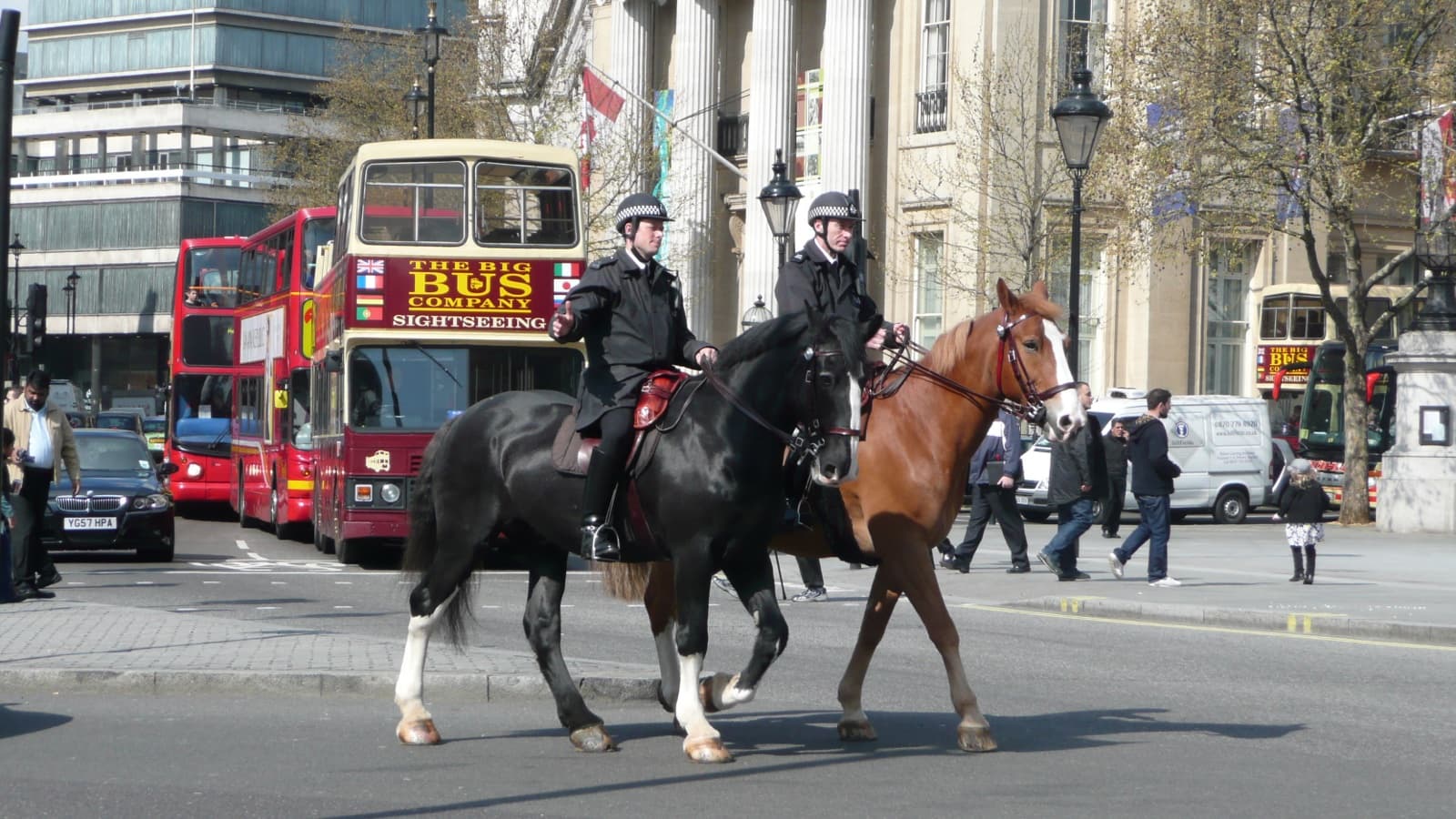
Metropolitan Police mounted officers on duty at Trafalgar Square, London · Photograph by Arriva436, 2008. CC-BY-SA-3.0. Wikimedia Commons.
One of the central civic duties of every UK resident is to know the law and to follow it. Every resident of the UK, whoever they are and wherever they come from, receives the same treatment under the law — the law applies to everyone equally.
British law is conventionally divided into two broad categories: criminal law and civil law. Criminal law deals with crimes; cases are usually investigated by the police or by other statutory agencies, and they are punished through the courts. Civil law deals with non-criminal disputes, typically between individuals or between organisations.
The police in the UK have a three-part statutory function: to protect life and property, to prevent disturbances (or 'keep the peace'), and to prevent and detect crime. The UK's police are organised into a set of separate territorial forces, each led by a Chief Constable; the forces are constitutionally independent of the government. In England and Wales, directly elected Police and Crime Commissioners (PCCs) are accountable for the delivery of efficient and effective policing in their area.
Alongside regular sworn police officers, Police Community Support Officers (PCSOs) patrol the streets, engage with members of the public, and assist warranted officers at the scene of crimes and at major public events. Members of the public are expected to help the police prevent and detect crime wherever they practically can.
Judges — collectively called 'the judiciary' — have the role of interpreting the law and of ensuring that trials are conducted fairly. Government ministers cannot direct or interfere with the judiciary's work.
The court system differs somewhat between the three legal jurisdictions of the UK. In England, Wales and Northern Ireland, most minor criminal matters are heard in a Magistrates' Court; in Scotland, equivalent minor matters go to a Justice of the Peace Court. More serious criminal cases in England, Wales and Northern Ireland are tried before a Crown Court with a judge and a jury. In Scotland, serious criminal trials take place in a Sheriff Court, with the very most serious cases (murder, for instance) reserved for a High Court.
Young defendants are dealt with in distinct structures. In England, Wales and Northern Ireland, an accused person aged between 10 and 17 is usually heard in a Youth Court before up to three specially trained magistrates or a District Judge. In Scotland, the equivalent of the Youth Court is the Children's Hearings System, which deals with children and young people who have committed offences.
County Courts deal with civil disputes across a wide range of subject matter — personal injury, family matters, breach of contract and divorce among them. For small-value civil disputes there is an informal 'small claims procedure' allowing parties to settle their claim without needing a lawyer: the procedure covers claims below £10,000 in England and Wales and below £5,000 in Scotland and Northern Ireland.
Court Hierarchy (England & Wales)
Scotland has its own system:
Sheriff Courts → High Court of Justiciary (supreme criminal court) · Court of Session (civil) · Scottish jury = 15 members
Key Facts
- •Criminal law relates to crimes investigated by the police and punished by the courts
- •Civil law is used to settle disputes between individuals or groups
- •Criminal law examples: carrying any weapon (even for self-defence); selling or buying illegal drugs (heroin, cocaine, ecstasy, cannabis); causing harassment because of religion or ethnic origin (racial crime); selling tobacco to anyone under 18; smoking in nearly every enclosed public place; selling alcohol to anyone under 18 or buying alcohol for under-18s
- •People aged 16 or over can drink alcohol with a meal in a hotel or restaurant
- •Civil law examples: housing law (disputes between landlords and tenants); consumer rights (faulty goods or services); employment law (wages, unfair dismissal, discrimination); debt
- •The job of the police is to: protect life and property; prevent disturbances (keeping the peace); prevent and detect crime
- •Police and Crime Commissioners (PCCs) in England and Wales were first directly elected in November 2012
- •Police community support officers (PCSOs) patrol the streets and support police officers at crime scenes
- •Complaints about the police in England and Wales go to the Independent Police Complaints Commission; in Scotland to the Police Complaints Commissioner; in Northern Ireland to the Police Ombudsman
- •Judges (the judiciary) are responsible for interpreting the law and ensuring trials are conducted fairly; the government cannot interfere with this
- •In England, Wales and Northern Ireland, most minor criminal cases are heard in a Magistrates' Court; in Scotland, in a Justice of the Peace Court
- •In England, Wales and Northern Ireland, serious offences are tried in a Crown Court with a judge and jury
- •In Scotland, serious cases go to a Sheriff Court; the most serious (e.g. murder) go to a High Court
- •In England, Wales and Northern Ireland a jury has 12 members; in Scotland a jury has 15 members
- •In Scotland, a third verdict of 'not proven' is possible alongside 'guilty' and 'not guilty'
- •In England, Wales and Northern Ireland, accused persons aged 10 to 17 are normally heard in a Youth Court
- •In Scotland, the Children's Hearings System deals with children and young people who have committed an offence
- •County Courts deal with civil disputes including personal injury, family matters, breaches of contract and divorce
- •The small claims procedure covers claims under £10,000 in England and Wales and under £5,000 in Scotland and Northern Ireland
- •Solicitors are trained lawyers who give advice on legal matters and represent clients in court
Key Dates
The Government and Devolution
The Prime Minister (PM) is the leader of whichever political party currently holds power. Their official residence and office is 10 Downing Street, in central London, a short walk from the Houses of Parliament, and they also have use of a country residence outside London called Chequers. The PM appoints around 20 senior MPs as ministers with responsibility for government departments; together these senior ministers form the cabinet, which typically meets weekly and takes the major decisions of government policy.
The second-largest party in the House of Commons has the formal role of the 'opposition'. The leader of the opposition is, by tradition, the person most likely to become Prime Minister if his or her party wins the next General Election. The opposition leader appoints senior colleagues as 'shadow ministers', together forming a shadow cabinet which mirrors and scrutinises each department of the governing cabinet.
Civil servants support the government in developing and implementing policy and in delivering public services. They are recruited on merit and are politically neutral — that is, they serve whichever government is in power. The civil service's statutory core values are integrity, honesty, objectivity and impartiality.
Towns, cities and rural areas across the UK are governed locally by democratically elected councils — commonly referred to as 'local authorities'. Local authorities are financed by a mixture of central government grants and local taxation. London as a whole is made up of 33 local authorities; the Greater London Authority (GLA) and the directly elected Mayor of London co-ordinate policies that cross borough boundaries.
Since 1997 the UK has been progressively devolving powers from the central government in Westminster to separately established governments in Wales, Scotland and Northern Ireland, giving each nation a degree of control over matters that most directly affect its people. Defence, foreign affairs, immigration, taxation and social security nonetheless all remain reserved to the central UK government.
The Welsh government and the National Assembly for Wales are based in Cardiff. The Assembly has 60 Assembly members (AMs) and elections are held every four years using a proportional-representation system. The Assembly has law-making power over Wales across 20 defined subject areas, and since 2011 it has been able to legislate on those devolved subjects without needing to seek the UK Parliament's consent.
The Scottish Parliament was established in 1999 and sits at Holyrood in Edinburgh. It has 129 members of the Scottish Parliament (MSPs), who are elected by proportional representation. The Scottish Parliament can legislate on any matter that has not been specifically reserved to the UK Parliament.
The Northern Ireland Assembly was set up following the Belfast Agreement (Good Friday Agreement) of 1998. It has 90 elected members, known as MLAs (Members of the Legislative Assembly), elected by proportional representation. The UK government retains the power to suspend any of the devolved assemblies — a power which has been used on several occasions in Northern Ireland.
Parliamentary proceedings are televised and are published in an official daily report called Hansard. The law requires radio and television coverage of political parties to be balanced overall.
Key Facts
- •The Prime Minister's official home is 10 Downing Street, in central London; he or she also has a country house called Chequers
- •The Prime Minister appoints about 20 senior MPs as ministers; together they form the cabinet, which meets weekly
- •Cabinet ministers include: Chancellor of the Exchequer (economy); Home Secretary (crime, policing and immigration); Foreign Secretary (foreign relations)
- •The second-largest party in the House of Commons is called the opposition; their senior MPs form the shadow cabinet
- •Prime Minister's Questions takes place every week while Parliament is sitting
- •The main political parties are: the Conservative Party, the Labour Party, the Liberal Democrats, and parties representing Scottish, Welsh or Northern Irish interests
- •Civil service core values are: integrity, honesty, objectivity and impartiality; civil servants are politically neutral
- •Local authorities are funded by money from central government and by local taxes
- •London has 33 local authorities, with the Greater London Authority and the Mayor of London coordinating policies
- •Since 1997, some powers have been devolved to Wales, Scotland and Northern Ireland; defence, foreign affairs, immigration, taxation and social security remain under central UK government control
- •There has been a Welsh Assembly and a Scottish Parliament since 1999; the Northern Ireland Assembly was established in 1998
- •The Welsh National Assembly has 60 Assembly members (AMs); elections are held every four years
- •The Assembly has power to make laws for Wales in 20 areas, including education, health, economic development and housing
- •Since 2011, the National Assembly for Wales can pass laws on devolved topics without UK Parliament agreement
- •The Scottish Parliament has 129 MSPs; it can legislate on civil and criminal law, health, education, planning and tax-raising powers
- •A Northern Ireland Parliament was established in 1922 but abolished in 1972; the Northern Ireland Assembly was re-established after the 1998 Belfast Agreement
- •The Northern Ireland Assembly has 90 MLAs; it can decide on education, agriculture, the environment, health and social services
- •The UK government has the power to suspend all devolved assemblies; it has used this power several times in Northern Ireland
- •Parliamentary proceedings are published in official reports called Hansard
- •By law, radio and television coverage of political parties must be balanced
Key Dates
Voting and Elections
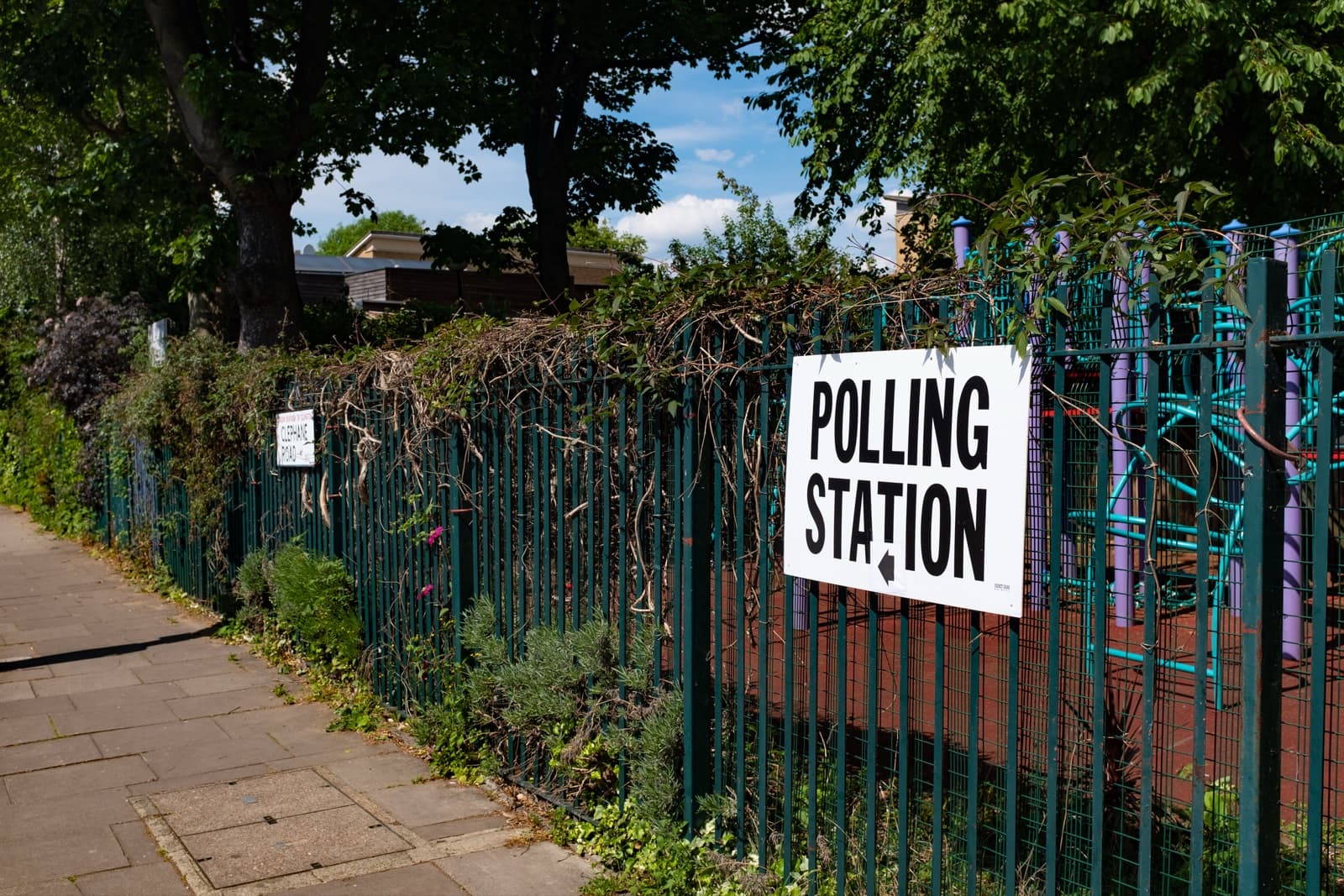
Polling station signage at Canonbury, London, during the European Parliament elections 2019 · Photograph by Russss, 2019. CC0 1.0 Universal. Wikimedia Commons.
The UK has had a fully democratic voting system since 1928. The current voting age of 18 was established in 1969, and with only a small set of exceptions every adult UK-born citizen and every adult naturalised citizen has the right to vote.
Adult citizens of the UK, together with adult citizens of the Commonwealth and of the Irish Republic who are resident in the UK, are eligible to vote in all public elections. Adult citizens of other EU member states who are resident in the UK can vote in all elections except for UK General Elections.
To cast a vote you must be listed on the electoral register. Registration is updated annually, in September or October. Northern Ireland applies a separate 'individual registration' system, under which each eligible person must complete their own registration form.
Voting in person takes place at designated polling stations (in Scotland: polling places). On election day polling stations operate from 7.00 am to 10.00 pm. In Northern Ireland the polling station requires photographic identification before it will issue a ballot. No one has the right to tell you how to vote — the ballot is secret and the choice is yours.
Most UK, Irish or Commonwealth citizens aged 18 or over are entitled to stand as candidates for public office. There are some exceptions: members of the armed forces, civil servants, and people convicted of certain serious criminal offences cannot stand. Members of the House of Lords are themselves barred from standing for election to the Commons, but are eligible for every other public office.
Proceedings in Parliament are open to the public. Both the Commons and the Lords have public galleries from which debates may be watched in person at the Palace of Westminster. The devolved legislatures have their own seats: MSPs meet at Holyrood in Edinburgh; Welsh AMs meet at the Senedd building in Cardiff Bay; and MLAs meet at Stormont in Belfast.
Key Facts
- •The UK has had a fully democratic voting system since 1928; the present voting age of 18 was set in 1969
- •Adult citizens of the UK, and citizens of the Commonwealth and the Irish Republic resident in the UK, can vote in all public elections
- •Adult citizens of other EU states resident in the UK can vote in all elections except General Elections
- •To vote, your name must be on the electoral register, which is updated every year in September or October
- •In Northern Ireland, an 'individual registration' system operates, where each eligible person must complete their own registration form
- •Polling stations are open from 7.00 am until 10.00 pm on election day
- •In Northern Ireland, you must show photographic identification at the polling station
- •No one has the right to make you vote for a particular candidate; you should make up your own mind
- •If it is difficult to get to a polling station, you can register for a postal ballot
- •Most citizens of the UK, the Irish Republic or the Commonwealth aged 18 or over can stand for public office
- •Members of the armed forces, civil servants and people guilty of certain criminal offences cannot stand for election
- •Members of the House of Lords may not stand for election to the House of Commons but are eligible for all other public offices
- •The public can listen to debates in the Palace of Westminster from public galleries in both the House of Commons and the House of Lords
- •In Scotland, MSPs meet at Holyrood in Edinburgh; in Wales, AMs meet in the Senedd in Cardiff Bay; in Northern Ireland, MLAs meet at Stormont in Belfast
The UK and International Institutions
The European Union flag — twelve gold stars in a circle on a blue background · SVG by Wikimedia contributors; flag design © Council of Europe. Public domain file; permitted usage per Council of Europe terms. Wikimedia Commons.
The Commonwealth is an association of independent countries that support each other and co-operate on shared goals in democracy and development. Most of the Commonwealth's member states were once part of the British Empire, although a handful of countries without that historical link have also chosen to join. The reigning British monarch — at present King Charles III — serves as the ceremonial head of the Commonwealth, which currently has 54 member states. Membership is voluntary. The Commonwealth is founded on the shared values of democracy, good government and the rule of law.
The European Union (EU) — formerly called the European Economic Community (EEC) — was founded by six western European states (Belgium, France, Germany, Italy, Luxembourg and the Netherlands) through the Treaty of Rome, signed on 25 March 1957. The UK initially chose not to join the new organisation but eventually joined the EEC in 1973. The UK subsequently left the EU following the 'Brexit' vote, with departure officially taking effect at 23:00 GMT on 31 January 2020. The EU now has 27 member states. With effect from 2024, no general principle of EU law forms part of UK law.
The Council of Europe is a separate and older body from the EU. It brings together 47 member countries — the UK among them — and has as its primary mission the protection and promotion of human rights within those countries. The Council has no legislative power but produces conventions and charters that the member states sign up to, the most influential being the European Convention on Human Rights.
The UK is a member of the United Nations (UN), the global international body whose membership exceeds 190 countries. The UN was founded after the Second World War with the twin aims of preventing further wars and promoting international peace and security. Its Security Council, which is responsible for recommending action in response to international crises and threats to peace, has 15 members — and the UK is one of five permanent members of the Council.
The UK also belongs to NATO — the North Atlantic Treaty Organization — a mutual-defence alliance of European and North American states. Members undertake to assist each other if any member comes under attack. NATO also has the standing purpose of maintaining peace between its own member states.
UK and International Institutions
These five organisations are often confused in the test — note the member counts and UK role
UK role: King Charles III is ceremonial head
Purpose: Promotes democracy, good government and rule of law
UK role: Left (Brexit) 31 Jan 2020 at 23:00 GMT
Purpose: Economic and political union among European states
UK role: Member; drew up the European Convention on Human Rights (ECHR)
Purpose: Promotes human rights, democracy and rule of law — separate from EU
UK role: One of 5 permanent members of the Security Council
Purpose: Maintains international peace and security
UK role: Founding member; mutual defence alliance
Purpose: Collective defence of European and North American nations
International institutions the UK participates in.
Key Facts
- •The Commonwealth is an association of countries that support each other towards shared goals in democracy and development
- •King Charles III is the ceremonial head of the Commonwealth, which currently has 54 member states
- •Commonwealth membership is voluntary; the Commonwealth can suspend membership but has no power to make laws for its members
- •The Commonwealth is based on the core values of democracy, good government and the rule of law
- •The EU was originally called the European Economic Community (EEC); it was set up by six countries who signed the Treaty of Rome on 25 March 1957
- •The six founding EEC members were: Belgium, France, Germany, Italy, Luxembourg and the Netherlands
- •The UK joined the EEC in 1973 but left the EU after the Brexit vote
- •Brexit officially took place at 23:00 GMT on 31 January 2020
- •There are now 27 EU member states
- •With effect from 2024, no general principle of EU law is part of UK law
- •The Council of Europe is separate from the EU; it has 47 member countries and is responsible for protection and promotion of human rights
- •The Council of Europe drew up the European Convention on Human Rights and Fundamental Freedoms
- •The UN has more than 190 member countries; it was set up after the Second World War to prevent war and promote international peace and security
- •The UN Security Council has 15 members; the UK is one of five permanent members
- •NATO is a group of European and North American countries that have agreed to help each other if they come under attack
Key Dates
Your Role in the Community
Becoming a British citizen or settling permanently in the UK carries responsibilities, but also opens up wide opportunities to take part in British public life. Every resident has the chance to participate in their community. The country operates around a core set of shared values and responsibilities that most people can subscribe to: obeying and respecting the law; being aware of, and respecting, the rights of other people; treating others fairly; behaving responsibly; helping and protecting your family; respecting and looking after the environment; treating everyone equally regardless of sex, race, religion, age, disability, class or sexual orientation; working to support yourself and your family; helping others; and participating in local and national democratic elections.
Registration on the electoral roll also carries a secondary civic duty: people on the electoral register may be randomly called for jury service. Jury duty applies to anyone on the register aged between 18 and 70.
Another way to contribute is to serve as a school governor (or, in Scotland, as a member of the school board). School governors are drawn from the local community, must be aged 18 or over, and take on three formal duties: setting the strategic direction of the school, ensuring that the school is held to account, and monitoring and evaluating the school's performance.
Political engagement can also take the form of joining a political party, which is a direct way to act on your own political beliefs and to take part in the democratic process. Policing offers additional volunteering routes: individuals can join their local force as a special constable or serve as a lay (non-police) representative, and can also apply to become a magistrate.
Donated blood is a vital clinical resource for hospitals, supporting treatment across a wide range of injuries and illnesses. The donation process takes roughly an hour. Organ donation is a further important volunteer commitment, given the many patients on UK transplant waiting lists — you can register as an organ donor at www.organdonation.nhs.uk. Living donors can also donate a kidney.
Volunteering — contributing your time to a good cause without being paid for it — is widespread in the UK, which has thousands of active registered charities and voluntary organisations. One formal national programme is the National Citizen Service, which offers 16- and 17-year-olds the chance to take part in outdoor activities, develop practical skills and contribute to a community-based project.
Environmental responsibility is another everyday civic theme. Recycling as much of your household waste as possible reduces the volume of rubbish going to landfill and reduces the energy needed to produce new goods. Shopping at local businesses supports farmers and retailers in your area and helps to lower your carbon footprint. Walking, cycling or using public transport in place of a private car produces less pollution and puts less strain on the environment.
Key Facts
- •Shared values and responsibilities include: obeying and respecting the law; respecting the rights of others; treating others with fairness; behaving responsibly; helping and protecting your family; respecting and preserving the environment; treating everyone equally regardless of sex, race, religion, age, disability, class or sexual orientation; working to provide for yourself and your family; helping others; voting in elections
- •People on the electoral register aged 18 to 70 can be randomly selected to serve on a jury
- •Parents can often help in classrooms by supporting activities or listening to children read; many schools organise fundraising events through parent-teacher associations (PTAs)
- •School governors (school board members in Scotland) must be aged 18 or over and have three key roles: setting the strategic direction of the school; ensuring accountability; monitoring and evaluating school performance
- •You can volunteer with the police as a special constable or lay (non-police) representative
- •You can apply to become a magistrate
- •Donated blood is used by hospitals to help people with a wide range of injuries and illnesses; giving blood takes about an hour
- •You can register as an organ donor at www.organdonation.nhs.uk; living people can also donate a kidney
- •Charities you should know include: British Red Cross, Age UK, NSPCC (National Society for the Prevention of Cruelty to Children), Crisis, Shelter, Cancer Research UK, National Trust, Friends of the Earth, PDSA (People's Dispensary for Sick Animals)
- •The National Citizen Service gives 16- and 17-year-olds the opportunity to enjoy outdoor activities, develop skills and take part in a community project
- •It is important to recycle as much waste as you can; using recycled materials uses less energy and reduces the amount sent to landfill
- •Shopping locally helps businesses and farmers in your area and reduces your carbon footprint
- •Walking and using public transport helps protect the environment by creating less pollution than using a car
Chapter Summary
All key facts from this chapter at a glance — read this to revise the full chapter quickly.
Chapter Summary
Quick revision- ✓The Chartists (1830s–1840s) campaigned for six changes: every man to have the vote; annual elections; equal regions in the electoral system; secret ballots; any man to stand as an MP; MPs to be paid
- ✓At the turn of the 19th century, only men over 21 who owned a certain amount of property could vote
- ✓1918 — women over 30 gained the right to vote; most Chartist reforms adopted
- ✓1928 — the right to vote was extended to men and women over 21; 1969 — the voting age was reduced to 18
- ✓The British constitution is described as 'unwritten' because it is not contained in a single document
- ✓The main constitutional institutions of the UK are: the monarchy; Parliament (House of Commons and House of Lords); the Prime Minister; the cabinet; the judiciary (courts); the police; the civil service; local government
- ✓Devolved governments in Scotland, Wales and Northern Ireland have the power to legislate on certain issues
- ✓Queen Elizabeth II reigned from 1952; celebrated her Diamond Jubilee in 2012; died 8 September 2022
- ✓King Charles III has been the sovereign since 2022; his heir apparent is William, Prince of Wales; William's children (Prince George, Princess Charlotte, Prince Louis) are next in line
- ✓Prince Edward became the Duke of Edinburgh in 2023
- ✓The National Anthem is 'God Save the King (or Queen)'; new citizens swear or affirm loyalty to the King as part of the citizenship ceremony
- ✓The monarch opens the new parliamentary session each year with a speech summarising government policies; all Acts of Parliament are made in the Majesty's name
- ✓MPs have four responsibilities: represent everyone in their constituency; help create new laws; scrutinise the government; debate important national issues
- ✓A General Election is held at least every five years; if an MP dies or resigns, a by-election is held in that constituency
- ✓MPs are elected through the 'first past the post' system: the candidate with the most votes wins
- ✓The Speaker chairs debates in the House of Commons, is neutral and does not represent a political party; chosen by MPs in a secret ballot
- ✓Members of the House of Lords are known as peers; they are not elected and do not represent a constituency
- ✓Until 1958, all peers were either hereditary, senior judges, or bishops of the Church of England; since 1958 the PM can nominate life peers
- ✓Since 1999, hereditary peers have lost the automatic right to attend the House of Lords
- ✓The House of Lords can suggest amendments, propose new laws and check laws passed by the House of Commons; the House of Commons can overrule the Lords
- ✓The European Convention on Human Rights includes: right to life; prohibition of torture and slavery; right to liberty and security; right to a fair trial; freedom of thought, conscience and religion; freedom of expression
- ✓The UK was one of the first countries to sign the European Convention on Human Rights in 1950
- ✓The Human Rights Act 1998 incorporated the European Convention on Human Rights into UK law
- ✓UK laws ensure people are not treated unfairly because of age, disability, sex, pregnancy, race, religion, sexuality or marital status
- ✓Domestic violence is a serious crime; the 24-hour National Domestic Violence Freephone Helpline is 0808 2000 247
- ✓Female genital mutilation (FGM) is illegal in the UK; practising it or taking someone abroad for it is a criminal offence
- ✓Forced marriage is a criminal offence; arranged marriages (with full consent of both parties) are acceptable in the UK
- ✓Income tax is paid on wages, self-employment profits, pensions, and income from property, savings and dividends; money raised pays for roads, education, police and the armed forces
- ✓The PAYE system automatically deducts tax from employment income; self-employed people use 'self-assessment'
- ✓Almost everybody in paid work must pay National Insurance Contributions, used for state benefits including the state pension and NHS; all young people receive a National Insurance number just before their 16th birthday
- ✓You must be at least 17 to drive a car or motorbike; at least 16 to ride a moped; you must pass a theory test and a practical driving test to get a UK driving licence
- ✓Drivers can use their licence until age 70; after that it is valid for three years at a time; in Northern Ireland newly qualified drivers must display an 'R' plate for one year
- ✓EU, Iceland, Liechtenstein and Norway licence holders can drive in the UK for as long as their licence is valid; other country holders can drive for up to 12 months
- ✓It is a serious criminal offence to drive without insurance; vehicles over three years old must have an annual MOT test
- ✓Criminal law relates to crimes investigated by the police; civil law settles disputes between individuals or groups
- ✓Criminal law examples: carrying any weapon; selling/buying illegal drugs; causing racial harassment; selling tobacco or alcohol to under-18s; smoking in nearly every enclosed public place
- ✓Civil law examples: housing disputes (landlord/tenant); consumer rights; employment law; debt
- ✓The job of the police: protect life and property; prevent disturbances; prevent and detect crime
- ✓Police and Crime Commissioners (PCCs) in England and Wales were first directly elected in November 2012
- ✓Police community support officers (PCSOs) patrol the streets and support police officers at crime scenes
- ✓Judges (the judiciary) are responsible for interpreting the law and ensuring trials are conducted fairly; the government cannot interfere
- ✓In England, Wales and Northern Ireland, most minor criminal cases are heard in a Magistrates' Court; in Scotland in a Justice of the Peace Court
- ✓Serious offences in England, Wales and Northern Ireland are tried in a Crown Court with a judge and jury; in Scotland in a Sheriff Court or High Court
- ✓A jury has 12 members in England, Wales and Northern Ireland; 15 members in Scotland; in Scotland a third verdict of 'not proven' is also possible
- ✓Accused persons aged 10 to 17 are normally heard in a Youth Court in England, Wales and Northern Ireland; in Scotland the Children's Hearings System
- ✓County Courts deal with civil disputes; small claims procedure covers under £10,000 (England/Wales) and under £5,000 (Scotland/Northern Ireland)
- ✓The Prime Minister's official home is 10 Downing Street; also has a country house called Chequers
- ✓The Prime Minister appoints about 20 senior MPs as ministers forming the cabinet, which meets weekly; key ministers include the Chancellor of the Exchequer, Home Secretary and Foreign Secretary
- ✓The second-largest party in the House of Commons is the opposition; their senior MPs form the shadow cabinet
- ✓Civil service core values are: integrity, honesty, objectivity and impartiality; civil servants are politically neutral
- ✓Local authorities are funded by central government and local taxes; London has 33 local authorities coordinated by the Greater London Authority and the Mayor of London
- ✓Since 1997, some powers have been devolved to Wales, Scotland and Northern Ireland; defence, foreign affairs, immigration, taxation and social security remain under central UK government control
- ✓Welsh National Assembly has 60 AMs; elections every four years using proportional representation; power to make laws for Wales in 20 areas; since 2011 can pass laws on devolved topics without UK Parliament agreement
- ✓Scottish Parliament (formed 1999) has 129 MSPs; can legislate on civil/criminal law, health, education, planning and tax-raising powers
- ✓Northern Ireland Parliament established 1922; abolished 1972; the Northern Ireland Assembly was re-established after the 1998 Belfast Agreement and has 90 MLAs
- ✓The UK government has the power to suspend all devolved assemblies; it has used this power several times in Northern Ireland
- ✓Parliamentary proceedings are published in official reports called Hansard; by law, TV and radio coverage of political parties must be balanced
- ✓The UK has had a fully democratic voting system since 1928; the present voting age of 18 was set in 1969
- ✓Adult citizens of the UK, Commonwealth and Irish Republic resident in the UK can vote in all public elections; adult EU citizens can vote in all elections except General Elections
- ✓To vote, your name must be on the electoral register, updated every year in September or October; in Northern Ireland an individual registration system operates and photographic ID is required at the polling station
- ✓Polling stations are open from 7.00 am until 10.00 pm on election day; if difficult to attend, you can register for a postal ballot
- ✓Most citizens of the UK, Irish Republic or Commonwealth aged 18 or over can stand for public office; exceptions include members of the armed forces, civil servants and people guilty of certain criminal offences
- ✓MSPs meet at Holyrood in Edinburgh; AMs meet in the Senedd in Cardiff Bay; MLAs meet at Stormont in Belfast
- ✓The Commonwealth has 54 member states; King Charles III is the ceremonial head; it is based on democracy, good government and the rule of law
- ✓The EEC was set up by six countries (Belgium, France, Germany, Italy, Luxembourg, Netherlands) who signed the Treaty of Rome on 25 March 1957; the UK joined in 1973
- ✓Brexit officially took place at 23:00 GMT on 31 January 2020; there are now 27 EU member states; from 2024, no general principle of EU law is part of UK law
- ✓The Council of Europe (separate from the EU) has 47 member countries and is responsible for human rights protection; it drew up the European Convention on Human Rights
- ✓The UN has more than 190 member countries; set up after WWII to prevent war; the UK is one of five permanent members of the UN Security Council
- ✓NATO is a group of European and North American countries that have agreed to help each other if they come under attack
- ✓Shared values and responsibilities include: obeying and respecting the law; respecting the rights of others; treating others fairly; behaving responsibly; respecting the environment; treating everyone equally; voting in elections
- ✓People on the electoral register aged 18 to 70 can be randomly selected to serve on a jury
- ✓School governors must be aged 18 or over; their three key roles are: setting strategic direction; ensuring accountability; monitoring and evaluating school performance
- ✓You can volunteer with the police as a special constable or lay representative, or apply to become a magistrate
- ✓You can donate blood (giving blood takes about an hour) and register as an organ donor at www.organdonation.nhs.uk; living people can also donate a kidney
- ✓The National Citizen Service gives 16- and 17-year-olds the opportunity to enjoy outdoor activities, develop skills and take part in a community project
- ✓It is important to recycle waste, shop locally and walk or use public transport to help protect the environment
Test Yourself on This Chapter
Ready to practice? Take a focused test on this topic.