A Global Power
20 min read·Last updated: April 2026
In this chapter
- 1. Constitutional Monarchy – The Bill of Rights
- 2. A Growing Population
- 3. The Act of Union (Treaty of Union) in Scotland
- 4. The Prime Minister
- 5. The Rebellion of the Clans
- 6. The Enlightenment
- 7. Before the Industrial Revolution
- 8. The Industrial Revolution
- 9. The Slave Trade
- 10. The American War of Independence
- 11. War with France
- 12. The Union Flag
- 13. The Victorian Age
- 14. The British Empire
- 15. Trade and Industry
- 16. The Crimean War
- 17. Ireland in the 19th Century
- 18. The Right to Vote
- 19. The Future of the Empire
- 20. Chapter Summary
Constitutional Monarchy – The Bill of Rights
At the joint coronation of William III and Mary II in 1689, a document known as the Declaration of Rights was read aloud. Its effect was to confirm that, henceforth, the monarch would not be able to levy taxes or administer justice without the agreement of Parliament. The constitutional balance between monarch and Parliament had now been permanently reset in Parliament's favour. The same year, the Bill of Rights was passed — formally enshrining Parliament's powers and placing clear limits on the Crown. Parliament took direct control of the succession itself, declaring that the monarch must always be a Protestant. A new Parliament was required to be elected at least every three years (a period that was later extended to seven years and more recently fixed at five). Each year, the monarch had to come to Parliament and ask for renewed funding for the army and navy.
The practical consequence of the new settlement was that the Crown could no longer govern without the support of ministers who could reliably command a majority in both Houses of Parliament. Two rival parliamentary groupings took recognisable shape at this point — the Whigs and the Tories. (The modern Conservative Party continues to be referred to colloquially as the Tories.) British party politics begins here.
The same period saw the emergence of a free press — newspapers and other publications operating outside direct government control. From 1695, printed newspapers no longer required a government licence to operate, and the number and variety of papers published in the country grew rapidly thereafter.
The laws passed in the aftermath of the Glorious Revolution mark the beginning of what is generally called 'constitutional monarchy'. The monarch remained politically significant, but could no longer impose particular policies or actions on the country in the teeth of Parliament's disagreement. After William III, ministers became progressively more important than the monarch in day-to-day government. None of this, however, yet amounted to democracy in the modern sense. The body of men entitled to vote for members of Parliament remained small: only men who owned property above a certain monetary value had the franchise, and no women at all could vote. Some parliamentary constituencies were effectively controlled by a single wealthy family and were known as 'pocket boroughs'; others had almost no voters at all and were known as 'rotten boroughs'.
UK Government Structure
The Monarch is Head of State. Parliament makes laws. The PM leads the government.
Key Facts
- •The Declaration of Rights was read at the coronation of William and Mary
- •The Bill of Rights (1689) confirmed the rights of Parliament and the limits of the king's power
- •Parliament took control of who could be monarch and declared that the king or queen must be a Protestant
- •A new Parliament had to be elected at least every three years (later seven, now five)
- •Every year the monarch had to ask Parliament to renew funding for the army and the navy
- •The two main groups in Parliament were known as the Whigs and the Tories — the beginning of party politics
- •From 1695, newspapers were allowed to operate without a government licence
- •'Pocket boroughs' were constituencies controlled by a single wealthy family
- •'Rotten boroughs' were constituencies with hardly any voters
- •Only men who owned property of a certain value were able to vote; no women had the vote
Key Dates
A Growing Population
This period was characterised by substantial population movement in both directions. Many people left Britain and Ireland to settle in the new American colonies and other overseas territories, while others arrived to live in Britain. A Jewish community re-established itself in Britain in 1656 — the first formally recorded since the medieval expulsion — initially settling in London. Between 1680 and 1720, substantial numbers of Huguenot refugees arrived from France: French Protestants, they had been persecuted for their religion at home. Many of the Huguenots were educated and skilled, and worked in Britain as scientists, bankers, weavers and craftspeople of other kinds.
Key Facts
- •The first Jews to come to Britain since the Middle Ages settled in London in 1656
- •Between 1680 and 1720 many Huguenot refugees came from France
- •The Huguenots were Protestants persecuted for their religion
- •Many Huguenots were educated and skilled and worked as scientists, in banking, or in weaving or other crafts
Key Dates
The Act of Union (Treaty of Union) in Scotland
William and Mary's successor on the throne was Mary's sister Anne, who had no surviving children. Her childlessness raised serious constitutional uncertainty over the royal succession in England, Wales and Ireland — and equally in Scotland. In 1707, as a resolution, the Act of Union (known in Scotland as the Treaty of Union) was agreed between the two parliaments, creating the new Kingdom of Great Britain. Scotland ceased from that point to be an independent country, but the Union settlement preserved its own distinct legal system, its own education system, and the Presbyterian Church of Scotland as its national Church.
Key Facts
- •Queen Anne, William and Mary's successor, had no surviving children
- •The Act of Union (Treaty of Union in Scotland) was agreed in 1707
- •The Act of Union created the Kingdom of Great Britain
- •Scotland kept its own legal and education systems and Presbyterian Church
Key Dates
The Prime Minister
Queen Anne died in 1714. Parliament chose her nearest Protestant relative, a German prince named George, as her successor — he took the throne as George I. An attempt by Scottish Jacobites to install James II's son on the throne in George's place was quickly defeated. George I did not speak very good English, which in practice meant he relied heavily on his ministers for the day-to-day business of government. Out of that practical reliance, the office of Prime Minister effectively emerged: the most important minister in Parliament became known as the Prime Minister. The first to be called by that title was Sir Robert Walpole, who held the post from 1721 to 1742.
UK Government Structure
The Monarch is Head of State. Parliament makes laws. The PM leads the government.
Key Facts
- •Queen Anne died in 1714 and Parliament chose George I (a German) as her successor because he was her nearest Protestant relative
- •An attempt by Scottish Jacobites to put James II's son on the throne was quickly defeated
- •George I did not speak very good English and relied on his ministers
- •The most important minister became known as the Prime Minister
- •Sir Robert Walpole was the first Prime Minister (1721–1742)
Key Dates
The Rebellion of the Clans
In 1745 there was a further Jacobite attempt — a renewed effort to restore a Stuart king to the throne, this time in place of George II (who had succeeded his father George I). Charles Edward Stuart, popularly remembered as Bonnie Prince Charlie and a grandson of James II, landed in Scotland and raised an army drawn from the clansmen of the Scottish Highlands. Charles had some early successes, but in 1746 he was decisively defeated by George II's forces at the Battle of Culloden. Charles escaped back to Europe.
The long-term effect of Culloden on Highland society was dramatic. The clans lost a great deal of their old political power and influence. Chieftains who retained favour with the English crown were effectively converted into landlords, while the clansmen they had traditionally led were in turn turned into rent-paying tenants on the land they worked.
The transition eventually hardened into what became known as the 'Highland Clearances'. Many Scottish landlords dismantled individual small farms — crofts — on their estates to create space for large-scale sheep and cattle farming. Evictions became widespread in the early 19th century. Substantial numbers of displaced Scottish families emigrated to North America in this period.
Robert Burns (1759–96), known in Scotland as 'The Bard', was the country's defining poet of the age. Burns wrote in three registers — the Scots language, English with a sprinkling of Scottish words, and standard English — and he also extensively reworked traditional folk songs by altering or adding lyrics. His single most enduring piece is probably the song Auld Lang Syne, which is sung around the world (and particularly in the UK) at New Year — the Scottish celebration of Hogmanay.
Key Facts
- •In 1745 Charles Edward Stuart (Bonnie Prince Charlie), grandson of James II, landed in Scotland
- •He was supported by clansmen from the Scottish highlands
- •Charles was defeated by George II's army at the Battle of Culloden in 1746
- •After Culloden the clans lost much of their power and influence
- •The 'Highland Clearances' saw small farms ('crofts') destroyed to make room for sheep and cattle
- •Many Scottish people left for North America in the early 19th century
- •Robert Burns (1759–96), known as 'The Bard', was a Scottish poet
- •Burns wrote in the Scots language, English with some Scottish words, and standard English
- •Burns' best-known work is probably the song Auld Lang Syne, sung at New Year (Hogmanay)
Key Dates
The Enlightenment
The 18th century saw a rapid flowering of new ideas across politics, philosophy and science — the period commonly called 'the Enlightenment'. An unusually large share of the era's most important thinkers were Scottish. Adam Smith produced work on economics that remains influential today; David Hume's analyses of human nature are still argued about by philosophers; and scientific developments such as James Watt's advances in steam power directly fed into the Industrial Revolution that was beginning to reshape Britain. One of the most important of the Enlightenment's operating principles was that every individual should have the right to hold and to act on their own political and religious beliefs, and that the state should not seek to dictate those beliefs. This principle continues to underpin British public life today.
Key Facts
- •The Enlightenment developed new ideas about politics, philosophy and science in the 18th century
- •Many of the great Enlightenment thinkers were Scottish
- •Adam Smith developed ideas about economics still referred to today
- •David Hume's ideas about human nature continue to influence philosophers
- •James Watt's work on steam power helped the progress of the Industrial Revolution
- •A core Enlightenment principle was that everyone should have the right to their own political and religious beliefs
Before the Industrial Revolution
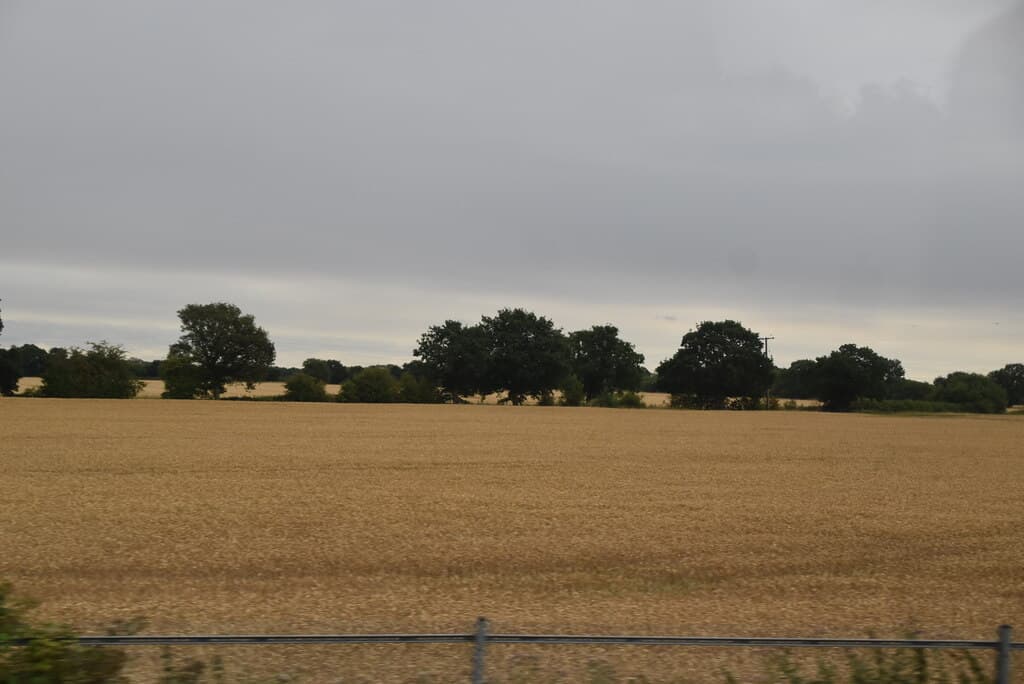
Ripening wheat, Moss, South Yorkshire · N Chadwick (Geograph Britain and Ireland), 2022. CC-BY-SA-2.0. Wikimedia Commons.
Prior to the 18th century, agriculture was overwhelmingly the largest single source of employment in Britain. Alongside farm work, much manufacturing took place in the form of 'cottage industries' — in which individuals and families worked from their own homes to produce goods such as cloth and lace for sale.
Key Facts
- •Before the 18th century, agriculture was the biggest source of employment in Britain
- •Cottage industries produced goods such as cloth and lace from home
The Industrial Revolution
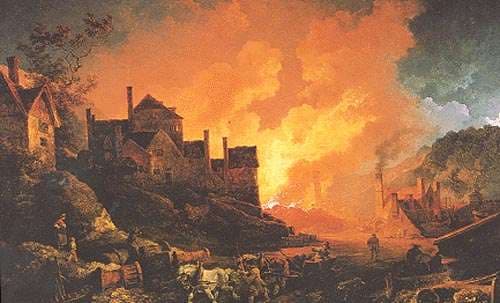
Coalbrookdale by Night (Philip James de Loutherbourg, 1801) · Philip James de Loutherbourg (1740–1812), Coalbrookdale by Night, 1801, Science Museum London. Public domain (PDM 1.0). Wikimedia Commons.
The Industrial Revolution describes the rapid development of modern industry in Britain across the 18th and 19th centuries. Britain was the first country in the world to industrialise at national scale. The process was driven by two linked developments: the invention and refinement of power machinery, and the widespread adoption of steam power to drive it. Both agriculture and the manufacture of consumer goods were progressively mechanised, improving productivity and expanding output. The new factories required coal and other raw materials in large quantities to keep them running, and a very large rural population migrated to work in the new mining and manufacturing trades.
Alongside textiles and power machinery, the development of the Bessemer process for the mass production of steel enabled two further transformative industries — large-scale shipbuilding, and the railways. Across the decades of industrialisation, manufacturing overtook agriculture as the primary source of paid employment in Britain.
Richard Arkwright (1732–92) originally trained and worked as a barber, with a sideline in wig-making and hair dyeing. When wigs went out of fashion he redirected his energies to the textile trade. Arkwright improved the existing carding machine — carding being the preparatory process of combing raw fibres so they can be spun into yarn — and went on to develop horse-driven spinning mills organised around a single central machine. The combination sharply increased the efficiency of textile production. Later he adopted steam engines to power the same machinery. Arkwright is particularly remembered not so much for any one invention as for the efficient, profitable, and tightly-organised way in which he ran his integrated factory operations.
Industrialisation required better transport infrastructure to move raw materials into factories and finished goods out of them. A national network of canals was built during this period to link factories in the new industrial regions — particularly in the middle and north of England — to the towns, cities and ports.
Working conditions in the new factories were, by modern standards, very poor. There was little or no regulatory protection for employees; hours were long, and the work was often dangerous. Children also worked in factories, on much the same terms as adult workers — sometimes on worse ones.
Overseas, this was also a period of rapid colonial expansion. Captain James Cook charted the coast of Australia and a small number of British colonies were established there. Britain took control of Canada, and the East India Company — originally a trading operation — progressively took over direct control of much of the Indian subcontinent. Colonies were also established in southern Africa.
British trade now extended around the world, and imports rose sharply. Sugar and tobacco arrived in Britain from North America and the West Indies; textiles, tea and spices came in from India and from the region we now call Indonesia. Overseas trading and settlement also frequently brought Britain into direct conflict with France, which was expanding along broadly similar lines into many of the same parts of the world.
Sake Dean Mahomet (1759–1851) was born in the Bengal region of India and served in the Bengal army before coming to Britain in 1782. He subsequently moved to Ireland, where he eloped in 1786 with an Irish woman named Jane Daly, and returned to England around the turn of the century. In 1810 he opened the Hindoostane Coffee House in George Street, London — the first curry house in Britain. Mahomet and his wife also introduced the UK to 'shampooing' — the Indian practice of therapeutic head massage.
Key Facts
- •Britain was the first country to industrialise on a large scale
- •The Industrial Revolution was driven by machinery and steam power
- •Agriculture and manufacturing became mechanised, increasing production
- •Coal and other raw materials were needed to power the new factories
- •Many people moved from the countryside into mining and manufacturing
- •The Bessemer process enabled mass production of steel, supporting shipbuilding and railways
- •Manufacturing jobs became the main source of employment in Britain
- •Richard Arkwright (1732–92) originally trained and worked as a barber, able to dye hair and make wigs
- •Arkwright improved the carding machine — the process of preparing fibres for spinning into yarn and fabric
- •Arkwright developed horse-driven spinning mills that used only one machine, increasing efficiency of production
- •Arkwright later used the steam engine to power machinery
- •Arkwright is particularly remembered for the efficient and profitable way he ran his factories
- •Canals were built to link factories to towns, cities and ports, particularly in the middle and north of England
- •Working conditions during the Industrial Revolution were very poor; there were no laws to protect employees
- •Children worked and were treated in the same way as adults — sometimes more harshly
- •Captain James Cook mapped the coast of Australia and a few colonies were established there
- •Britain gained control over Canada
- •The East India Company, originally set up to trade, gained control of large parts of India
- •Colonies began to be established in southern Africa
- •Sugar and tobacco came from North America and the West Indies
- •Textiles, tea and spices came from India and the area that is today called Indonesia
- •Trading sometimes brought Britain into conflict with other countries, particularly France
- •Sake Dean Mahomet (1759–1851) was born in the Bengal region of India and served in the Bengal army
- •Mahomet came to Britain in 1782, then moved to Ireland and eloped with an Irish girl called Jane Daly in 1786
- •In 1810 Mahomet opened the Hindoostane Coffee House in George Street, London — the first curry house in Britain
- •Mahomet and his wife introduced 'shampooing', the Indian art of head massage, to Britain
Key Dates
The Slave Trade
A significant part of Britain's commercial growth and accumulated prosperity in this period was built on the slave trade. Slavery itself was illegal within Britain, but by the 18th century it had become a fully developed overseas industry — one dominated jointly by Britain and the American colonies. Slaves were taken overwhelmingly from West Africa, shipped across the Atlantic in brutal conditions on British vessels, and forced to work on tobacco and sugar plantations in North America and the Caribbean. Conditions of both life and labour for enslaved people were extremely poor. Many tried to escape; others mounted direct revolts against their owners in protest.
A domestic British opposition to the slave trade gathered strength nonetheless. The first formal anti-slavery groups in Britain were organised by the Quakers in the late 1700s and submitted petitions to Parliament calling for the trade to be banned. William Wilberforce, an evangelical Christian and a sitting MP, played a particularly prominent role in shifting both public opinion and the parliamentary arithmetic. In 1807, together with other abolitionists, he succeeded in getting Parliament to make it illegal to trade slaves on British ships or out of British ports. Full abolition across the whole of the British Empire followed in 1833 with the Emancipation Act. The Royal Navy subsequently intercepted slave ships of other nations, freed the slaves carried on them, and punished the slave traders. After 1833, roughly 2 million Indian and Chinese labourers were brought into colonial workforces across the Empire to replace the labour previously extracted from enslaved people — working on Caribbean sugar plantations, in South African mines, on East African railways, and in the army in Kenya.
Key Facts
- •Slavery was illegal within Britain itself but was a fully established overseas industry by the 18th century
- •Slaves came primarily from West Africa and worked on tobacco and sugar plantations in America and the Caribbean
- •The first formal anti-slavery groups were set up by the Quakers in the late 1700s
- •William Wilberforce, an evangelical Christian and MP, helped turn public opinion against the slave trade
- •In 1807 it became illegal to trade slaves in British ships or from British ports
- •In 1833 the Emancipation Act abolished slavery throughout the British Empire
- •The Royal Navy stopped slave ships from other countries and freed the slaves
- •After 1833, 2 million Indian and Chinese workers replaced the freed slaves across the Empire
Key Dates
The American War of Independence
By the 1760s Britain had established substantial colonial populations in North America. The colonies were wealthy and, by colonial standards, unusually self-governing in practice. Many of the original colonist families had gone to America in the 17th century explicitly in order to secure religious freedom, and the colonial population was on the whole well educated and increasingly attracted to ideas about political liberty. When the British government sought to increase the tax revenue it raised from the colonies, the colonists saw the move as an attack on their established freedoms and responded with the slogan 'no taxation without representation' in the British Parliament. Parliament made efforts to compromise by repealing some of the new taxes, but the relationship between Westminster and the colonies continued to deteriorate. Armed clashes between colonists and British soldiers followed. In 1776 thirteen of the American colonies formally declared their independence, asserting a right of the people to establish governments of their own choosing. The colonists ultimately defeated the British army, and Britain formally recognised American independence in 1783.
Key Facts
- •By the 1760s there were substantial British colonies in North America
- •Many colonist families had gone to North America for religious freedom
- •The colonists' slogan was 'no taxation without representation' in the British Parliament
- •In 1776, 13 American colonies declared their independence
- •Britain recognised the colonies' independence in 1783
Key Dates
War with France
Through much of the 18th century, Britain fought a recurring series of wars against France. When in 1789 a revolution broke out in France, the new revolutionary French government quickly declared war on Britain. Napoleon, who rose to take the title of Emperor of France, prosecuted that war against Britain across the next two decades. Britain's navy engaged combined French and Spanish fleets at sea and famously defeated them at the Battle of Trafalgar in 1805. The British fleet at Trafalgar was commanded by Admiral Nelson, who was himself killed in the battle. Nelson is commemorated in Trafalgar Square in London by Nelson's Column, and his flagship — HMS Victory — is preserved and can still be visited in Portsmouth. The British army was also engaged against France on land. The Napoleonic Wars came to an end in 1815 with the defeat of Napoleon by the Duke of Wellington at the Battle of Waterloo. Wellington — nicknamed 'the Iron Duke' — subsequently entered politics and in time became Prime Minister.
British History at a Glance
- Stone Age~10,000 BC
Hunter-gatherers; Stonehenge (~3000 BC)
- Iron Age / Celts~750 BC
Celtic peoples; Beaker people
- RomansAD 43–410
Claudius invades; Hadrian's Wall; Boudicca
- Anglo-SaxonsAD 410–1066
Athelstan (first King of England); Alfred the Great
- VikingsAD 789–1066
Raids and Danelaw; Canute rules England
- Normans & Medieval1066–1485
Battle of Hastings; Magna Carta 1215; Bannockburn 1314
- Tudors & Stuarts1485–1714
Henry VIII; Elizabeth I; Civil War; Glorious Revolution 1688
- Georgian / Empire1714–1837
First PM (Walpole 1721); Industrial Revolution; Waterloo 1815
- Victorian1837–1901
Great Exhibition 1851; Slavery abolished; Suffragettes
- 20th Century1901–2000
WWI; WWII; NHS 1948; Windrush; Thatcher
Key Facts
- •In 1789 there was a revolution in France and the new French government declared war on Britain
- •Napoleon, who became Emperor of France, continued the war
- •The Battle of Trafalgar (1805) saw Britain's navy defeat combined French and Spanish fleets
- •Admiral Nelson commanded the British fleet at Trafalgar and was killed in the battle
- •Nelson's Column in Trafalgar Square, London, is a monument to Admiral Nelson
- •Nelson's ship, HMS Victory, can be visited in Portsmouth
- •In 1815 the French Wars ended with Napoleon's defeat at the Battle of Waterloo
- •The Duke of Wellington defeated Napoleon and was known as the Iron Duke
- •Wellington later became Prime Minister
Key Dates
The Union Flag
Ireland had shared a monarch with England and Wales since the reign of Henry VIII, but it had remained constitutionally a separate kingdom. That arrangement ended with the Act of Union of 1800, which took effect in 1801 and formally united Ireland politically with England, Scotland and Wales. The new entity was named the United Kingdom of Great Britain and Ireland. The symbolic expression of the union was a new official flag — the Union Flag, widely referred to as the Union Jack — which combined the crosses associated with the three individual nations of England, Scotland and Ireland. The flag is still in use today as the official flag of the UK.
The Union Flag is built up from three saints' crosses:
Wales has its own separate official flag featuring the Welsh dragon. The Welsh dragon is not included in the Union Flag because, at the time the first version of the Union Flag was drawn up in 1606 — combining the flags of Scotland and England — Wales was already constitutionally united with England and therefore had no separate standing to add.
What is the Union Jack made of?
Why isn't Wales in the Union Jack? Wales was already united with England when the Union Flag was first created in 1606 (combining England and Scotland). Wales is represented by the red dragon flag (Y Ddraig Goch).
Key Facts
- •The cross of St George, patron saint of England, is a red cross on a white ground.
- •The cross of St Andrew, patron saint of Scotland, is a diagonal white cross on a blue ground.
- •The cross of St Patrick, patron saint of Ireland, is a diagonal red cross on a white ground.
- •The Act of Union of 1800 unified Ireland with England, Scotland and Wales from 1801
- •This created the United Kingdom of Great Britain and Ireland
- •The Union Flag is often called the Union Jack
- •The Welsh dragon does not appear on the Union Flag because when the first Union Flag was created in 1606 from the flags of Scotland and England, the Principality of Wales was already united with England
Key Dates
The Victorian Age
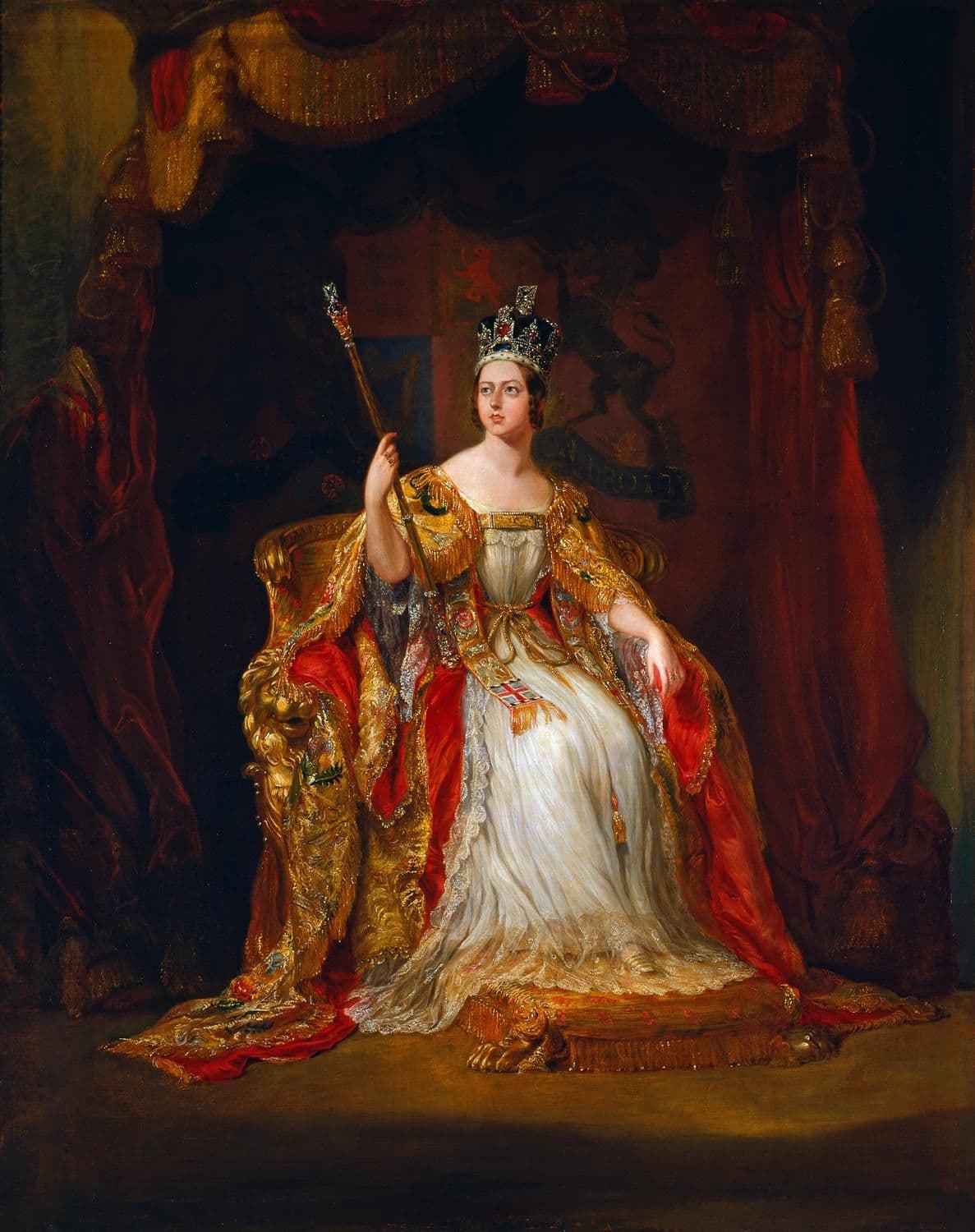
Coronation portrait of Queen Victoria (George Hayter, 1838) · George Hayter (1792–1871), Coronation Portrait of Queen Victoria, 1838. Public domain (PD-Art). Wikimedia Commons.
Queen Victoria came to the throne of the UK in 1837 at the age of 18, and her reign continued until 1901 — a span of almost 64 years. At the time the present chapter's source material was compiled (2013), that was the longest reign of any British monarch (a record since surpassed by Queen Elizabeth II). The period as a whole is usually referred to as the Victorian Age. It was marked by a substantial increase in British power and influence abroad. At home, the middle classes grew steadily in economic and political weight, and a broad group of reformers worked to improve the living conditions of the poor.
Key Facts
- •Queen Victoria became queen of the UK in 1837 at the age of 18
- •She reigned until 1901 — almost 64 years
- •At the date of writing (2013) this was the longest reign of any British monarch
- •Her reign is known as the Victorian Age
- •Britain increased in power and influence abroad during the Victorian Age
- •The middle classes became increasingly significant and reformers led moves to improve conditions for the poor
Key Dates
The British Empire
The Victorian Age saw the British Empire expand to cover the whole of India, the whole of Australia, and large parts of Africa. At its peak it was the largest empire the world has ever seen, with an estimated population of over 400 million people under British rule.
The era was marked by substantial population movement in both directions. People were widely encouraged to leave the UK to settle in the colonies and dominions overseas: between 1853 and 1913 as many as 13 million British citizens left the country to build lives abroad. Migration into Britain continued in parallel. Between 1870 and 1914 roughly 120,000 Russian and Polish Jews came to Britain specifically to escape persecution at home; many settled in London's East End and in Manchester and Leeds. Substantial numbers of people from around the Empire — including from India and various parts of Africa — also came to Britain during this period to live, to work and to study.
Key Facts
- •The British Empire grew to cover all of India, Australia and large parts of Africa
- •It became the largest empire the world has ever seen, with an estimated population of more than 400 million people
- •Between 1853 and 1913, as many as 13 million British citizens left the country to settle overseas
- •Between 1870 and 1914, around 120,000 Russian and Polish Jews came to Britain to escape persecution
- •Many Russian and Polish Jews settled in London's East End and in Manchester and Leeds
- •People from the Empire, including India and Africa, also came to Britain to live, work and study
Trade and Industry
Victorian Britain remained a major international trading nation. The government of the day moved steadily towards 'free trade', repealing a range of taxes that had previously applied to imported goods. A particularly high-profile example was the repeal of the Corn Laws in 1846 — the laws had kept out cheap foreign grain, and the repeal opened up cheaper grain imports. These reforms supported British industry in general, because manufacturers could now source their raw materials more cheaply.
Working conditions in factories, although still bad by modern standards, also began gradually to improve. In 1847 Parliament introduced a statutory 10-hour cap on the daily working hours of women and children in factories. Better housing, too, began to be built specifically for working-class tenants.
Transport infrastructure improved in parallel, which in turn enabled faster and cheaper movement of goods and people across the country. Just before Queen Victoria came to the throne, the engineer George Stephenson and his son Robert had pioneered the steam railway engine; the Victorian decades saw a huge nationwide expansion of Britain's railway system. Railways were also extended throughout the Empire. Civil engineering more generally produced spectacular bridge and tunnel projects in this era, associated above all with the engineer Isambard Kingdom Brunel.
Isambard Kingdom Brunel (1806–59) was originally from Portsmouth, in the south of England. He worked as an engineer across a remarkable range of projects — tunnels, bridges, railway lines and ships. He was the driving engineering figure behind the construction of the Great Western Railway, the first major main-line railway in Britain, running from Paddington Station in London down through the south west of England, across to the West Midlands and on into Wales. A number of Brunel's bridges remain in active use today.
British industry led the world during the 19th century. Between them, the UK's factories and foundries produced more than half of the world's iron, more than half of its coal, and more than half of its cotton cloth. The UK also became a major centre for financial services, in particular insurance and banking. In 1851 the Great Exhibition was held in the specially constructed Crystal Palace in Hyde Park — a vast steel-and-glass pavilion. Exhibits ranged from enormous industrial machines to delicate handmade goods. Countries from all over the world displayed their wares, but the majority of the exhibits on display had been made in Britain.
British History at a Glance
- Stone Age~10,000 BC
Hunter-gatherers; Stonehenge (~3000 BC)
- Iron Age / Celts~750 BC
Celtic peoples; Beaker people
- RomansAD 43–410
Claudius invades; Hadrian's Wall; Boudicca
- Anglo-SaxonsAD 410–1066
Athelstan (first King of England); Alfred the Great
- VikingsAD 789–1066
Raids and Danelaw; Canute rules England
- Normans & Medieval1066–1485
Battle of Hastings; Magna Carta 1215; Bannockburn 1314
- Tudors & Stuarts1485–1714
Henry VIII; Elizabeth I; Civil War; Glorious Revolution 1688
- Georgian / Empire1714–1837
First PM (Walpole 1721); Industrial Revolution; Waterloo 1815
- Victorian1837–1901
Great Exhibition 1851; Slavery abolished; Suffragettes
- 20th Century1901–2000
WWI; WWII; NHS 1948; Windrush; Thatcher
Key Facts
- •The government promoted free trade, abolishing a number of taxes on imported goods
- •The Corn Laws were repealed in 1846, allowing cheaper imports of grain
- •In 1847 the hours that women and children could work were limited by law to 10 hours per day
- •George and Robert Stephenson (father and son) pioneered the railway engine
- •Isambard Kingdom Brunel (1806–59) built tunnels, bridges, railway lines and ships
- •Brunel constructed the Great Western Railway — the first major railway built in Britain — from Paddington to the south west, West Midlands and Wales
- •The UK produced more than half of the world's iron, coal and cotton cloth in the 19th century
- •The UK became a centre for financial services including insurance and banking
- •The Great Exhibition opened in 1851 in Hyde Park in the Crystal Palace, made of steel and glass
Key Dates
The Crimean War
Between 1853 and 1856 Britain fought, in alliance with Turkey and France, against Russia in what became known as the Crimean War. The conflict was the first war to be extensively reported in the media of the time — through war correspondence in newspapers and through early war photography. Conditions in the field were poor, and a striking proportion of British military deaths were caused by diseases contracted in field hospitals rather than by wounds taken in battle. It was during this war that Queen Victoria introduced the Victoria Cross, the UK's highest medal for acts of bravery by soldiers.
Florence Nightingale (1820–1910) was born in Italy to English parents. At the age of 31 she trained as a nurse in Germany, and in 1854 she travelled to Turkey, where she worked in military hospitals with British soldiers wounded in the Crimean War. Nightingale and her team of nurses dramatically improved hospital sanitation and working conditions and drove down the mortality rate among their patients. In 1860 she founded the Nightingale Training School for Nurses at St Thomas' Hospital in London — the first formal nursing school of its kind in the world. The school exists to this day, and so do many of the clinical practices Nightingale instituted. She is widely regarded as the founder of modern nursing.
British History at a Glance
- Stone Age~10,000 BC
Hunter-gatherers; Stonehenge (~3000 BC)
- Iron Age / Celts~750 BC
Celtic peoples; Beaker people
- RomansAD 43–410
Claudius invades; Hadrian's Wall; Boudicca
- Anglo-SaxonsAD 410–1066
Athelstan (first King of England); Alfred the Great
- VikingsAD 789–1066
Raids and Danelaw; Canute rules England
- Normans & Medieval1066–1485
Battle of Hastings; Magna Carta 1215; Bannockburn 1314
- Tudors & Stuarts1485–1714
Henry VIII; Elizabeth I; Civil War; Glorious Revolution 1688
- Georgian / Empire1714–1837
First PM (Walpole 1721); Industrial Revolution; Waterloo 1815
- Victorian1837–1901
Great Exhibition 1851; Slavery abolished; Suffragettes
- 20th Century1901–2000
WWI; WWII; NHS 1948; Windrush; Thatcher
Key Facts
- •The Crimean War (1853–56) saw Britain fight with Turkey and France against Russia
- •It was the first war to be extensively covered by the media through news stories and photographs
- •Many soldiers died from illnesses caught in the hospitals, rather than from war wounds
- •Queen Victoria introduced the Victoria Cross medal during the Crimean War
- •The Victoria Cross honours acts of valour by soldiers
- •Florence Nightingale (1820–1910) was born in Italy to English parents
- •She went to Turkey in 1854 and worked in military hospitals during the Crimean War
- •In 1860 she established the Nightingale Training School for nurses at St Thomas' Hospital, London — the first of its kind
- •Florence Nightingale is often regarded as the founder of modern nursing
Key Dates
Ireland in the 19th Century
Conditions of life in 19th-century Ireland were, overall, markedly worse than in the rest of the UK. Two thirds of the Irish population still depended on farming for their livelihood, typically on extremely small holdings, and a very large share of the population relied on the potato as the staple of their daily diet. When the potato crop failed in the middle of the century, the consequence was a catastrophic famine. About one million people died of starvation or of associated disease, and a further million and a half emigrated from Ireland — some to the United States and others across the Irish Sea to England. By 1861, sizeable Irish communities had established themselves in Liverpool, London, Manchester and Glasgow.
The Irish Nationalist political movement grew steadily in strength through the 19th century. Within that movement there were two broad strands: some, such as the Fenians, advocated complete independence from Britain. Others, such as Charles Stuart Parnell, argued for 'Home Rule' — a settlement under which Ireland would remain within the United Kingdom but would gain its own separate parliament.
Key Facts
- •Two-thirds of Ireland's population still depended on farming in the 19th century
- •Many Irish people depended on potatoes as a large part of their diet
- •The potato crop failed in the middle of the century, causing a famine
- •A million people died from disease and starvation; another million and a half left Ireland
- •By 1861 there were large Irish populations in Liverpool, London, Manchester and Glasgow
- •The Fenians favoured complete Irish independence
- •Charles Stuart Parnell advocated 'Home Rule' — Ireland remaining in the UK but having its own parliament
The Right to Vote
As the new middle classes grew in economic weight in Victorian industrial towns and cities, they began to press for a commensurate share of political power. The Reform Act of 1832 was the first major response: it significantly expanded the voting franchise, and at the same time abolished the old pocket and rotten boroughs, transferring parliamentary seats to the growing industrial towns and cities. The 1832 Act produced a permanent shift of political power away from the countryside and towards urban Britain, but voting rights continued to be tied to the ownership of property — which meant that the emerging industrial working class still had no vote.
Soon afterwards a further movement emerged, specifically demanding the vote for working-class men and for other people without property. These Chartist campaigners submitted mass petitions to Parliament. Their campaigns appeared at first to achieve little, but in 1867 Parliament passed a second Reform Act, which created many more urban seats and lowered the property qualification required to vote. The majority of men, however, still lacked the franchise, and no women could yet vote.
As the electorate expanded, politicians realised that they would now need to reach out to ordinary voters if they wanted to be sure of being elected. The political parties developed their own outreach organisations accordingly. Universal suffrage — the right of every adult, male or female, to vote — followed in the early decades of the 20th century.
British women in the 19th century had, in common with women across Europe, significantly fewer legal rights than men. Until 1870, a married woman's earnings, property and money all passed automatically into her husband's legal control. Acts of Parliament in 1870 and 1882 partially corrected this: married women were given the right to keep their own earnings and their own property. In the late 19th and early 20th centuries, an increasing number of British women organised and demonstrated for greater civil rights, and above all for the right to vote on the same terms as men. The organised women's suffrage movement took shape, and the most visible campaigners became known collectively as 'suffragettes'.
Emmeline Pankhurst (1858–1928) was born in Manchester. In 1889 she founded the Women's Franchise League, which campaigned specifically to secure the vote in local elections for married women. In 1903 she was a co-founder of the Women's Social and Political Union (WSPU) — the first organisation whose members were commonly called 'suffragettes'. The WSPU's campaigns increasingly incorporated civil disobedience: members chained themselves to railings, broke windows and set fires. Many suffragettes, Emmeline among them, went on hunger strike when imprisoned. In 1918 women over the age of 30 were at last granted voting rights and the right to stand as candidates for Parliament, partly in recognition of the substantial contribution women had made to the UK war effort during the First World War. Shortly before Emmeline Pankhurst's own death in 1928, women were finally given the right to vote at the age of 21 — the same voting age as men.
British History at a Glance
- Stone Age~10,000 BC
Hunter-gatherers; Stonehenge (~3000 BC)
- Iron Age / Celts~750 BC
Celtic peoples; Beaker people
- RomansAD 43–410
Claudius invades; Hadrian's Wall; Boudicca
- Anglo-SaxonsAD 410–1066
Athelstan (first King of England); Alfred the Great
- VikingsAD 789–1066
Raids and Danelaw; Canute rules England
- Normans & Medieval1066–1485
Battle of Hastings; Magna Carta 1215; Bannockburn 1314
- Tudors & Stuarts1485–1714
Henry VIII; Elizabeth I; Civil War; Glorious Revolution 1688
- Georgian / Empire1714–1837
First PM (Walpole 1721); Industrial Revolution; Waterloo 1815
- Victorian1837–1901
Great Exhibition 1851; Slavery abolished; Suffragettes
- 20th Century1901–2000
WWI; WWII; NHS 1948; Windrush; Thatcher
Key Facts
- •The Reform Act of 1832 greatly increased the number of people with the right to vote
- •The 1832 Act abolished the old pocket and rotten boroughs; more seats went to towns and cities
- •The Chartists presented petitions to Parliament demanding the vote for working-class and property-less people
- •The 1867 Reform Act created more urban seats and reduced the property required to vote
- •Acts of Parliament in 1870 and 1882 gave wives the right to keep their own earnings and property
- •Women campaigners formed the women's suffrage movement and became known as 'suffragettes'
- •Emmeline Pankhurst set up the Women's Franchise League in 1889
- •Pankhurst helped found the Women's Social and Political Union (WSPU) in 1903 — the first 'suffragettes'
- •Suffragettes chained themselves to railings, smashed windows, committed arson and went on hunger strike
- •In 1918 women over the age of 30 were given voting rights and the right to stand for Parliament
- •Shortly before Emmeline's death in 1928, women were given the right to vote at age 21, the same as men
Key Dates
The Future of the Empire
Although the British Empire continued to grow in extent until the 1920s, the late 19th century was also a period of increasingly open public debate about the Empire's long-term future. Supporters of continued expansion argued that the Empire brought the country clear benefits through increased trade and commerce. Critics took the opposite view: that the Empire had become over-stretched, and that recurring conflicts in parts of it — on the north-west frontier of India, or in southern Africa, for example — represented a steady drain on British resources. Notwithstanding those debates, most of the British public of the time continued to believe in the Empire as a force for good in the world.
The Boer War of 1899 to 1902 brought the arguments about the Empire's future to a sharper pitch. Britain went to war in South Africa against settlers of Dutch origin known as the Boers. The Boers fought very effectively, and the war ran on for over three years. Large numbers died in the fighting, and still larger numbers from disease. There was visible public sympathy for the Boer side within Britain, and people began openly to question whether the Empire could or should continue to expand. As the separate parts of the Empire developed politically, most of them progressively gained greater freedom and autonomy from Britain itself. By the second half of the 20th century the process had played out, for the most part in an orderly way: Empire gave way to Commonwealth, and individual member countries were granted their independence.
Rudyard Kipling (1865–1936) was born in India and over his lifetime lived in India, in the UK, and in the USA. He wrote books and poems set in both India and the UK. Much of his work reflected, and promoted, the view that the British Empire was a force for good. Kipling received the Nobel Prize in Literature in 1907. His best-known books include the Just So Stories and The Jungle Book, both of which remain popular today, and his poem If has repeatedly been voted one of the UK's favourite poems. It begins:
'If you can keep your head when all about you / Are losing theirs and blaming it on you; / If you can trust yourself when all men doubt you, / But make allowance for their doubting too; / If you can wait and not be tired by waiting, / Or being lied about, don't deal in lies, / Or being hated, don't give way to hating, / And yet don't look too good, nor talk too wise' (If, Rudyard Kipling)
Key Facts
- •The British Empire continued to grow until the 1920s
- •Supporters of expansion believed the Empire benefited Britain through increased trade and commerce
- •Critics thought the Empire had become over-expanded and that conflicts (e.g., India's north-west frontier, southern Africa) were a drain on resources
- •The Boer War (1899–1902) was fought in South Africa against settlers from the Netherlands called the Boers
- •The Boer War lasted over three years; many died in fighting and more from disease
- •By the second half of the 20th century there was an orderly transition from Empire to Commonwealth
- •Rudyard Kipling (1865–1936) was born in India and wrote books and poems set in India and the UK
- •Kipling was awarded the Nobel Prize in Literature in 1907
- •Kipling's books include the Just So Stories and The Jungle Book
- •Kipling's poem If has often been voted among the UK's favourite poems
Key Dates
Chapter Summary
All key facts from this chapter at a glance — read this to revise the full chapter quickly.
Chapter Summary
Quick revision- ✓The Bill of Rights (1689) confirmed the rights of Parliament and the limits of the king's power; Parliament controls who can be monarch and the monarch must be a Protestant
- ✓A new Parliament must be elected at least every five years (originally three, then seven)
- ✓From 1695, newspapers were allowed to operate without a government licence — the beginning of a free press
- ✓The two main groups in Parliament were the Whigs and the Tories (Tories is still used for the Conservative Party) — the beginning of party politics
- ✓'Pocket boroughs' were constituencies controlled by a single wealthy family; 'rotten boroughs' had hardly any voters; only men who owned property of certain value could vote — no women
- ✓The first Jews to come to Britain since the Middle Ages settled in London in 1656; between 1680 and 1720 Huguenot Protestant refugees came from France
- ✓The Act of Union 1707 created the Kingdom of Great Britain; Scotland kept its own legal and education systems and Presbyterian Church
- ✓When Queen Anne died in 1714, Parliament chose George I (her nearest Protestant relative, a German); Sir Robert Walpole was the first Prime Minister (1721–1742)
- ✓In 1745 Charles Edward Stuart (Bonnie Prince Charlie) landed in Scotland but was defeated at the Battle of Culloden in 1746; the Highland Clearances followed, destroying small farms (crofts) to make room for sheep and cattle
- ✓Robert Burns (1759–96), 'The Bard', wrote Auld Lang Syne — sung at New Year (Hogmanay in Scotland)
- ✓The Enlightenment (18th century) was led by many Scottish thinkers: Adam Smith (economics), David Hume (philosophy), James Watt (steam power)
- ✓Britain was the first country to industrialise on a large scale, driven by machinery and steam power; the Bessemer process enabled mass production of steel supporting shipbuilding and railways
- ✓Richard Arkwright (1732–92) was originally a barber; he improved the carding machine, developed horse-driven spinning mills, and later powered them with steam engines
- ✓Canals linked factories to towns and ports; working conditions were very poor — no laws protected employees and children worked too
- ✓Sake Dean Mahomet (1759–1851) came to Britain in 1782 and in 1810 opened the Hindoostane Coffee House in London — the first curry house in Britain; he and his wife also introduced 'shampooing' (Indian head massage)
- ✓Slavery was illegal within Britain but established overseas; slaves came mainly from West Africa and worked on tobacco and sugar plantations in America and the Caribbean
- ✓William Wilberforce helped turn opinion against the slave trade; in 1807 trading slaves in British ships or ports became illegal; in 1833 the Emancipation Act abolished slavery throughout the British Empire
- ✓In 1776, 13 American colonies declared independence; Britain recognised this in 1783 — colonists' slogan was 'no taxation without representation'
- ✓Britain fought France in several wars: the Battle of Trafalgar (1805) saw Admiral Nelson defeat the French and Spanish fleets but Nelson was killed; the Battle of Waterloo (1815) saw the Duke of Wellington defeat Napoleon
- ✓Nelson's Column is in Trafalgar Square; HMS Victory can be visited in Portsmouth; Wellington was known as the Iron Duke and later became Prime Minister
- ✓The Union Flag (Union Jack) combines the cross of St George (England), the cross of St Andrew (Scotland) and the cross of St Patrick (Ireland); the Welsh dragon is not included because Wales was already united with England when the first Union Flag was created in 1606
- ✓The Act of Union 1800 united Ireland with Great Britain from 1801, creating the United Kingdom of Great Britain and Ireland
- ✓Queen Victoria became queen in 1837 at age 18 and reigned until 1901 — almost 64 years (the longest reign as of 2013); her reign is known as the Victorian Age
- ✓The British Empire grew to cover all of India, Australia and large parts of Africa — the largest empire ever, with a population over 400 million
- ✓The Corn Laws were repealed in 1846; in 1847 women and children's working hours were limited to 10 hours per day; George and Robert Stephenson pioneered the railway engine
- ✓Isambard Kingdom Brunel (1806–59) built the Great Western Railway from Paddington to the south west, West Midlands and Wales; many of his bridges are still in use
- ✓The UK produced more than half the world's iron, coal and cotton cloth in the 19th century; the Great Exhibition opened in 1851 in Crystal Palace, Hyde Park
- ✓The Crimean War (1853–56) was fought with Turkey and France against Russia; it was the first war extensively covered by the media; Queen Victoria introduced the Victoria Cross medal
- ✓Florence Nightingale (1820–1910) improved hospital conditions during the Crimean War; in 1860 she established the Nightingale Training School for nurses at St Thomas' Hospital, London — she is regarded as the founder of modern nursing
- ✓The Irish potato famine killed about 1 million people; another 1.5 million emigrated; by 1861 large Irish communities lived in Liverpool, London, Manchester and Glasgow
- ✓The Reform Act of 1832 abolished pocket and rotten boroughs; the 1867 Reform Act created more urban seats; Acts in 1870 and 1882 gave wives the right to keep their own earnings and property
- ✓Emmeline Pankhurst founded the Women's Franchise League (1889) and the WSPU (1903 — the first 'suffragettes'); in 1918 women over 30 gained the vote; in 1928 women gained the vote at 21, the same as men
- ✓The Boer War (1899–1902) was fought against Dutch settlers in South Africa; by the second half of the 20th century the Empire transitioned to the Commonwealth
- ✓Rudyard Kipling (1865–1936) was born in India; he won the Nobel Prize in Literature in 1907; best-known works include The Jungle Book, Just So Stories and the poem If
Test Yourself on This Chapter
Ready to practice? Take a focused test on this topic.