Early Britain
10 min read·Last updated: April 2026
In this chapter
Early Britain (Stone Age to Iron Age)
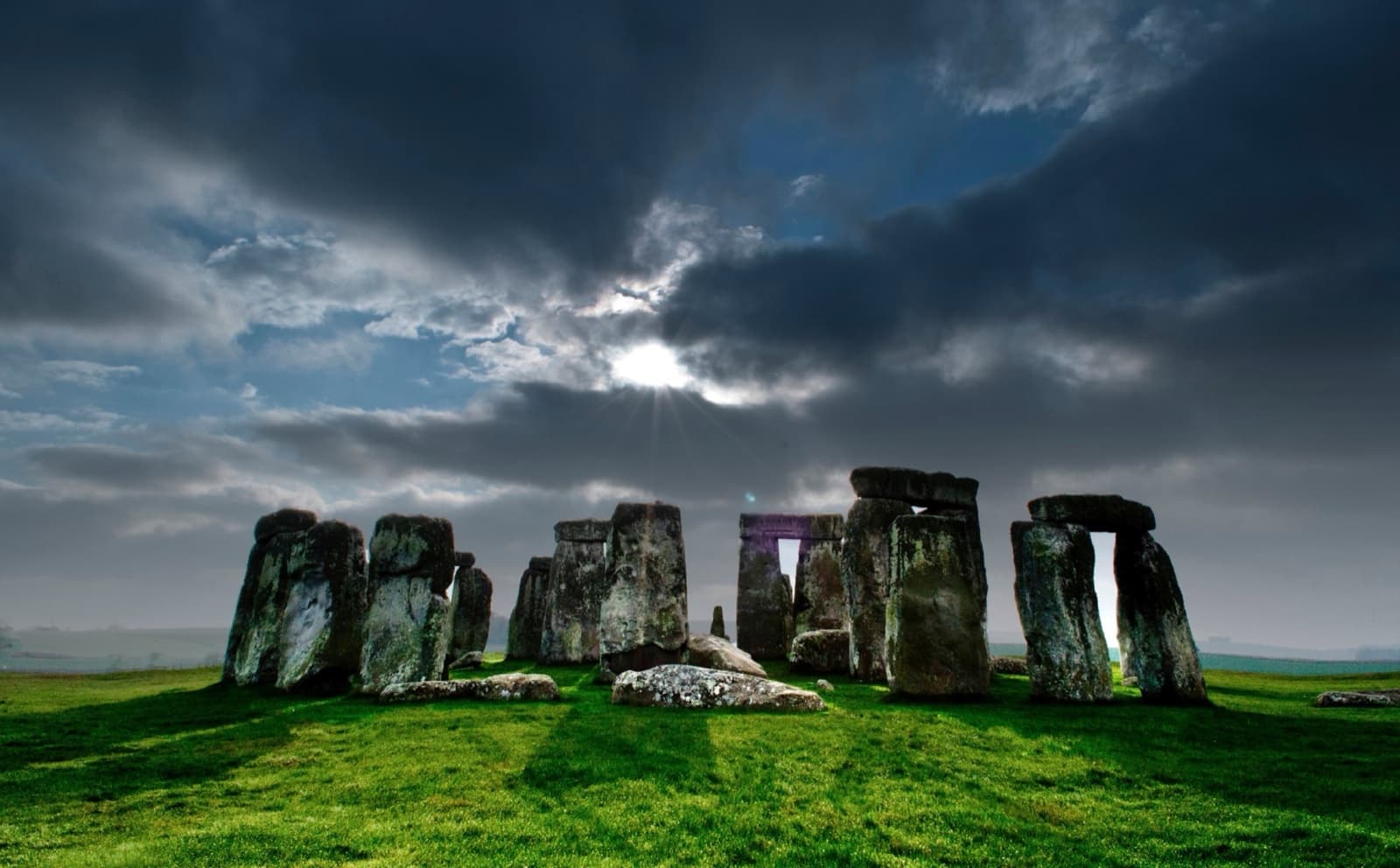
Stonehenge on Salisbury Plain, Wiltshire · Sanjay Nair. CC-BY-SA-3.0. Wikimedia Commons.
Human occupation of what is now Britain stretches back thousands of years before any written record. The earliest inhabitants, living through what archaeologists call the Stone Age, were hunter-gatherers — small mobile groups who followed herds of deer and wild horses across a landscape that was, for much of the period, attached to mainland Europe by a land bridge. Only around 10,000 years ago did rising seas sever that land bridge and turn the territory into the collection of islands known today.
The first farmers appeared here about 6,000 years ago; their ancestors are thought to have travelled from south-east Europe. They built permanent structures — houses, collective tombs, and ritual monuments — and left marks on the landscape that are still visible. The most famous of these, Stonehenge, remains standing on the chalk plain of what is now the English county of Wiltshire, and was probably used as a gathering site for seasonal ceremonies. Further north, the settlement of Skara Brae on Orkney — off the northern coast of Scotland — is recognised as the best preserved prehistoric village in northern Europe, and has been central to archaeologists' understanding of domestic life at the close of the Stone Age.
The Bronze Age opens with the mastery of bronze metalworking, around 4,000 years ago. Communities lived in roundhouses and buried their dead in circular earthen mounds known as round barrows; their metalworkers produced tools, ornaments and weapons of considerable craftsmanship in both bronze and gold. The Iron Age that followed brought the same techniques to iron as a material. Roundhouses remained the common dwelling, now often clustered into larger settlements and, in more strategic locations, protected inside defensive ramparts called hill forts — a particularly well-preserved example survives at Maiden Castle in the English county of Dorset. Most Iron Age people made their living as farmers, as craft workers or as warriors. The language of the Iron Age population belonged to the Celtic family of languages, a grouping that was then widely spoken across Europe; related Celtic languages are still spoken in parts of Wales, Scotland and Ireland today. By the end of the Iron Age the local economy had become sophisticated enough that the first coins minted on British soil appeared in circulation, some of them inscribed with the names of individual Iron Age kings — a practical marker for where recorded British history can be said to begin.
British History at a Glance
- Stone Age~10,000 BC
Hunter-gatherers; Stonehenge (~3000 BC)
- Iron Age / Celts~750 BC
Celtic peoples; Beaker people
- RomansAD 43–410
Claudius invades; Hadrian's Wall; Boudicca
- Anglo-SaxonsAD 410–1066
Athelstan (first King of England); Alfred the Great
- VikingsAD 789–1066
Raids and Danelaw; Canute rules England
- Normans & Medieval1066–1485
Battle of Hastings; Magna Carta 1215; Bannockburn 1314
- Tudors & Stuarts1485–1714
Henry VIII; Elizabeth I; Civil War; Glorious Revolution 1688
- Georgian / Empire1714–1837
First PM (Walpole 1721); Industrial Revolution; Waterloo 1815
- Victorian1837–1901
Great Exhibition 1851; Slavery abolished; Suffragettes
- 20th Century1901–2000
WWI; WWII; NHS 1948; Windrush; Thatcher
Key Facts
- •The first people to live in Britain were hunter-gatherers, in the Stone Age
- •For much of the Stone Age, Britain was connected to the continent by a land bridge
- •Britain became permanently separated from the continent about 10,000 years ago
- •The first farmers arrived in Britain about 6,000 years ago, probably from south-east Europe
- •Stonehenge still stands in the English county of Wiltshire and was probably a gathering place for seasonal ceremonies
- •Skara Brae on Orkney is the best preserved prehistoric village in northern Europe
- •Around 4,000 years ago, people learned to make bronze — the Bronze Age
- •Bronze Age people lived in roundhouses and buried their dead in round barrows
- •Maiden Castle in Dorset is an impressive Iron Age hill fort that can still be seen today
- •Iron Age people spoke a Celtic language; related languages are still spoken today in parts of Wales, Scotland and Ireland
- •Iron Age people made the first coins minted in Britain, some inscribed with names of Iron Age kings
The Romans
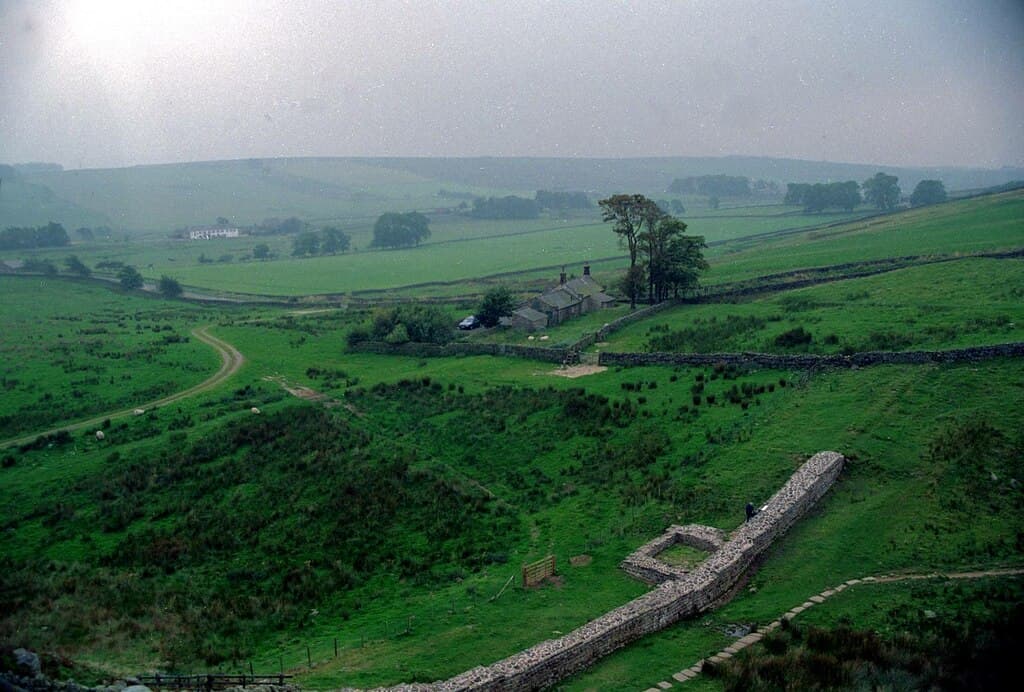
Hadrian's Wall and turret at Peel Crags, Northumberland · Martin Tester (Geograph Britain and Ireland). CC-BY-SA-2.0. Wikimedia Commons.
The first Roman expedition to Britain was led by Julius Caesar in person in 55 BC. That invasion was unsuccessful, and for close to a century afterwards the islands remained outside the imperial frontier. The second attempt, in AD 43 under the Emperor Claudius, went very differently — although Claudius's army met real resistance from several native British tribes, the Romans ultimately secured control over almost the whole of Britain. One of the most celebrated tribal leaders to fight against the Roman advance was Boudicca, queen of the Iceni in what is today eastern England. She remains a nationally remembered figure, and a bronze statue of her stands on Westminster Bridge in London, close to the Houses of Parliament.
The northernmost parts of what is now Scotland were never brought under Roman rule. To hold the imperial frontier against the Picts — the peoples who were the ancestors of the modern Scots — the Emperor Hadrian ordered the building of a long defensive wall across the north of England, punctuated by forts at regular intervals along its length. Sections of Hadrian's Wall survive in the landscape today, as do the excavated forts at Housesteads and Vindolanda. The wall is a popular walking route and is inscribed on UNESCO's (United Nations Education, Scientific and Cultural Organization) register as a World Heritage Site.
Roman Britain lasted about 400 years in total. Under that rule, metalled roads and substantial public buildings were constructed, a formal legal structure was put in place, and new plants and new species of animals were brought into the country. It was during the 3rd and 4th centuries AD that the first Christian communities are known to have formed on British soil.
Key Facts
- •Julius Caesar led an unsuccessful Roman invasion of Britain in 55 BC
- •In AD 43 Emperor Claudius led a new invasion and occupied almost all of Britain
- •Boudicca, queen of the Iceni, fought against the Romans
- •There is a statue of Boudicca on Westminster Bridge in London, near the Houses of Parliament
- •Areas of what is now Scotland were never conquered by the Romans
- •Emperor Hadrian built Hadrian's Wall in the north of England to keep out the Picts
- •Parts of Hadrian's Wall, including the forts of Housesteads and Vindolanda, can still be seen
- •Hadrian's Wall is a UNESCO World Heritage Site
- •The Romans remained in Britain for 400 years
- •The Romans built roads and public buildings, created a structure of law, and introduced new plants and animals
- •The first Christian communities appeared in Britain during the 3rd and 4th centuries AD
Key Dates
The Anglo-Saxons
The Roman army was pulled out of Britain in AD 410 to reinforce other frontiers of a contracting empire — and did not return. Into the vacuum came a fresh wave of migrant peoples from northern Europe: the Jutes, the Angles and the Saxons. Collectively known as the Anglo-Saxons, they spoke Germanic languages that are the ancestral stock of modern English. Native British armies resisted them, but by roughly AD 600 a patchwork of Anglo-Saxon kingdoms had established itself across most of what is now England. An exceptional survival from this period is the burial discovered at Sutton Hoo in modern Suffolk, where an Anglo-Saxon king was laid to rest inside a timber ship complete with armour and treasure, the whole then covered by a mound of earth. Large parts of the west of Britain — much of what is now Wales, and Scotland in its entirety — lay outside Anglo-Saxon rule.
The Anglo-Saxons were not Christian when they first arrived. During this period, however, Christian missionaries travelled into Britain and began to teach and convert. From Ireland came the missionaries who spread the faith through the north: the best-known of these are St Patrick, who became the patron saint of Ireland, and St Columba, who founded a monastery on the island of Iona off the western coast of what is now Scotland. From Rome came a second wave under St Augustine, whose mission worked through the south; Augustine himself went on to become the first Archbishop of Canterbury.
Key Facts
- •The Roman army left Britain in AD 410 to defend other parts of the Roman Empire and never returned
- •Britain was invaded by the Jutes, the Angles and the Saxons from northern Europe
- •The languages of the Jutes, Angles and Saxons are the basis of modern-day English
- •By about AD 600 Anglo-Saxon kingdoms were established in Britain, mainly in what is now England
- •The burial place of one Anglo-Saxon king was at Sutton Hoo in modern Suffolk — a ship burial covered with earth
- •Much of what is now Wales and Scotland remained free of Anglo-Saxon rule
- •St Patrick became the patron saint of Ireland
- •St Columba founded a monastery on the island of Iona, off the coast of what is now Scotland
- •St Augustine led missionaries from Rome and became the first Archbishop of Canterbury
Key Dates
The Vikings
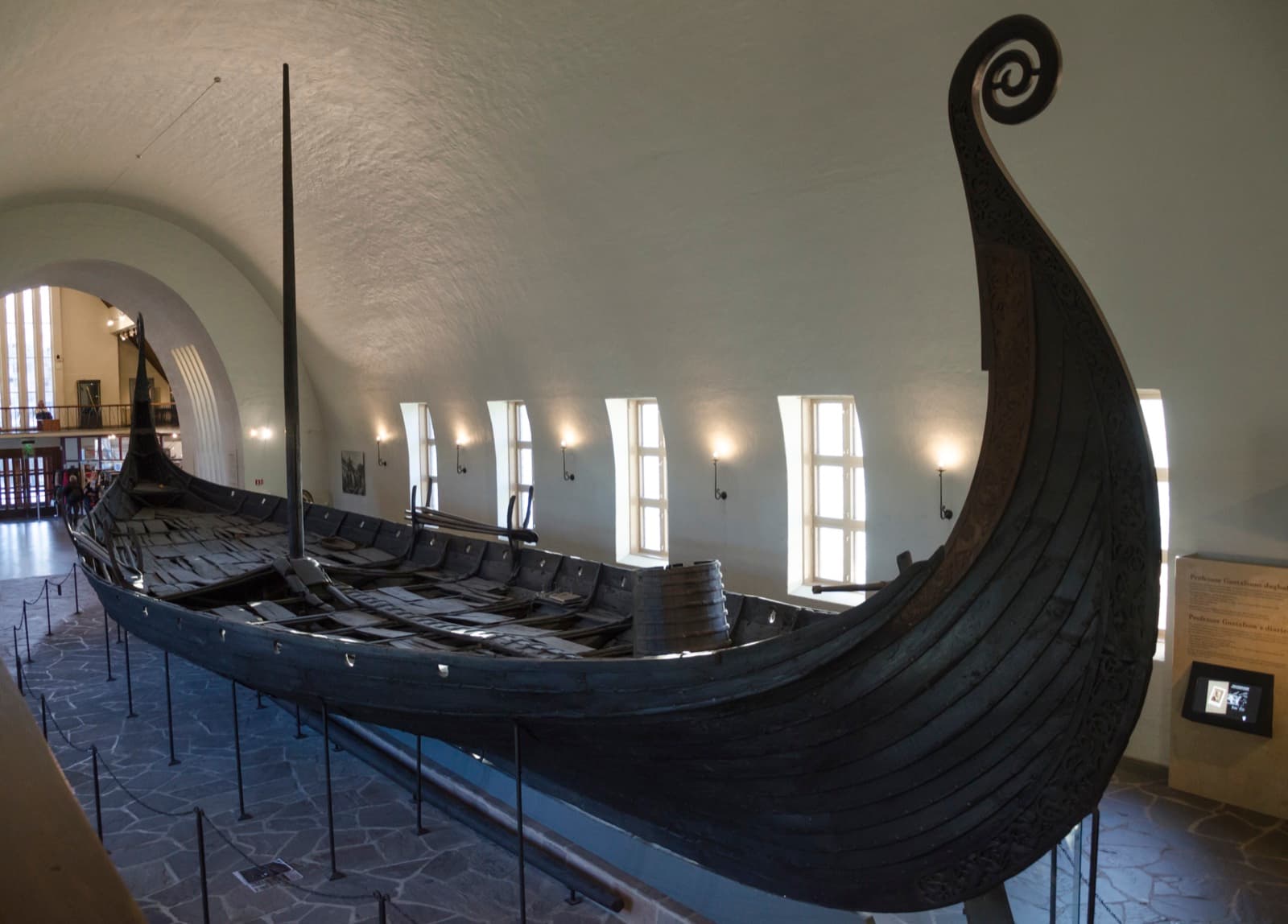
The Oseberg Viking ship (c.834 AD) on display at the Viking Ship Museum, Oslo · Petter Ulleland, 2016. CC-BY-SA-4.0. Wikimedia Commons.
The Vikings came originally from Denmark and Norway. Their first appearance in Britain, in AD 789, took the form of coastal raids — seaborne attacks in which they carried off goods and people as slaves. Over time the raids gave way to settlement, particularly on the eastern side of England and in Scotland. In England, the resistance was organised by Alfred the Great, who brought the Anglo-Saxon kingdoms into a single front and eventually defeated the Viking forces in battle. Many Viking invaders chose to stay behind afterwards, most densely in the north and east of England within a region that became known as the Danelaw — and many place names in that region, Grimsby and Scunthorpe among them, are direct inheritances from the Viking languages. Intermarriage with local communities followed, and a number of the Viking settlers converted to Christianity.
Anglo-Saxon kings went on ruling in England after this, with one short interruption during which the throne was held by a line of Danish kings. The first of that line was Cnut, also spelled Canute.
Further north, the pressure of Viking raiding had the effect of pushing the peoples of what is now Scotland towards political unity. They came together under a single king, Kenneth MacAlpin, and it is from around this time that the name 'Scotland' began to be used to describe the territory itself.
Key Facts
- •The Vikings came from Denmark and Norway
- •They first visited Britain in AD 789 to raid coastal towns and take away goods and slaves
- •King Alfred the Great united the Anglo-Saxon kingdoms in England and defeated the Vikings
- •Many Viking invaders stayed in the east and north of England, in an area known as the Danelaw
- •Place names such as Grimsby and Scunthorpe come from the Viking languages
- •The first Danish king of England was Cnut (also called Canute)
- •Kenneth MacAlpin united the people of the north under one king
- •The term 'Scotland' began to be used to describe that country
Key Dates
The Norman Conquest
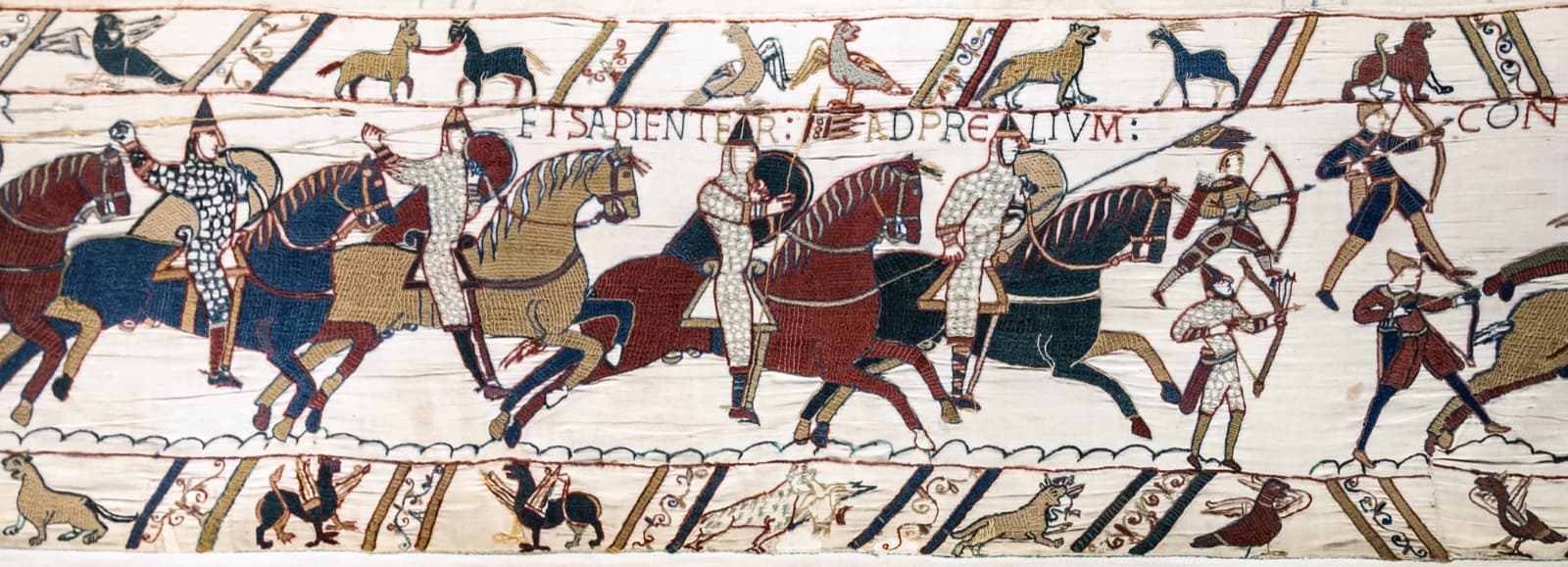
Bayeux Tapestry, Scene 51 — Norman knights and archers at the Battle of Hastings · Photograph by Myrabella, 2013; tapestry c.1070–1080. CC0 1.0 Universal. Wikimedia Commons.
The year 1066 is the conventional closing date of the early period in British history. In that year William, the Duke of Normandy — Normandy being a region of what is now northern France — led an invasion of England and defeated the Saxon king Harold at the Battle of Hastings. Harold was killed during the battle, and William took the English throne as William the Conqueror. The events of the campaign were recorded in an extraordinary long-form piece of needlework, the Bayeux Tapestry, which survives intact today and remains on public display in France.
The Norman Conquest is notable as the last successful foreign invasion of England, and its consequences ran deep: government, land tenure and the structure of the social order were all reshaped under Norman rule. Norman French, the working language of the incoming ruling class, fed substantial vocabulary into the ongoing development of the English language. Initially the Normans pressed on into Wales and took territory there, though the Welsh later won back much of what had been lost. On the northern border, Norman forces clashed with the Scots and secured some borderland territory, but Scotland itself was never invaded.
William also set in motion one of the most ambitious administrative surveys of any medieval state. Royal commissioners travelled across England and compiled an inventory of every town and village, recording who was living there, who held the land, and what livestock was on it. The resulting ledger became known as the Domesday Book. It still exists today, and gives historians a remarkably detailed picture of English society in the generation immediately after the Conquest.
Key Facts
- •In 1066 William, Duke of Normandy, defeated Harold at the Battle of Hastings
- •Harold was killed in the battle
- •William became king of England and is known as William the Conqueror
- •The battle is commemorated in the Bayeux Tapestry, which can still be seen in France today
- •The Norman Conquest was the last successful foreign invasion of England
- •Norman French, the language of the new ruling class, influenced the English language
- •The Normans conquered Wales initially, but the Welsh gradually won territory back
- •The Normans took over some land on the Scottish border but did not invade Scotland
- •William ordered the Domesday Book — a survey of towns, villages, people, land and animals
- •The Domesday Book still exists today and gives a picture of society just after the Norman Conquest
Key Dates
Chapter Summary
All key facts from this chapter at a glance — read this to revise the full chapter quickly.
Chapter Summary
Quick revision- ✓The first people to live in Britain were hunter-gatherers, in the Stone Age
- ✓For much of the Stone Age, Britain was connected to the continent by a land bridge; Britain became permanently separated from the continent about 10,000 years ago
- ✓The first farmers arrived in Britain about 6,000 years ago, probably from south-east Europe
- ✓Stonehenge still stands in the English county of Wiltshire and was probably a gathering place for seasonal ceremonies
- ✓Skara Brae on Orkney is the best preserved prehistoric village in northern Europe
- ✓Around 4,000 years ago, people learned to make bronze — the Bronze Age; people lived in roundhouses and buried their dead in round barrows
- ✓Maiden Castle in Dorset is an impressive Iron Age hill fort that can still be seen today
- ✓Iron Age people spoke a Celtic language; related languages are still spoken today in parts of Wales, Scotland and Ireland
- ✓Iron Age people made the first coins minted in Britain, some inscribed with the names of Iron Age kings
- ✓55 BC — Julius Caesar led an unsuccessful Roman invasion of Britain
- ✓AD 43 — Emperor Claudius led a new invasion and occupied almost all of Britain
- ✓Boudicca, queen of the Iceni, fought against the Romans; there is a statue of her on Westminster Bridge in London, near the Houses of Parliament
- ✓Areas of what is now Scotland were never conquered by the Romans
- ✓Emperor Hadrian built Hadrian's Wall in the north of England to keep out the Picts (ancestors of the Scottish people)
- ✓Parts of Hadrian's Wall, including the forts of Housesteads and Vindolanda, can still be seen; the Wall is a UNESCO World Heritage Site
- ✓The Romans remained in Britain for 400 years; they built roads and public buildings, created a structure of law, and introduced new plants and animals
- ✓The first Christian communities appeared in Britain during the 3rd and 4th centuries AD
- ✓AD 410 — the Roman army left Britain to defend other parts of the Roman Empire and never returned
- ✓Britain was then invaded by the Jutes, the Angles and the Saxons from northern Europe; their languages are the basis of modern-day English
- ✓By about AD 600, Anglo-Saxon kingdoms were established in Britain, mainly in what is now England
- ✓The burial place of one Anglo-Saxon king was at Sutton Hoo in modern Suffolk — a ship burial covered with a mound of earth
- ✓Much of what is now Wales and Scotland remained free of Anglo-Saxon rule
- ✓St Patrick became the patron saint of Ireland; St Columba founded a monastery on the island of Iona, off the coast of what is now Scotland
- ✓St Augustine led missionaries from Rome and became the first Archbishop of Canterbury
- ✓AD 789 — the Vikings (from Denmark and Norway) first visited Britain to raid coastal towns and take away goods and slaves
- ✓King Alfred the Great united the Anglo-Saxon kingdoms in England and defeated the Vikings
- ✓Many Viking invaders stayed in the east and north of England, in an area known as the Danelaw; place names such as Grimsby and Scunthorpe come from the Viking languages
- ✓The first Danish king of England was Cnut (also called Canute)
- ✓The threat of Viking attacks encouraged the people of the north to unite under Kenneth MacAlpin; the term 'Scotland' began to be used
- ✓1066 — William, Duke of Normandy, defeated Harold (the Saxon king) at the Battle of Hastings; Harold was killed
- ✓William became King of England — known as William the Conqueror
- ✓The battle is commemorated in the Bayeux Tapestry, which can still be seen in France today
- ✓The Norman Conquest was the last successful foreign invasion of England
- ✓Norman French, the language of the new ruling class, influenced the development of the English language
- ✓The Normans conquered Wales initially, but the Welsh gradually won territory back; the Normans took some land on the Scottish border but did not invade Scotland
- ✓William ordered the Domesday Book — a survey of all towns, villages, people, land and animals; it still exists today and gives a picture of society just after the Norman Conquest
Test Yourself on This Chapter
Ready to practice? Take a focused test on this topic.