Customs and Traditions
8 min read·Last updated: April 2026
In this chapter
The Main Christian Festivals
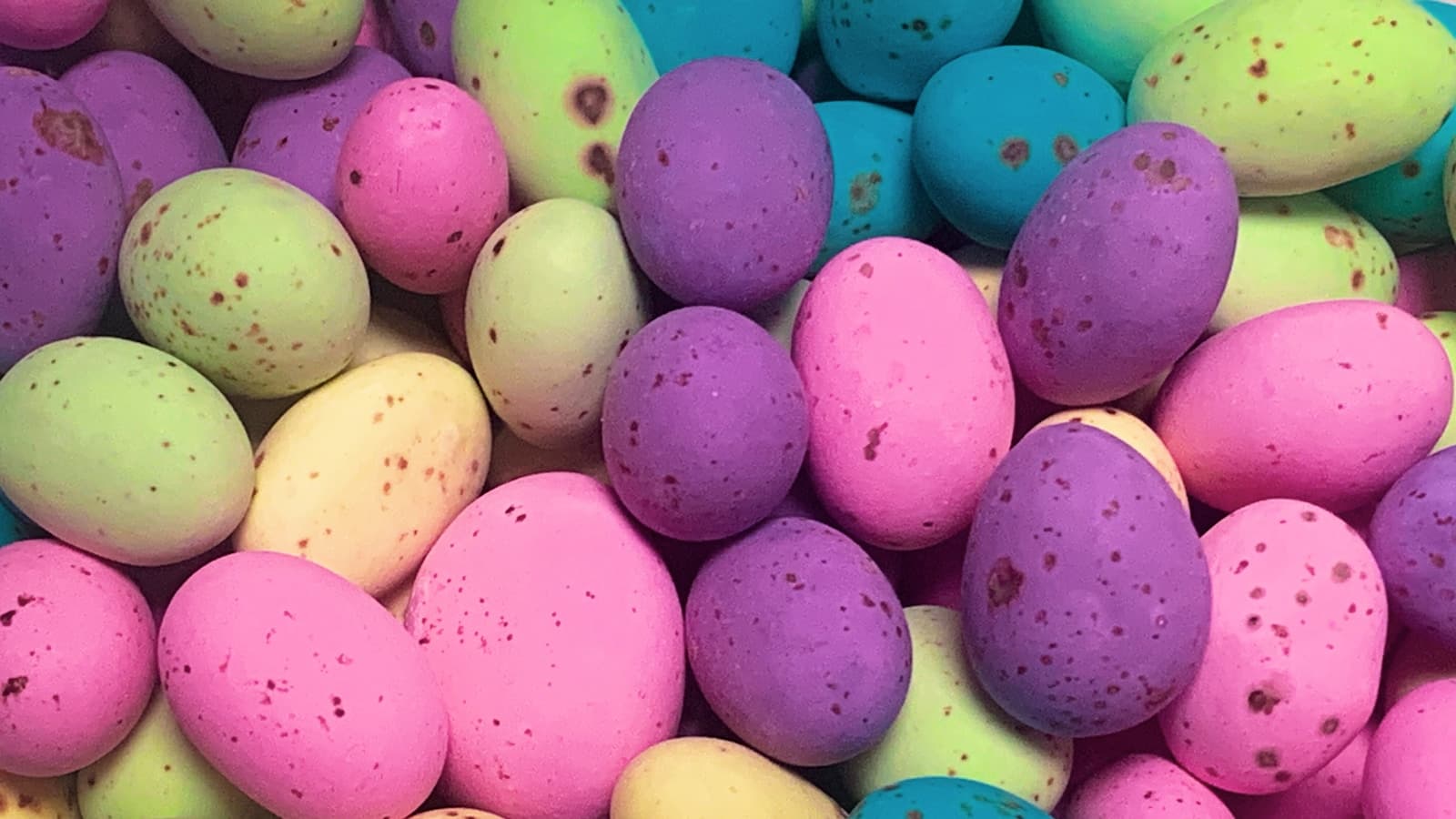
Colourful speckled Easter eggs in a bowl · Photograph by Glen Carrie. Unsplash Licence. unsplash.com
The Christian calendar provides British public life with two of its most widely observed fixed points. The first is Christmas, which falls on 25 December and marks the birth of Jesus. The day itself is a statutory public holiday, and many Christians attend a church service either on the evening of 24 December (Christmas Eve) or on Christmas Day. The day is traditionally spent at home in family company, typically built around a large meal of roast turkey with Christmas pudding and mince pies as the conventional sweet courses. Gifts are exchanged, cards sent, and the house decorated — often including a decorated tree in a central room. Small children are told that presents appearing overnight have been delivered by Father Christmas, also commonly called Santa Claus. The day immediately after — 26 December, known as Boxing Day — is itself a separate public holiday.
The second major Christian observance, Easter, has no fixed date: it moves between March and April each year according to the lunar calendar. It commemorates two linked events: the death of Jesus on Good Friday and his resurrection on Easter Sunday. Good Friday and the Monday that follows Easter Sunday are both statutory holidays. The 40-day fasting period that leads up to Easter is called Lent. The day immediately before Lent opens is Shrove Tuesday — widely known as Pancake Day, after the practical custom of using up perishable ingredients such as eggs, fat and milk in pancakes before the fast. Lent itself then begins on Ash Wednesday, when participating Christians are marked with an ash cross on the forehead to symbolise mortality and sorrow for sin. Easter is observed by the non-religious as well: chocolate 'Easter eggs' are given as gifts as a symbol of new life.
Key Facts
- •Christmas Day is 25 December and celebrates the birth of Jesus Christ; it is a public holiday
- •Boxing Day is the day after Christmas Day (26 December) and is also a public holiday
- •Christmas traditions include roast turkey, Christmas pudding and mince pies; giving gifts; sending cards; decorating a tree
- •Father Christmas (also known as Santa Claus) is believed by young children to bring presents during the night before Christmas Day
- •Easter takes place in March or April and marks the death of Jesus Christ on Good Friday and his rising from the dead on Easter Sunday
- •Both Good Friday and Easter Monday are public holidays
- •The 40 days before Easter are known as Lent
- •Shrove Tuesday (Pancake Day) is the day before Lent starts; people eat pancakes traditionally made to use up eggs, fat and milk before fasting
- •Lent begins on Ash Wednesday when Christians are marked with an ash cross on their forehead
- •Easter eggs are chocolate eggs given as presents at Easter as a symbol of new life
Other Religious Festivals
Beyond the Christian calendar, the UK's religious communities mark a number of other significant annual festivals in parallel. Each of the major non-Christian traditions has its own visible presence in British public life, from civic celebrations and parades to supermarket shelves and shared community meals.
Diwali is a five-day autumn festival observed by both Hindus and Sikhs, typically falling in October or November. Popularly known as the Festival of Lights, it celebrates the triumph of good over evil and the acquisition of knowledge. Leicester hosts one of the most prominent Diwali celebrations in the country, drawing crowds from across the Midlands each year.
Hannukah runs for eight days during November or December. For Jewish communities it recalls the historical struggle of the Jews for religious freedom; a candle is lit on each day of the festival on an eight-branched stand called a menorah, commemorating a legendary supply of oil that lasted for eight days rather than the single day expected.
Eid al-Fitr marks the end of Ramadan, the month during which Muslims fast from dawn to dusk. Because the Islamic calendar is lunar, the festival's date shifts through the solar calendar from year to year. Muslims gather for special prayers and shared meals, offering thanks for the strength to complete the month of fasting.
Eid ul Adha honours the account of the prophet Ibrahim's willingness to sacrifice his son at God's command, reminding Muslims of their own devotional commitment. Traditionally an animal is sacrificed and eaten at the festival; within the UK this must take place in a regulated slaughterhouse.
Vaisakhi (also written Baisakhi) is a Sikh festival that falls on 14 April every year. It marks the founding of the Khalsa — the communal body of the Sikh faith — and is celebrated with parades, traditional dancing and singing.
Key Facts
- •Diwali (October or November, lasts five days) is known as the Festival of Lights and is celebrated by Hindus and Sikhs; it celebrates the victory of good over evil; there is a famous celebration in Leicester
- •Hannukah (November or December, eight days) commemorates the Jews' struggle for religious freedom; a candle is lit each day on a menorah (stand of eight candles)
- •Eid al-Fitr celebrates the end of Ramadan (a month of fasting for Muslims); the date changes every year; Muslims attend special services and meals
- •Eid ul Adha remembers that the prophet Ibrahim was willing to sacrifice his son; many Muslims sacrifice an animal to eat; in Britain this must be done in a slaughterhouse
- •Vaisakhi (also spelled Baisakhi) is a Sikh festival on 14 April each year celebrating the founding of the Khalsa (the Sikh community); celebrated with parades, dancing and singing
Other Festivals and Traditions
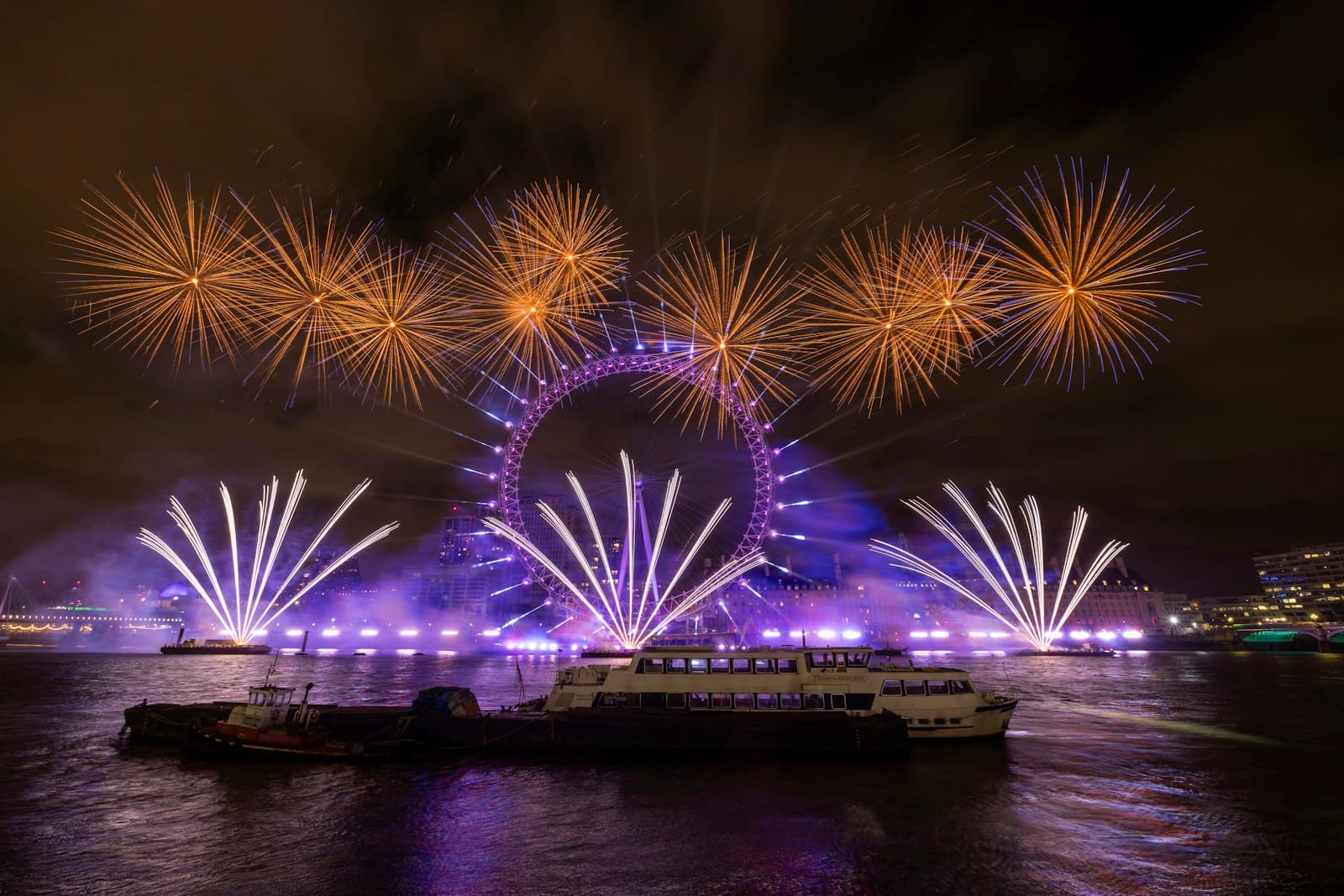
New Year fireworks above the London Eye at midnight — representing the UK's Hogmanay and New Year's Eve celebrations · Photograph by Andrea Santoni. Unsplash Licence. unsplash.com
Several of Britain's most visible annual customs have no single religious anchor and instead mark seasonal or civic events. Many are celebrated across the four nations in broadly the same way; a few — most notably Hogmanay in Scotland and the Battle of the Boyne observance in Northern Ireland — have strong regional character.
New Year's Day, on 1 January, is a public holiday throughout the UK, and the celebrations typically begin the evening before on New Year's Eve (31 December). Scotland treats this handover of the year as its own distinct festival, Hogmanay; in Scotland 2 January is also a public holiday, and for many Scots Hogmanay is a bigger occasion than Christmas itself.
On 14 February, Valentine's Day is marked by the exchange of cards and gifts between couples, and sometimes by anonymous cards sent to a person the sender secretly admires.
1 April is April Fool's Day, a morning for playful pranks — jokes are exchanged only until midday, and television and newspaper outlets routinely run fictional April Fool stories of their own.
Mothering Sunday (also Mother's Day) falls on the Sunday that sits three weeks before Easter and is marked by cards and gifts sent to mothers. Father's Day arrives later in the year on the third Sunday of June, and follows the same pattern of cards and presents.
Halloween, on 31 October, has roots in a pre-Christian festival marking the start of winter. Modern observance sees young people dressing in frightening costumes for 'trick or treat' — and the treats are traditionally given to head off the tricks. Pumpkins are hollowed out and a candle is placed inside the shell to make lanterns.
Bonfire Night falls on 5 November and is celebrated across Great Britain with domestic or organised firework displays. It commemorates an event in 1605 when a Catholic group led by Guy Fawkes planned, and failed, to detonate a bomb at the Houses of Parliament aimed at the Protestant king of the day.
Remembrance Day, on 11 November, honours those who died in military service for the UK and its allies. The day was originally created to mourn the dead of the First World War, the fighting of which ended at the eleventh hour of 11 November 1918. Poppies — the red flowers that grew on the old First World War battlefields — are worn on the lapel as a symbol. At exactly 11.00 am a two-minute silence is observed nationally, and formal wreaths are laid at the Cenotaph war memorial in Whitehall, London.
Key Facts
- •New Year is 1 January; in Scotland, 31 December is called Hogmanay and 2 January is also a public holiday; for some Scottish people, Hogmanay is a bigger holiday than Christmas
- •Valentine's Day is 14 February; lovers exchange cards and gifts
- •April Fool's Day is 1 April; people play jokes on each other until midday
- •Mothering Sunday (Mother's Day) is the Sunday three weeks before Easter
- •Father's Day is the third Sunday in June
- •Halloween is 31 October; an ancient festival with pagan roots; young people dress up for 'trick or treat'; people carve lanterns from pumpkins
- •Bonfire Night is 5 November; fireworks are set off to mark the failed 1605 Gunpowder Plot when Catholics led by Guy Fawkes tried to kill the Protestant king
- •Remembrance Day is 11 November; commemorates those who died fighting for the UK; people wear red poppies; at 11.00 am there is a two-minute silence
- •Wreaths are laid at the Cenotaph in Whitehall on Remembrance Day
- •The First World War ended on 11 November 1918
Key Dates
Bank Holidays
Alongside the religious and civic festivals already covered, the UK recognises a further set of secular public holidays known collectively as bank holidays. On a bank holiday, banks close for the day and a large share of other businesses — shops, offices, public services — follow suit in whole or in part. These days carry no religious meaning; they are timetabled purely to provide periodic breaks through the working year. Three of them fall within the warmer half of the year: one in early May, one at the end of May or the start of June, and one during August. Northern Ireland adds a further public holiday of its own in July, marking the anniversary of the Battle of the Boyne.
Key Facts
- •Bank holidays are public holidays when banks and many other businesses close; they have no religious significance
- •Bank holidays fall at the beginning of May, in late May or early June, and in August
- •In Northern Ireland, the anniversary of the Battle of the Boyne in July is also a public holiday
Chapter Summary
All key facts from this chapter at a glance — read this to revise the full chapter quickly.
Chapter Summary
Quick revision- ✓Christmas Day is 25 December; celebrates the birth of Jesus Christ; it is a public holiday
- ✓Boxing Day is 26 December and is also a public holiday
- ✓Christmas traditions include roast turkey, Christmas pudding and mince pies; giving gifts; sending cards; decorating a tree
- ✓Father Christmas (also known as Santa Claus) is believed by young children to bring presents during the night before Christmas Day
- ✓Easter takes place in March or April; marks the death of Jesus Christ on Good Friday and his rising from the dead on Easter Sunday
- ✓Both Good Friday and Easter Monday are public holidays
- ✓The 40 days before Easter are known as Lent
- ✓Shrove Tuesday (Pancake Day) is the day before Lent starts; people eat pancakes made to use up eggs, fat and milk before fasting
- ✓Lent begins on Ash Wednesday when Christians are marked with an ash cross on their forehead as a symbol of death and sorrow for sin
- ✓Easter eggs are chocolate eggs given as presents at Easter as a symbol of new life
- ✓Diwali (October or November, lasts five days) is known as the Festival of Lights; celebrated by Hindus and Sikhs; celebrates the victory of good over evil; there is a famous celebration in Leicester
- ✓Hannukah (November or December, eight days) commemorates the Jews' struggle for religious freedom; a candle is lit each day on a menorah (stand of eight candles)
- ✓Eid al-Fitr celebrates the end of Ramadan (a month of fasting for Muslims); the date changes every year; Muslims attend special services and meals
- ✓Eid ul Adha remembers that the prophet Ibrahim was willing to sacrifice his son; many Muslims sacrifice an animal to eat; in Britain this must be done in a slaughterhouse
- ✓Vaisakhi (also spelled Baisakhi) is a Sikh festival on 14 April each year celebrating the founding of the Khalsa (the Sikh community); celebrated with parades, dancing and singing
- ✓New Year is 1 January; in Scotland, 31 December is called Hogmanay and 2 January is also a public holiday; for some Scottish people, Hogmanay is a bigger holiday than Christmas
- ✓Valentine's Day is 14 February; lovers exchange cards and gifts; sometimes people send anonymous cards to someone they secretly admire
- ✓April Fool's Day is 1 April; people play jokes on each other until midday; TV and newspapers often carry April Fool stories
- ✓Mothering Sunday (Mother's Day) is the Sunday three weeks before Easter; Father's Day is the third Sunday in June
- ✓Halloween is 31 October; an ancient festival with pagan roots marking the beginning of winter; young people dress up in frightening costumes for 'trick or treat'; people carve lanterns from pumpkins
- ✓Bonfire Night is 5 November; fireworks are set off to mark the failed 1605 Gunpowder Plot when Catholics led by Guy Fawkes tried to kill the Protestant king with a bomb in the Houses of Parliament
- ✓Remembrance Day is 11 November; commemorates those who died fighting for the UK and its allies; originally commemorated the dead of WWI (which ended 11 November 1918)
- ✓On Remembrance Day people wear red poppies; at 11.00 am there is a two-minute silence and wreaths are laid at the Cenotaph in Whitehall
- ✓Bank holidays are public holidays when banks and many businesses close; they have no religious significance
- ✓Bank holidays fall at the beginning of May, in late May or early June, and in August
- ✓In Northern Ireland, the anniversary of the Battle of the Boyne in July is also a public holiday
Test Yourself on This Chapter
Ready to practice? Take a focused test on this topic.