Arts and Culture
18 min read·Last updated: April 2026
In this chapter
Music
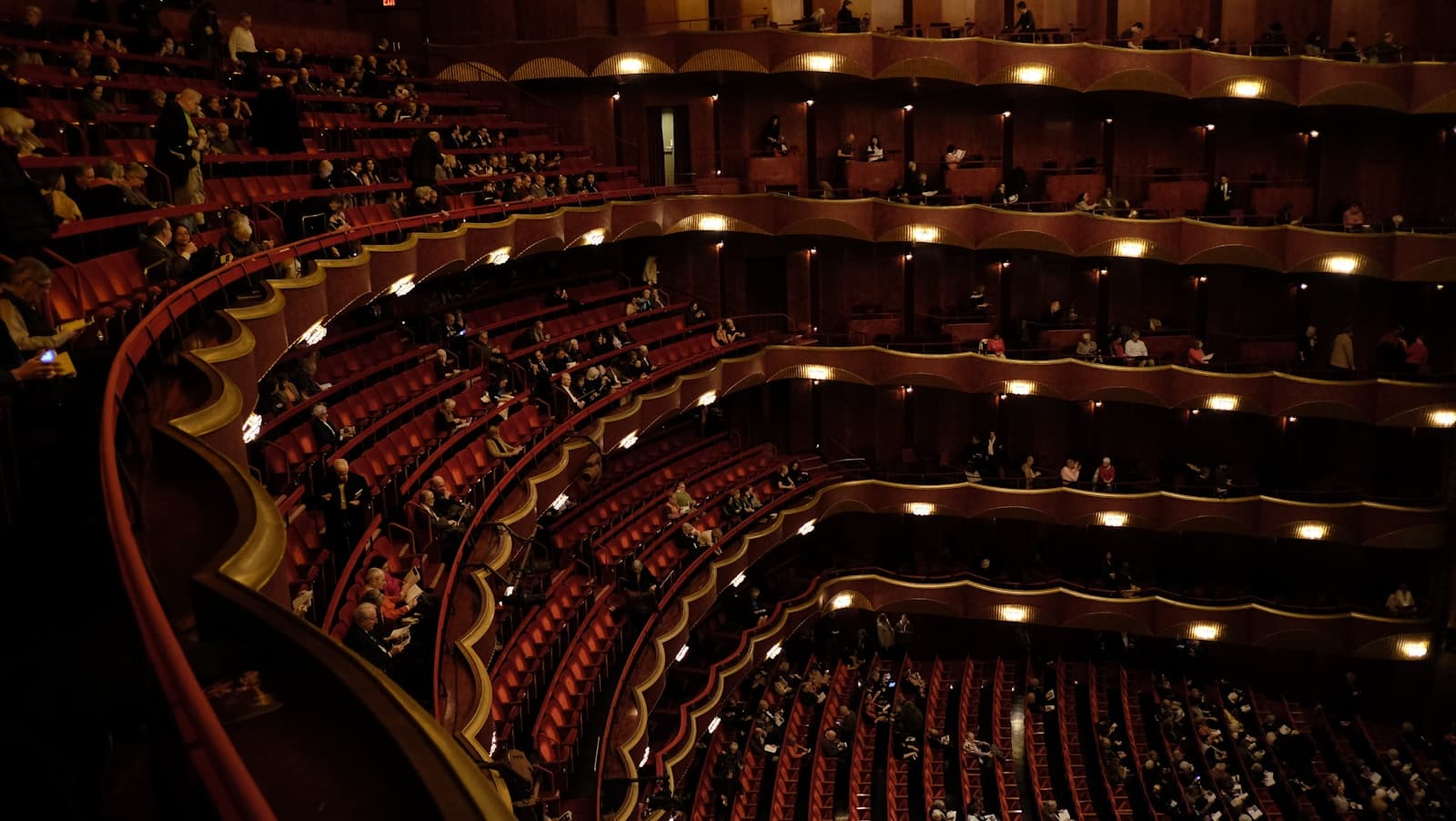
Audience seated inside a concert hall during an orchestral performance, evoking the Proms at the Royal Albert Hall · Photograph by Alev Takil. Unsplash Licence. unsplash.com
Music occupies a central place in British cultural life, with a tradition that runs from classical composers through folk song, jazz, and contemporary pop. Live music of every kind is programmed across the country throughout the year, and the UK sits comfortably among the most productive music-making nations in the world.
At the classical end of the spectrum, the eight-week summer festival known as the Proms is an annual fixture. Concerts take place at a number of venues, the Royal Albert Hall in London foremost among them. The series has been run by the BBC since 1927, and its final concert — the Last Night of the Proms — is broadcast on television to a very wide audience.
Popular music — folk, jazz, and rock and pop — has flourished in Britain through the course of the 20th century. Since the 1960s, British pop in particular has been one of the country's most distinctive cultural exports. Bands such as The Beatles and The Rolling Stones from that decade remain influential both at home and internationally, and successive British musical movements have continued to innovate: the Punk movement of the late 1970s was followed by the boy-band and girl-band wave of the 1990s and by steady evolution since.
Large-capacity venues across the UK host major music events year-round. Wembley Stadium in north-west London, The O2 in Greenwich in south-east London, and the Scottish Exhibition and Conference Centre (SECC) in Glasgow are three of the most prominent. Every summer brings festival season, with Glastonbury, the Isle of Wight Festival and the V Festival among the best-known outdoor events.
The Welsh-language cultural tradition is represented by the National Eisteddfod of Wales, an annual festival of music, dance, art and original performance held largely in Welsh and featuring set competitions for Welsh poetry. For contemporary awards, the Mercury Music Prize is handed out each September for the best album of the year from the UK or Ireland, and the Brit Awards is an annual ceremony honouring (among other categories) best British group and best British solo artist.
Notable British Composers
In chronological order — years shown are birth–death or active period
- 1659–95Henry Purcell
Organist at Westminster Abbey; church music and theatre
- 1695–1759George Frideric Handel
German-born; became British 1727 — Water Music, Messiah
- 1857–1934Sir Edward Elgar
Pomp and Circumstance Marches; Land of Hope and Glory
- 1872–1958Ralph Vaughan Williams
Orchestral and choral music; influenced by English folk music
- 1874–1934Gustav Holst
The Planets suite; Jupiter adapted as 'I vow to thee my country'
- 1902–83Sir William Walton
Coronation marches for George VI and Elizabeth II; Façade
- 1913–76Benjamin Britten
Operas Peter Grimes and Billy Budd; founded Aldeburgh festival
Key British arts and culture milestones covered in the Life in the UK test.
Key Facts
- •The Proms is an eight-week summer season of orchestral classical music, including the Royal Albert Hall in London, organised by the BBC since 1927
- •The Last Night of the Proms is the most well-known concert in the Proms series and is broadcast on television
- •Henry Purcell (1659–95) was the organist at Westminster Abbey; he wrote church music, operas and other pieces and developed a British style distinct from Europe
- •George Frederick Handel (1695–1759) was German-born; became a British citizen in 1727; wrote the Water Music for King George I and Music for the Royal Fireworks for George II; also wrote the oratorio Messiah
- •Gustav Holst (1874–1934): The Planets suite; adapted Jupiter as the hymn I vow to thee my country
- •Sir Edward Elgar (1857–1934) was born in Worcester; his best-known work is the Pomp and Circumstance Marches; Land of Hope and Glory is usually played at the Last Night of the Proms
- •Ralph Vaughan Williams (1872–1958) wrote music for orchestras and choirs and was strongly influenced by traditional English folk music
- •Sir William Walton (1902–83) wrote a wide range of music from film scores to opera; wrote marches for the coronations of King George VI and Queen Elizabeth II; best-known works are Façade and Balthazar's Feast
- •Benjamin Britten (1913–76) is best known for his operas including Peter Grimes and Billy Budd; wrote A Young Person's Guide to the Orchestra; founded the Aldeburgh festival in Suffolk
- •Britain has had a major impact on popular music around the world since the 1960s; bands including The Beatles and The Rolling Stones continue to be influential
- •British pop music innovations include the Punk movement of the late 1970s and the trend towards boy and girl bands in the 1990s
- •Large music venues include Wembley Stadium, The O2 in Greenwich and the SECC in Glasgow
- •Famous music festivals include Glastonbury, the Isle of Wight Festival and the V Festival
- •The National Eisteddfod of Wales is an annual cultural festival held largely in Welsh, including competitions for Welsh poetry
- •The Mercury Music Prize is awarded each September for the best album from the UK and Ireland
- •The Brit Awards is an annual event with categories such as best British group and best British solo artist
Key Dates
Theatre
Towns and cities across the UK support working theatres, ranging from the small and community-run to the large and metropolitan. Theatres are a recognisable feature of the local cultural landscape, staging both professional productions and amateur work. In London, the concentration of theatres around the West End district — widely nicknamed 'Theatreland' — is particularly well known.
British musical theatre has a strong tradition stretching back well into the 19th century. Gilbert and Sullivan's comic operas of that period — HMS Pinafore, The Pirates of Penzance and The Mikado among them — poked often-sharp fun at the politics and social pretensions of the day. In the 20th and 21st centuries, Andrew Lloyd Webber's shows have written a further chapter in the British musical, finding worldwide audiences.
A distinctively British seasonal theatre form is the pantomime. Produced in many theatres over the Christmas period, pantomimes are light-hearted plays drawn from fairy tales and threaded with music and comedy, aimed at family audiences. One of the traditional characters of a pantomime is 'the Dame' — always a female character but always played, by convention, by a male actor.
The Edinburgh Festival is mounted every summer in the Scottish capital. It is actually not a single festival but a cluster of overlapping arts and cultural festivals; the largest and most widely known of them is the Edinburgh Festival Fringe (commonly just 'the Fringe'), a showcase of mainly theatre and comedy performances that often features experimental work and first-run productions.
At the awards end, the Laurence Olivier Awards are handed out annually at a London venue across a range of categories — best director, best actor, best actress and others. They are named after the British stage and screen actor Sir Laurence Olivier (later Lord Olivier), who is most associated with his celebrated performances in Shakespeare.
Key Facts
- •London's West End, also known as 'Theatreland', is particularly well known for theatre
- •The Mousetrap, a murder-mystery play by Dame Agatha Christie, has been running in the West End since 1952 and has had the longest initial run of any show in history
- •Gilbert and Sullivan wrote comic operas in the 19th century, including HMS Pinafore, The Pirates of Penzance and The Mikado
- •Andrew Lloyd Webber wrote the music for Jesus Christ Superstar and Evita (with Tim Rice), and also Cats and The Phantom of the Opera
- •Pantomime is a British Christmas theatre tradition based on fairy stories, with music, comedy and the Dame character (a woman played by a man)
- •The Edinburgh Festival takes place every summer and includes the Edinburgh Festival Fringe ('the Fringe') — the biggest and most well-known arts festival
- •The Fringe is a showcase of mainly theatre and comedy performances, often showing experimental work
- •The Laurence Olivier Awards take place annually in London with categories including best director, best actor and best actress
- •The Laurence Olivier Awards are named after Sir Laurence Olivier (later Lord Olivier), best known for his roles in Shakespeare plays
Art
Through the Middle Ages, most art produced in Britain was religious in orientation — wall paintings in churches and illuminations in religious books were the dominant forms. Much of that medieval religious art was destroyed or whitewashed after the Protestant Reformation, but wealthy families increasingly began to collect paintings and sculptures of other kinds, laying the ground for a secular collecting tradition.
Today, works by both British and international artists are on show in galleries around the country. Some of the most significant national galleries are the National Gallery, Tate Britain and Tate Modern (all in London), the National Museum in Cardiff, and the National Gallery of Scotland in Edinburgh.
Contemporary British art has its own dedicated award: the Turner Prize, founded in 1984 and named after Joseph Turner. Four artists are shortlisted for the prize each year and their work shown at Tate Britain ahead of the announcement. The Turner Prize is regarded as one of the most prestigious visual-art awards in Europe, and previous winners include Damien Hirst and Richard Wright.
A major 19th-century artistic movement was the Pre-Raphaelite Brotherhood, active in the second half of the century. Its members painted finely detailed pictures on religious and literary themes in unusually bright and jewel-like colours. The group included Holman Hunt, Dante Gabriel Rossetti and Sir John Millais.
Notable British Artists & Sculptors
In chronological order — years shown are birth–death or active period
- 1713–84Allan Ramsay
Scottish portrait painter; The Origin of Painting
- 1727–88Thomas Gainsborough
Portrait painter; often painted landscapes in backgrounds
- 1775–1851Joseph Turner
Influential landscape painter; raised profile of landscape art
- 1776–1837John Constable
Landscape painter; celebrated Dedham Vale (Suffolk–Essex border)
- c. 1848The Pre-Raphaelites
Important group of artists in the second half of the 19th century
- 1856–1941Sir John Lavery
Northern Irish portrait painter; painted the Royal Family
- 1898–1986Henry Moore
English sculptor; large abstract bronze sculptures
- 1922–2011Lucian Freud
German-born British artist; known for portraits
- 1937–David Hockney
Contributed to the pop art movement of the 1960s
Key British arts and culture milestones covered in the Life in the UK test.
Key Facts
- •The National Gallery, Tate Britain and Tate Modern in London, the National Museum in Cardiff, and the National Gallery of Scotland in Edinburgh are among the most well-known art galleries in the UK
- •The Turner Prize was established in 1984, is named after Joseph Turner and celebrates contemporary art; four works are shortlisted every year and shown at Tate Britain
- •The Turner Prize is recognised as one of the most prestigious visual art awards in Europe; previous winners include Damien Hirst and Richard Wright
- •The Pre-Raphaelites were an important group of artists in the second half of the 19th century who painted detailed pictures on religious or literary themes in bright colours; the group included Holman Hunt, Dante Gabriel Rossetti and Sir John Millais
- •Thomas Gainsborough (1727–88) was a portrait painter who often painted people in country or garden scenery
- •David Allan (1744–96) was a Scottish painter best known for painting portraits; his most famous work is called The Origin of Painting
- •Joseph Turner (1775–1851) was an influential landscape painter in a modern style who raised the profile of landscape painting
- •John Constable (1776–1837) was a landscape painter most famous for his works of Dedham Vale on the Suffolk–Essex border
- •Sir John Lavery (1856–1941) was a very successful Northern Irish portrait painter whose work included painting the Royal Family
- •Henry Moore (1898–1986) was an English sculptor and artist best known for his large bronze abstract sculptures
- •John Petts (1914–91) was a Welsh artist best known for his engravings and stained glass
- •Lucian Freud (1922–2011) was a German-born British artist best known for his portraits
- •David Hockney (1937–) was an important contributor to the 'pop art' movement of the 1960s and continues to be influential today
Key Dates
Medieval to Georgian Architecture
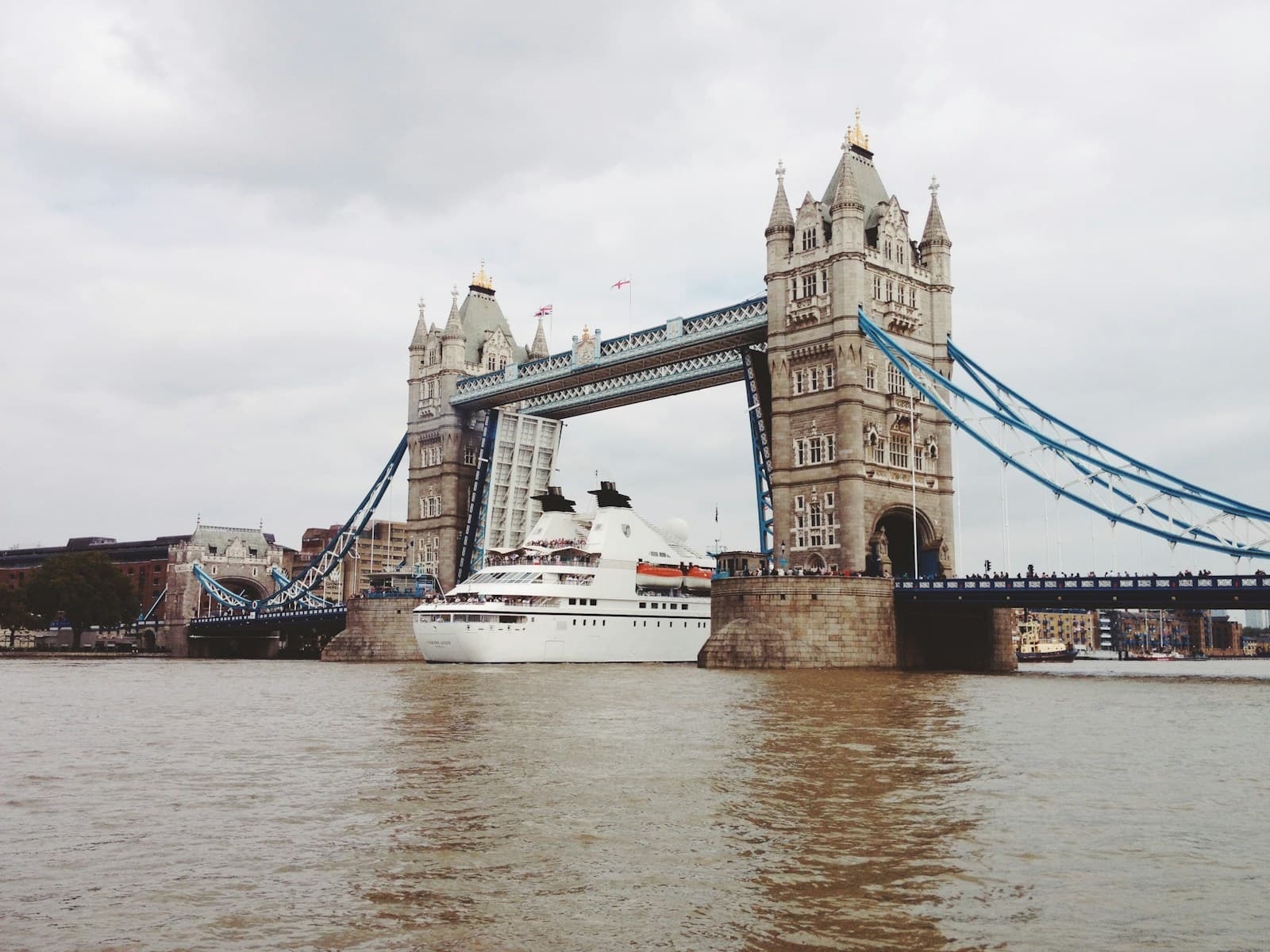
Tower Bridge over the River Thames in London, near the Tower of London · Photograph by Robert Bye. Unsplash Licence. unsplash.com
Britain's built heritage is rich and stylistically varied. Medieval Britain produced great Gothic cathedrals and churches, many of which remain standing today — Durham, Lincoln, Canterbury and Salisbury are leading examples. The White Tower at the Tower of London is a surviving instance of a Norman castle keep, built under orders of William the Conqueror shortly after the Conquest.
As the kingdom became more internally peaceful and wealth accumulated among the landed nobility, substantial country houses — Hardwick Hall in Derbyshire is a classic example — were built for private families. In the 17th century, Inigo Jones drew on the principles of classical (Greek and Roman) architecture to design elegant buildings for the crown, including the Queen's House at Greenwich and the Banqueting House on Whitehall in London. Later in the same century, Sir Christopher Wren adapted the ornate European architectural styles then in vogue into a distinctively British idiom, most famously in his design for the post-Fire replacement of St Paul's Cathedral.
The 18th century then moved towards cleaner, simpler designs. The Scottish architect Robert Adam was one of the period's most influential figures — he worked not only in the UK but also across Europe and into North America, and he typically designed the interior decoration of a building alongside the exterior. His private commissions included Dumfries House in Scotland, and his wider influence shaped urban developments such as the famous Royal Crescent at Bath.
Key Facts
- •Medieval cathedrals still standing today include those in Durham, Lincoln, Canterbury and Salisbury
- •The White Tower in the Tower of London is an example of a Norman castle keep, built on the orders of William the Conqueror
- •Hardwick Hall in Derbyshire is an example of a great country house from when the countryside became more peaceful
- •Inigo Jones (17th century) took inspiration from classical architecture to design the Queen's House at Greenwich and the Banqueting House in Whitehall
- •Sir Christopher Wren helped develop a British version of ornate European styles, including the new St Paul's Cathedral
- •Robert Adam (18th century) was a Scottish architect who influenced architecture in the UK, Europe and America; designed Dumfries House in Scotland
- •Robert Adam's ideas influenced architects in cities such as Bath, where the Royal Crescent was built
Victorian and Modern Architecture
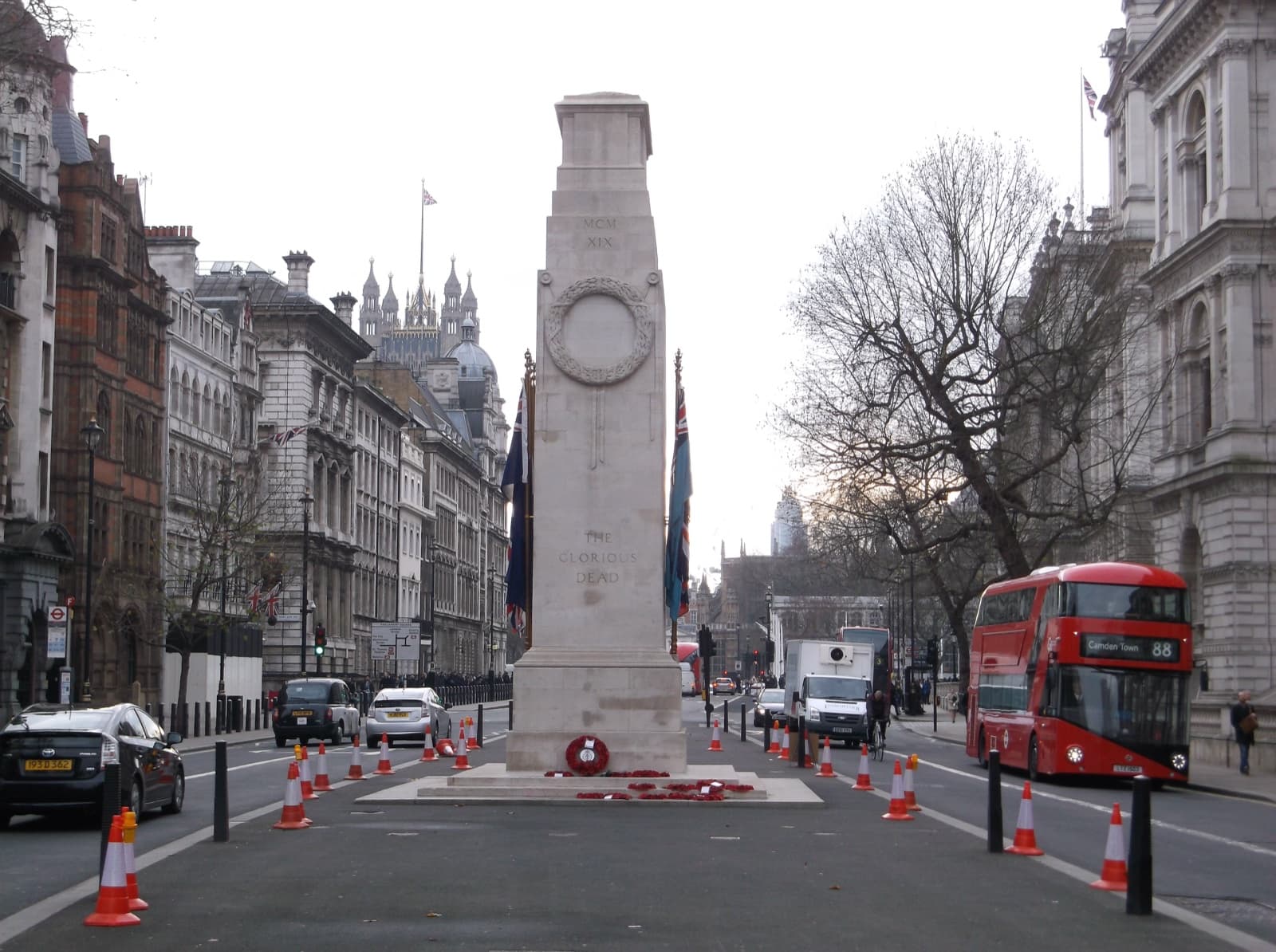
The Cenotaph war memorial on Whitehall, London, site of the annual Remembrance Day service · Harry Mitchell, 2015. CC-BY-4.0. Wikimedia Commons.
The 19th century saw a deliberate revival of the medieval Gothic style in British public architecture. As British cities expanded under industrialisation, grand public buildings were put up in Gothic idiom: the Houses of Parliament in Westminster and St Pancras Station in London are the best-known examples, and similarly grand town halls in cities such as Manchester and Sheffield followed the same architectural logic.
In the early 20th century Sir Edwin Lutyens took a British architectural practice across the Empire. Among his most prominent projects was the master plan for New Delhi as the seat of British government in India. After the First World War, Lutyens designed many war memorials around the world, including the Cenotaph on Whitehall in central London. The Cenotaph is the site of the annual Remembrance Day service attended by the monarch, by senior politicians, and by ambassadors from other countries.
The late-20th and 21st-century British architectural scene has produced several internationally significant names. Sir Norman Foster, Lord (Richard) Rogers and Dame Zaha Hadid have worked on headline projects both within the UK and around the world.
Running alongside architecture proper is the British tradition of formal garden and landscape design. In the 18th century, Lancelot 'Capability' Brown laid out the parklands around many country houses so that the estates looked as though the landscaping were natural — gently contoured grass, carefully placed groves of trees, and artificial lakes. Later in the tradition, Gertrude Jekyll often collaborated with Edwin Lutyens on colourful planted gardens around the houses he built. The annual Chelsea Flower Show is the contemporary showpiece for British and international garden design.
Key Facts
- •In the 19th century, the medieval 'gothic' style became popular again; the Houses of Parliament and St Pancras Station were built in this style
- •Town halls in cities such as Manchester and Sheffield were also built in the gothic revival style of the 19th century
- •Sir Edwin Lutyens (20th century) designed New Delhi to be the seat of government in India and was responsible for many war memorials including the Cenotaph in Whitehall
- •The Cenotaph in Whitehall is the site of the annual Remembrance Day service
- •Modern British architects Sir Norman Foster, Lord (Richard) Rogers and Dame Zaha Hadid continue to work on major projects worldwide
- •Lancelot 'Capability' Brown (18th century) designed the grounds around country houses to appear naturally landscaped with grass, trees and lakes
- •Gertrude Jekyll often worked with Edwin Lutyens to design colourful gardens
- •The annual Chelsea Flower Show showcases garden design from Britain and around the world
Fashion and Design
Britain has produced a long sequence of influential designers across furniture, ceramics, interiors and clothing. The furniture designer Thomas Chippendale worked in the 18th century; the ceramicist Clarice Cliff produced distinctive Art Deco pieces in the early 20th century; and Sir Terence Conran was one of the century's most influential interior designers. On the clothing side, leading British fashion designers of recent decades include Mary Quant, Alexander McQueen and Vivienne Westwood.
Key Facts
- •Thomas Chippendale designed furniture in the 18th century
- •Clarice Cliff designed Art Deco ceramics
- •Sir Terence Conran was a 20th-century interior designer
- •Leading fashion designers of recent years include Mary Quant, Alexander McQueen and Vivienne Westwood
Literature
British writers have been unusually successful at international literary prizes: several British authors have won the Nobel Prize in Literature, including the novelist Sir William Golding, the poet Seamus Heaney, and the playwright Harold Pinter. In the popular fiction category, the UK is responsible for two of the 20th century's most widely read franchises — Agatha Christie's detective novels, read across the world, and the James Bond series introduced in the novels of Ian Fleming. In a public poll run in 2003, the country's best-loved novel was voted to be JRR Tolkien's The Lord of the Rings.
The Man Booker Prize for Fiction, first awarded in 1968, is handed out each year to what a panel of judges considers the year's best novel by an author from the Commonwealth, Ireland or Zimbabwe. Winners in recent decades have included Ian McEwan, Hilary Mantel and Julian Barnes.
The British literary canon itself stretches back more than two centuries. Jane Austen's novels of the early 19th century — Pride and Prejudice and Sense and Sensibility among them — explore marriage, family and social station. A generation later, Charles Dickens was writing some of the most enduring narratives of Victorian England, including Oliver Twist and Great Expectations, and creating characters (Scrooge, Mr Micawber) who have passed into the wider culture. Thomas Hardy's novels of late-Victorian rural life include Far from the Madding Crowd and Jude the Obscure. The Scottish writer Robert Louis Stevenson produced adventure fiction (Treasure Island, Kidnapped) and the novella Dr Jekyll and Mr Hyde. Sir Arthur Conan Doyle, another Scot — and by training a doctor — created Sherlock Holmes, among the first great fictional detectives. In the 20th century Evelyn Waugh wrote sharply satirical novels (Decline and Fall, Scoop) and the more earnest Brideshead Revisited; Graham Greene produced a string of novels shaped by his religious convictions, including The Heart of the Matter, Brighton Rock, The Honorary Consul and Our Man in Havana; and Sir Kingsley Amis, author of more than twenty novels, is best remembered for his comic debut Lucky Jim. Among living British authors, J K Rowling's Harry Potter series has achieved unusual global reach.
Key Facts
- •British Nobel Prize in Literature winners include Sir William Golding (novelist), Seamus Heaney (poet) and Harold Pinter (playwright)
- •Agatha Christie's detective stories are read all over the world
- •Ian Fleming's books introduced the character James Bond
- •In 2003, The Lord of the Rings by JRR Tolkien was voted the country's best-loved novel
- •The Man Booker Prize for Fiction is awarded annually for the best novel by an author from the Commonwealth, Ireland or Zimbabwe; awarded since 1968; past winners include Ian McEwan, Hilary Mantel and Julian Barnes
- •Jane Austen (1775–1817) wrote Pride and Prejudice and Sense and Sensibility; her novels are concerned with marriage and family relationships
- •Charles Dickens (1812–70) wrote Oliver Twist and Great Expectations; famous characters include Scrooge and Mr Micawber
- •Robert Louis Stevenson (1850–94) wrote Treasure Island, Kidnapped and Dr Jekyll and Mr Hyde
- •Thomas Hardy (1840–1928) was an author and poet whose best-known novels focus on rural society, including Far from the Madding Crowd and Jude the Obscure
- •Sir Arthur Conan Doyle (1859–1930) was a Scottish doctor and writer best known for his stories about Sherlock Holmes, one of the first fictional detectives
- •Evelyn Waugh (1903–66) wrote satirical novels including Decline and Fall and Scoop; best known for Brideshead Revisited
- •Sir Kingsley Amis (1922–95) was an English novelist and poet who wrote more than 20 novels; best known for Lucky Jim
- •Graham Greene (1904–91) wrote novels influenced by his religious beliefs, including The Heart of the Matter, The Honorary Consul, Brighton Rock and Our Man in Havana
- •J K Rowling (1965–) wrote the Harry Potter series of children's books which have enjoyed huge international success
Key Dates
British Poets
British poetry is one of the richest national poetic traditions in the world. Beowulf, an Anglo-Saxon poem that tells of its hero's battles against monsters, is still read and still translated into modern English. The Middle Ages bequeathed Chaucer's The Canterbury Tales and the Arthurian romance Sir Gawain and the Green Knight, set at the court of King Arthur.
Shakespeare, better known as a playwright, also wrote a large body of sonnets (14-line poems) and a handful of longer poems. A generation or two later, John Milton produced the blank-verse epic Paradise Lost. A later poetic strand found its subject in nature, most notably William Wordsworth. Sir Walter Scott wrote poems drawn from Scottish and Anglo-Scottish border traditions and, in his prose work, novels set in Scotland.
Poetry was a widely read form through the 19th century, with William Blake, John Keats, Lord Byron, Percy Shelley, Alfred Lord Tennyson, and both Robert and Elizabeth Browning all writing major work. In the 20th century, a distinct 'war poetry' tradition emerged from the trenches of the First World War — Wilfred Owen and Siegfried Sassoon are its leading figures — and later British popular poets have included Sir Walter de la Mare, John Masefield, Sir John Betjeman and Ted Hughes. Many of the best-known poets are buried or commemorated in Poet's Corner at Westminster Abbey.
Famous opening lines to remember include: 'Oh to be in England now that April's there...' (Robert Browning, 1812–89, Home Thoughts from Abroad); 'She walks in beauty, like the night...' (Lord Byron, 1788–1824, She Walks in Beauty); 'I wander'd lonely as a cloud...' (William Wordsworth, 1770–1850, The Daffodils); 'Tyger! Tyger! Burning bright...' (William Blake, 1757–1827, The Tyger); 'What passing-bells for these who die as cattle?...' (Wilfred Owen, 1893–1918, Anthem for Doomed Youth).
Key Facts
- •Beowulf is an Anglo-Saxon poem about a hero's battles against monsters and is still translated into modern English today
- •Medieval poems include Chaucer's Canterbury Tales and Sir Gawain and the Green Knight
- •Shakespeare wrote many sonnets (14-line poems) and longer poems, as well as his plays
- •John Milton wrote Paradise Lost
- •William Wordsworth was inspired by nature
- •Sir Walter Scott wrote poems inspired by Scotland and the border region tradition, and also wrote novels set in Scotland
- •19th-century poets include William Blake, John Keats, Lord Byron, Percy Shelley, Alfred Lord Tennyson, and Robert and Elizabeth Browning
- •Wilfred Owen and Siegfried Sassoon wrote about their experiences in the First World War
- •More recent popular poets include Sir Walter de la Mare, John Masefield, Sir John Betjeman and Ted Hughes
- •Some of the best-known poets are buried or commemorated in Poet's Corner in Westminster Abbey
- •Robert Browning (1812–89): Home Thoughts from Abroad — 'Oh to be in England now that April's there'
- •Lord Byron (1788–1824): She Walks in Beauty — 'She walks in beauty, like the night'
- •William Wordsworth (1770–1850): The Daffodils — 'I wander'd lonely as a cloud'
- •William Blake (1757–1827): The Tyger — 'Tyger! Tyger! Burning bright'
- •Wilfred Owen (1893–1918): Anthem for Doomed Youth — 'What passing-bells for these who die as cattle?'
Key Dates
Chapter Summary
All key facts from this chapter at a glance — read this to revise the full chapter quickly.
Chapter Summary
Quick revision- ✓The Proms is an eight-week summer season of orchestral classical music, organised by the BBC since 1927; the Last Night of the Proms is the most well-known concert and is broadcast on television
- ✓Henry Purcell (1659–95) was the organist at Westminster Abbey; developed a British musical style distinct from Europe
- ✓George Frederick Handel (1695–1759) was German-born; became a British citizen in 1727; wrote the Water Music, Music for the Royal Fireworks and the oratorio Messiah
- ✓Sir Edward Elgar (1857–1934) born in Worcester; best known for Pomp and Circumstance Marches; Land of Hope and Glory is usually played at the Last Night of the Proms
- ✓Ralph Vaughan Williams (1872–1958) wrote music for orchestras and choirs strongly influenced by traditional English folk music
- ✓Gustav Holst (1874–1934): The Planets suite; adapted Jupiter as the hymn 'I vow to thee my country'
- ✓Sir William Walton (1902–83) wrote marches for the coronations of George VI and Elizabeth II; best known for Façade and Balthazar's Feast
- ✓Benjamin Britten (1913–76) wrote operas Peter Grimes and Billy Budd, and A Young Person's Guide to the Orchestra; founded the Aldeburgh festival in Suffolk
- ✓Britain has had a major impact on popular music since the 1960s; bands including The Beatles and The Rolling Stones continue to be influential
- ✓British pop music innovations include the Punk movement of the late 1970s and the trend towards boy and girl bands in the 1990s
- ✓Large music venues include Wembley Stadium, The O2 in Greenwich and the SECC in Glasgow
- ✓Famous music festivals include Glastonbury, the Isle of Wight Festival and the V Festival
- ✓The National Eisteddfod of Wales is an annual cultural festival held largely in Welsh, including competitions for Welsh poetry
- ✓The Mercury Music Prize is awarded each September for the best album from the UK and Ireland
- ✓The Brit Awards is an annual event with categories such as best British group and best British solo artist
- ✓London's West End ('Theatreland') is particularly well known for theatre
- ✓The Mousetrap by Dame Agatha Christie has been running in the West End since 1952 — the longest initial run of any show in history
- ✓Gilbert and Sullivan wrote comic operas in the 19th century, including HMS Pinafore, The Pirates of Penzance and The Mikado
- ✓Andrew Lloyd Webber wrote the music for Jesus Christ Superstar and Evita (with Tim Rice), and also Cats and The Phantom of the Opera
- ✓Pantomime is a British Christmas theatre tradition based on fairy stories, with music, comedy and the Dame character (a woman played by a man)
- ✓The Edinburgh Festival takes place every summer; the Edinburgh Festival Fringe is the biggest arts festival — mainly theatre and comedy, often experimental work
- ✓The Laurence Olivier Awards take place annually in London; named after Sir Laurence Olivier (later Lord Olivier), best known for his Shakespeare roles
- ✓Well-known UK art galleries: National Gallery, Tate Britain and Tate Modern in London; National Museum in Cardiff; National Gallery of Scotland in Edinburgh
- ✓The Turner Prize was established in 1984, named after Joseph Turner; celebrates contemporary art; four works shortlisted every year at Tate Britain; previous winners include Damien Hirst and Richard Wright
- ✓The Pre-Raphaelites were an important artist group in the second half of the 19th century, painting detailed pictures on religious or literary themes in bright colours; included Holman Hunt, Dante Gabriel Rossetti and Sir John Millais
- ✓Thomas Gainsborough (1727–88) was a portrait painter who often painted people in country or garden scenery
- ✓David Allan (1744–96) was a Scottish portrait painter; his most famous work is The Origin of Painting
- ✓Joseph Turner (1775–1851) was an influential landscape painter in a modern style who raised the profile of landscape painting
- ✓John Constable (1776–1837) was a landscape painter most famous for his works of Dedham Vale on the Suffolk–Essex border
- ✓Sir John Lavery (1856–1941) was a Northern Irish portrait painter who painted the Royal Family
- ✓Henry Moore (1898–1986) was an English sculptor best known for large bronze abstract sculptures
- ✓John Petts (1914–91) was a Welsh artist best known for his engravings and stained glass
- ✓Lucian Freud (1922–2011) was a German-born British artist best known for his portraits
- ✓David Hockney (1937–) contributed to the 'pop art' movement of the 1960s and continues to be influential
- ✓Medieval cathedrals still standing today include those in Durham, Lincoln, Canterbury and Salisbury
- ✓The White Tower in the Tower of London is a Norman castle keep, built on the orders of William the Conqueror
- ✓Inigo Jones (17th century) designed the Queen's House at Greenwich and the Banqueting House in Whitehall, inspired by classical architecture
- ✓Sir Christopher Wren helped develop a British version of ornate European styles, including the new St Paul's Cathedral
- ✓Robert Adam (18th century) was a Scottish architect who influenced architecture across the UK, Europe and America; designed Dumfries House in Scotland; his ideas influenced the Royal Crescent in Bath
- ✓In the 19th century, the medieval 'gothic' style became popular again; the Houses of Parliament and St Pancras Station were built in this style
- ✓Sir Edwin Lutyens designed New Delhi as the seat of government in India; responsible for many war memorials including the Cenotaph in Whitehall
- ✓The Cenotaph is the site of the annual Remembrance Day service attended by the Queen, politicians and foreign ambassadors
- ✓Modern British architects Sir Norman Foster, Lord (Richard) Rogers and Dame Zaha Hadid continue to work on major projects worldwide
- ✓Lancelot 'Capability' Brown (18th century) designed grounds of country houses to appear naturally landscaped with grass, trees and lakes
- ✓Gertrude Jekyll often worked with Edwin Lutyens to design colourful gardens; the annual Chelsea Flower Show showcases garden design from Britain and around the world
- ✓Thomas Chippendale designed furniture (18th century); Clarice Cliff designed Art Deco ceramics; Sir Terence Conran was a 20th-century interior designer
- ✓Leading fashion designers of recent years include Mary Quant, Alexander McQueen and Vivienne Westwood
- ✓British Nobel Prize in Literature winners include Sir William Golding (novelist), Seamus Heaney (poet) and Harold Pinter (playwright)
- ✓Agatha Christie's detective stories are read all over the world; Ian Fleming's books introduced the character James Bond
- ✓In 2003, The Lord of the Rings by JRR Tolkien was voted the country's best-loved novel
- ✓The Man Booker Prize for Fiction is awarded annually for the best novel by an author from the Commonwealth, Ireland or Zimbabwe; awarded since 1968; past winners include Ian McEwan, Hilary Mantel and Julian Barnes
- ✓Jane Austen (1775–1817) wrote Pride and Prejudice and Sense and Sensibility
- ✓Charles Dickens (1812–70) wrote Oliver Twist and Great Expectations; famous characters include Scrooge and Mr Micawber
- ✓Thomas Hardy (1840–1928): Far from the Madding Crowd; Jude the Obscure
- ✓Robert Louis Stevenson (1850–94): Treasure Island; Kidnapped; Dr Jekyll and Mr Hyde
- ✓Sir Arthur Conan Doyle (1859–1930) created Sherlock Holmes, one of the first fictional detectives
- ✓Evelyn Waugh (1903–66): Decline and Fall; Scoop; best known for Brideshead Revisited
- ✓Graham Greene (1904–91): The Heart of the Matter; Brighton Rock; The Honorary Consul; Our Man in Havana
- ✓Sir Kingsley Amis (1922–95) wrote more than 20 novels; best known for Lucky Jim
- ✓J K Rowling (1965–) wrote the Harry Potter series, which has enjoyed huge international success
- ✓Beowulf is an Anglo-Saxon poem about a hero's battles against monsters; still translated into modern English today
- ✓Medieval poems include Chaucer's Canterbury Tales and Sir Gawain and the Green Knight (about a knight at the court of King Arthur)
- ✓Shakespeare wrote many sonnets (14-line poems) and longer poems; John Milton wrote Paradise Lost
- ✓William Wordsworth was inspired by nature; Sir Walter Scott wrote poems inspired by Scotland and also wrote novels set in Scotland
- ✓19th-century poets include William Blake, John Keats, Lord Byron, Percy Shelley, Alfred Lord Tennyson, and Robert and Elizabeth Browning
- ✓Wilfred Owen and Siegfried Sassoon wrote about their experiences in the First World War
- ✓More recent popular poets include Sir Walter de la Mare, John Masefield, Sir John Betjeman and Ted Hughes
- ✓Some of the best-known poets are buried or commemorated in Poet's Corner in Westminster Abbey
- ✓Famous poetic lines: Robert Browning — 'Oh to be in England now that April's there'; Lord Byron — 'She walks in beauty, like the night'; William Wordsworth — 'I wander'd lonely as a cloud'; William Blake — 'Tyger! Tyger! Burning bright'; Wilfred Owen — 'What passing-bells for these who die as cattle?'
Test Yourself on This Chapter
Ready to practice? Take a focused test on this topic.